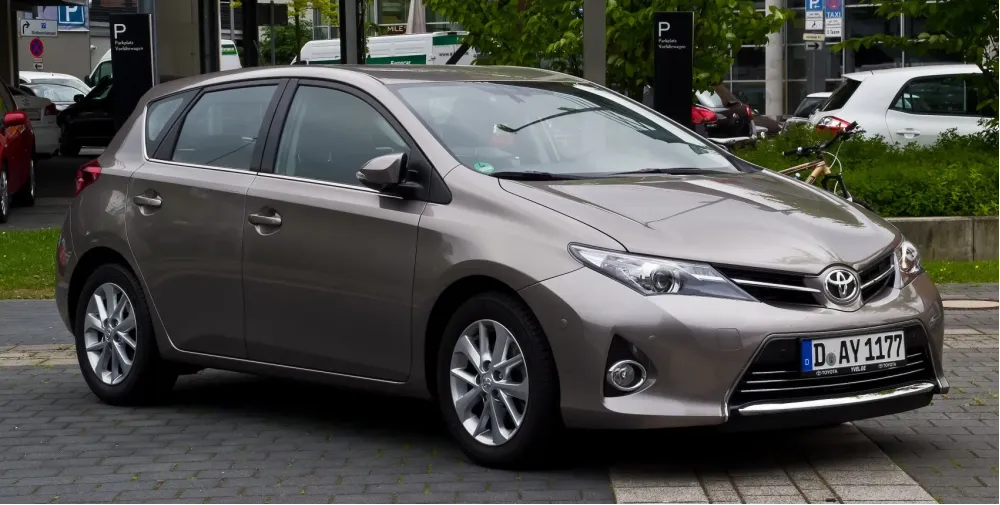
Click on image to view the full photo gallery
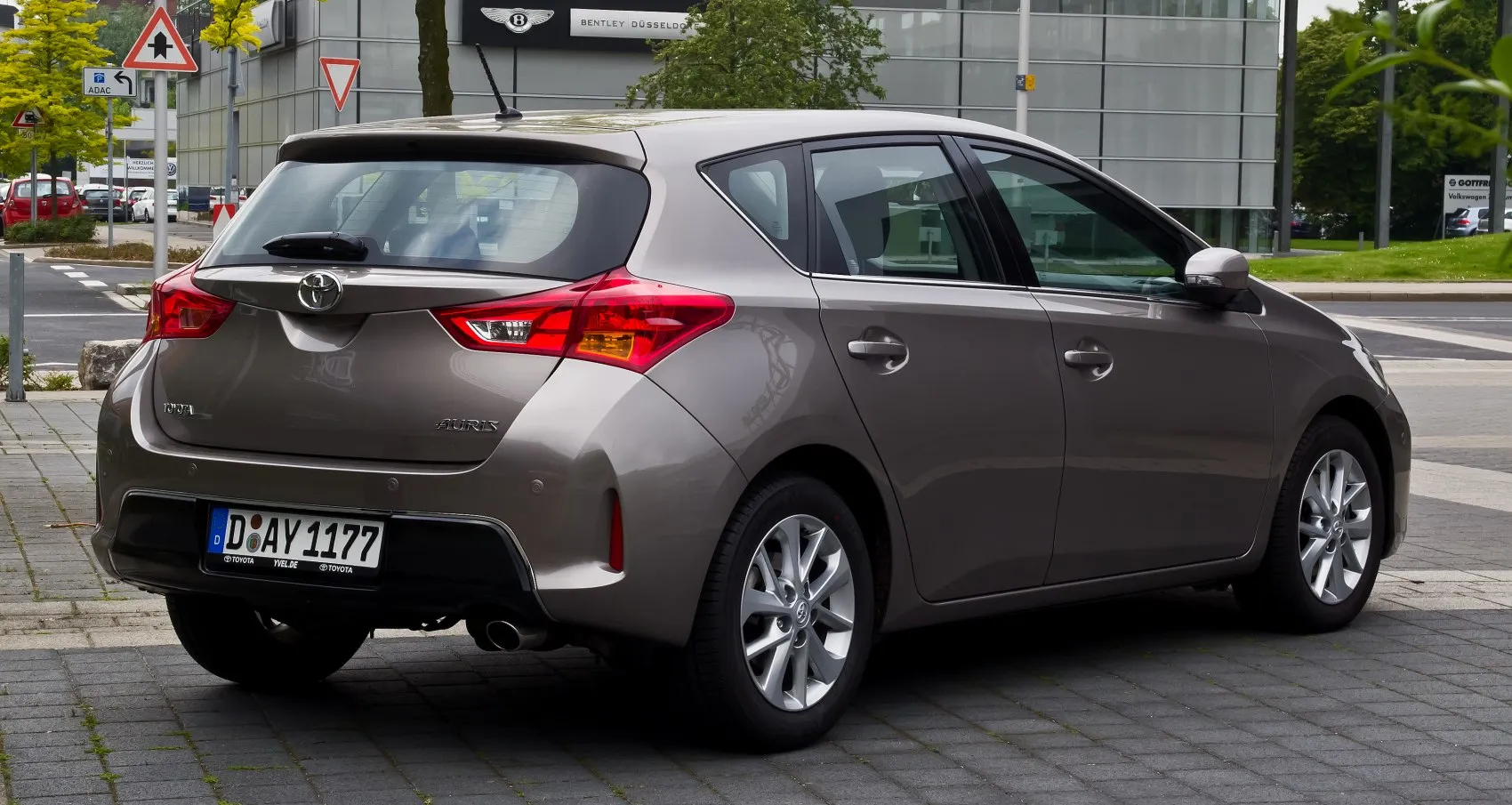
Toyota Auris II 1.6 Valvematic (132 Hp) Multidrive S
Overall Rating
Toyota Auris:
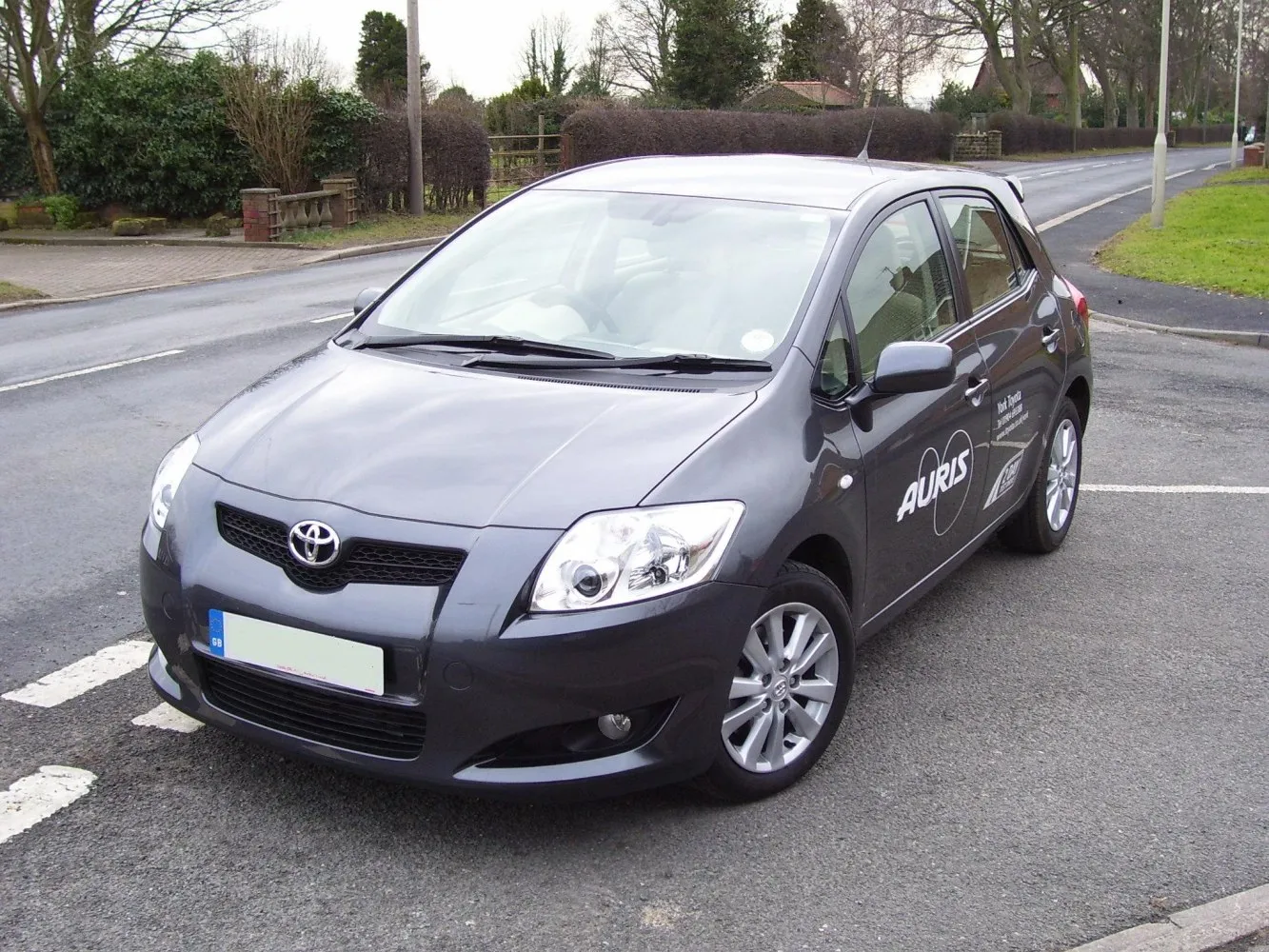
The Toyota Auris is a compact car derived from the Corolla, manufactured and sold by Toyota. Introduced in 2006, the first generation three/five-door hatchback shared the platform with the E150 series Corolla, while the second generation five-door hatchback and estate car called "Touring Sports" uses the E180 platform. The "Auris" name is based on the Latin word for "gold", "aurum".
In Europe, Toyota positioned the Auris as the replacement for the Corolla hatchback, while the saloon car version continued with the Corolla nameplate. Starting with the E210 model, the Auris nameplate was discontinued and used the Corolla nameplate instead, except for Taiwan, retained the Auris nameplate for the hatchback version until July 2020....(Read more on Wikipedia)
II Overview:
Toyota Auris (II). With 160 Nm of torque, it offers ample pulling power. It has moderate fuel consumption (~7.4 l/100km). Weighing only 1282 kg, it’s quite light. Front‑wheel drive delivers efficiency and easy handling. Acceleration is relatively slow (0–100 km/h in 11.1 s). The top speed reaches 190 km/h. A compact car with a rear door that swings upward to provide access to the cargo area. Seating for 5 makes it ideal for daily use.
The Toyota Auris II achieved an excellent 5-star Euro NCAP rating in 2013, demonstrating strong adult occupant protection and a comprehensive safety package for its class.
1.6 Valvematic (132 Hp) Multidrive S Verdict:

Performance Verdict
The Multidrive S (CVT) transmission provides smooth, linear acceleration but can lead to a 'rubber band' effect under hard acceleration, dulling the engine's potential.
Fuel Economy
Decent fuel economy for a petrol automatic, though not as frugal as the diesel or hybrid options.
Pros and Cons:
Pros:
- • Exceptional reliability and build quality
- • Outstanding fuel economy, especially with hybrid and diesel options
- • Strong Euro NCAP safety rating
- • Practical and spacious interior for its class
- • Smooth and refined hybrid powertrain
Cons:
- • Uninspiring driving dynamics compared to rivals
- • Some petrol engines can feel underpowered or noisy at higher revs
- • CVT transmission can lead to engine drone under acceleration
- • Interior design is functional but lacks flair
Specifications:
Specifications are compared to those of the previous generation(facelift 2010: 2010 - 2012).
| General: | |
|---|---|
| Brand: | Toyota |
| Model: | Auris |
| Generation: | II |
| Modification (Engine): | 1.6 Valvematic (132 Hp) Multidrive S |
| Start of production: | 2012 |
| End of production: | 2015 |
| Powertrain Architecture: | Internal Combustion engine |
| Body type: | Hatchback |
| Seats: | 5 |
| Doors: | 5 |
| Engine: | |
|---|---|
| Power: | 132 Hp @ 6400 rpm. Same horsepower |
| Power per litre: | 82.6 Hp/l [30mm more] |
| Torque: | 160 Nm @ 4400 rpm. |
| Engine Model/Code: | 1ZR-FAE More details about the engine 1ZR-FAE |
| Engine displacement: | 1598 |
| Number of cylinders: | 4 |
| Engine configuration: | Inline |
| Number of valves per cylinder: | 4 |
| Fuel injection system: | Multi-port manifold injection |
| Engine aspiration: | Naturally aspirated engine |
| Valvetrain: | DOHC, Valvematic |
| Engine oil capacity: | 4.2 l |
| Coolant: | 5.8 l |
| Engine layout: | Front, Transverse |
| Cylinder Bore: | 80.5 mm |
| Piston Stroke: | 78.5 mm |
| Compression ratio: | 10.7:1 |
| Performance: | |
|---|---|
| Fuel Type: | Petrol (Gasoline) |
| Fuel consumption (economy) - urban: | 7.4 l/100 km |
| Fuel consumption (economy) - extra urban: | 4.8 l/100 km |
| Fuel consumption (economy) - combined (NEDC): | 5.7 l/100 km |
| Fuel consumption (economy) - urban (NEDC): | 7.4 l/100 km |
| Fuel consumption (economy) - extra urban (NEDC): | 4.8 l/100 km |
| Fuel consumption (economy) - combined: | 5.7 l/100 km |
| Emission standard: | Euro 5 |
| Acceleration 0 - 100 km/h: | 11.1 sec |
| Acceleration 0 - 62 mph: | 11.1 sec |
| Maximum speed: | 190 km/h |
| Weight-to-power ratio: | 9.1 kg/Hp, 109.5 Hp/tonne |
| Weight-to-torque ratio: | 7.5 kg/Nm, 132.8 Nm/tonne |
| Acceleration 0 - 60 mph: | 10.5 sec |
| Space: | |
|---|---|
| Kerb Weight: | 1205-1360 |
| Max. weight: | 1830 |
| Max. roof load: | 75 kg |
| Max load: | 470-625 |
| Trunk (boot) space - maximum: | 1200 l |
| Trunk (boot) space - minimum: | 360 l |
| Permitted trailer load with brakes (12%): | 1300 kg |
| Fuel tank capacity: | 50 l |
| Permitted trailer load without brakes: | 450 kg |
| Permitted towbar download: | 55 kg |
| Size: | |
|---|---|
| Length: | 4275 mm [30mm more] |
| Width: | 1760 mm [Same width.] |
| Height: | 1460 mm [55mm less] |
| Wheelbase: | 2600 mm [Same wheelbase.] |
| Front track: | 1515-1535 mm |
| Rear (Back) track: | 1510-1535 mm |
| Minimum turning circle (turning diameter): | 11 m [above average] |
| Powertrain: | |
|---|---|
| Drivetrain Architecture | The Internal combustion engine (ICE) drives the front wheels of the vehicle. |
| Drive wheel | Front wheel drive |
| Transmission type | Automatic |
| Gearbox type | Multidrive S |
| Front brakes | Ventilated discs [Best for performance and cooling.] |
| Rear brakes | Disc [above average] |
| Assisting systems | ABS (Anti-lock braking system) |
| Steering type | Steering rack and pinion |
| Power steering | Electric Steering |
| Tires size | 195/65 R15; 205/55 R16; 225/45 R17 |
| Wheel rims size | 6J x 15; 6.5J x 16; 7J x 17 |
| Front suspension | Independent, type McPherson with coil spring and anti-roll bar |
| Rear suspension | Double wishbone |













Better than its competitors? Tell us why the Toyota Auris stands out.