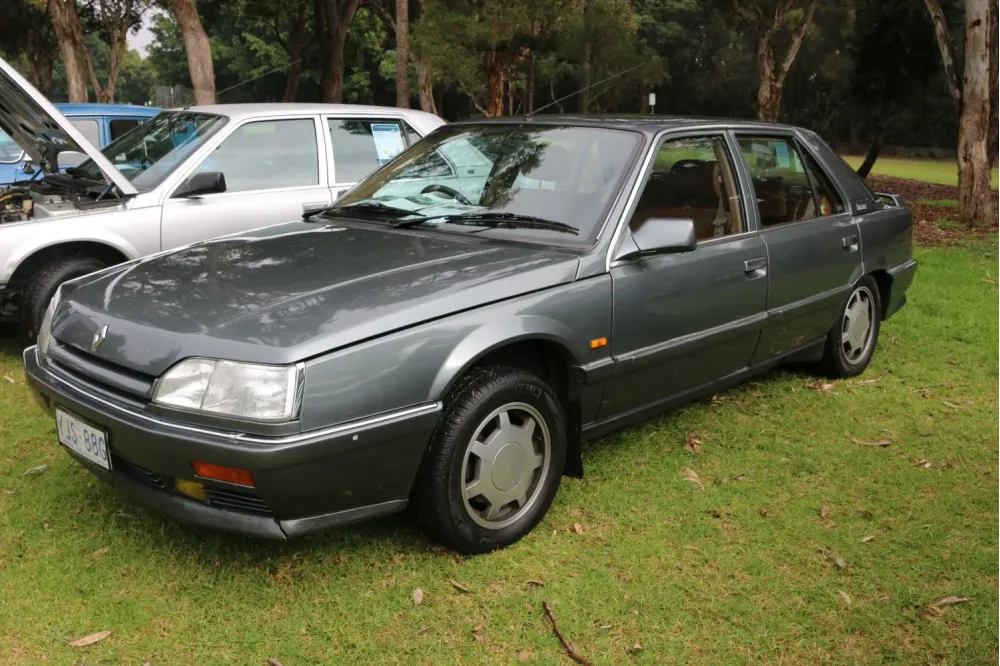
Click on image to view the full photo gallery
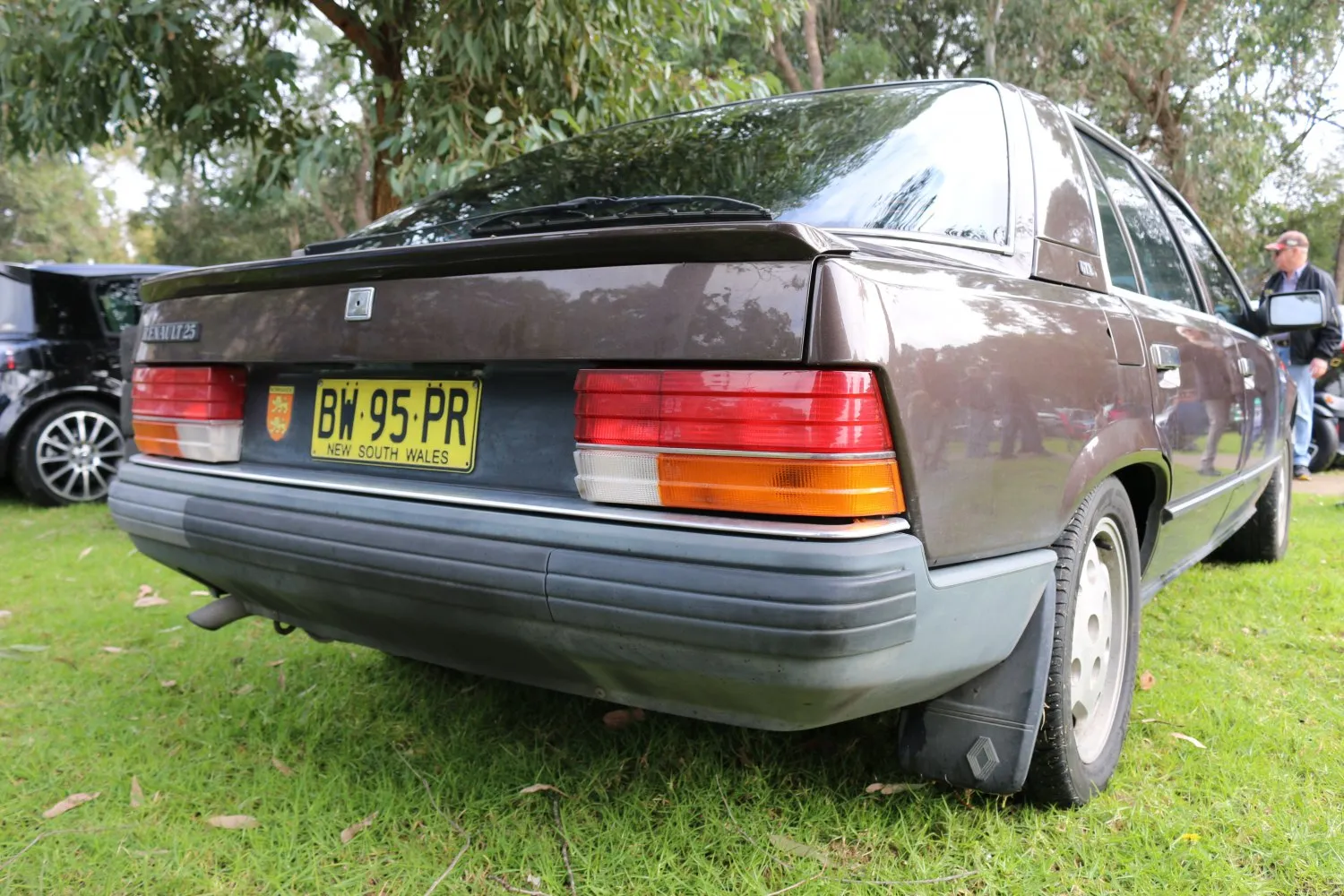
Renault 25 B29 2.0 i (120 Hp)
Overall Rating
Renault 25:
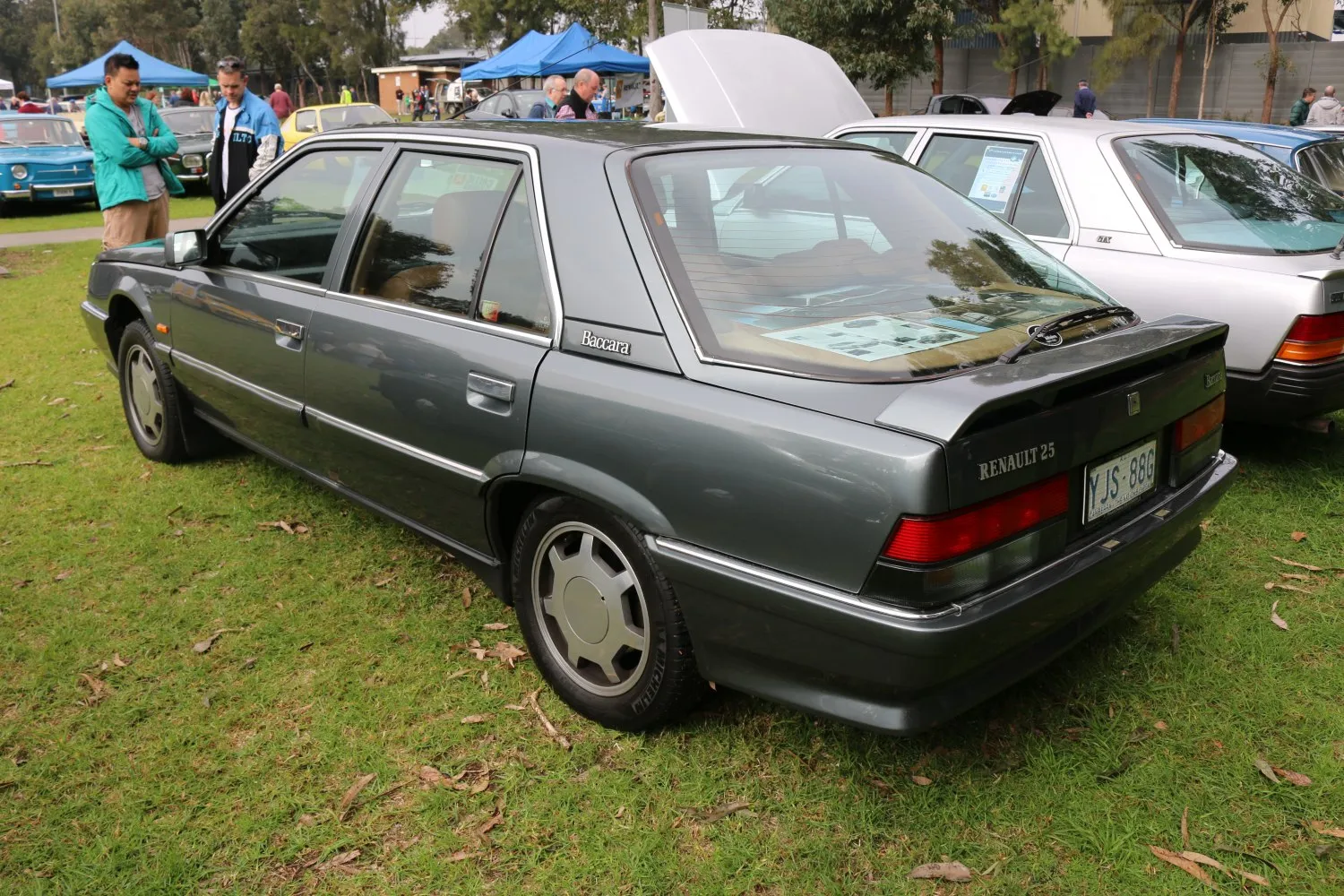
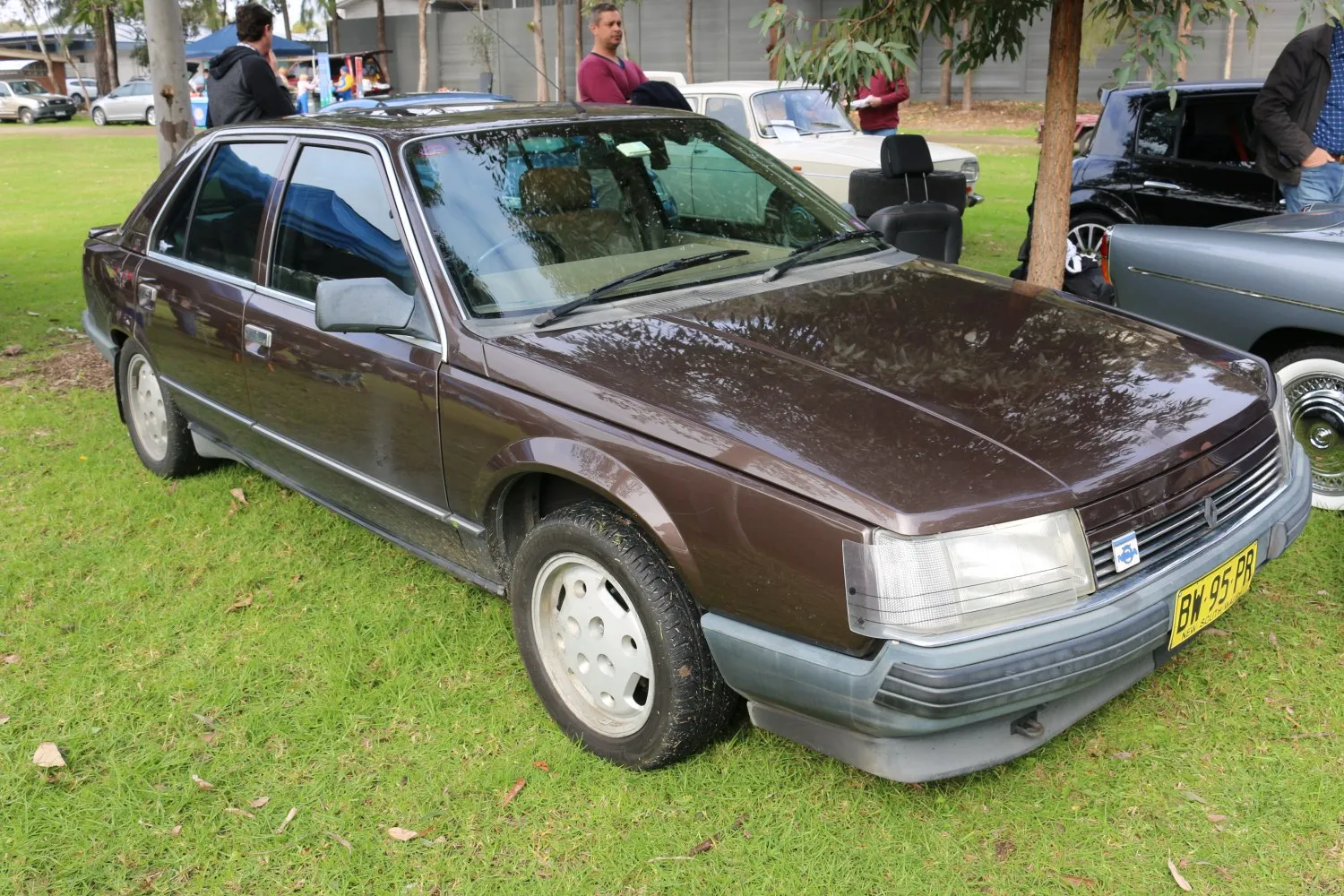
The Renault 25 is an executive car produced by the French automaker Renault from 1983 to 1992.
The 25 was Renault's flagship, the most expensive, prestigious, and largest vehicle in the company's line up. It placed second in the 1985 European Car of the Year rankings. In total, 780,976 were built from 1983 until 1992.
All 25s were built in Sandouville, near Le Havre, France.
Introduced at the end of 1983 for a March 1984 start of sales, the Renault 25 was a large step forward in nearly every aspect from the Renault 20 / Renault 30 range it was replacing. Its five-door liftback body was penned by designers Gaston Juchet and Robert Opron of Citroën SM fame, and the unconventional style was aimed at giving the car a notchback look in order to overcome customer preference outside France for formal sedans in the segment outside of France. The wraparound rear window was one of Opron's signature design features, used on many of his earlier designs such as the SM, the Renault Fuego, and the Renault 11....(Read more on Wikipedia)
B29 Overview:
Renault 25 (B29). With 168 Nm of torque, it offers ample pulling power. It has moderate fuel consumption (~10.9 l/100km). Weighing only 1180 kg, it’s quite light. Front‑wheel drive delivers efficiency and easy handling. Acceleration is relatively slow (0–100 km/h in 10.7 s). The top speed reaches 195 km/h. A compact car with a rear door that swings upward to provide access to the cargo area. Seating for 5 makes it ideal for daily use.
The Renault 25 predates modern Euro NCAP testing protocols. While advanced for its time, it lacks contemporary safety features like multiple airbags and advanced driver-assistance systems.
2.0 i (120 Hp) Verdict:

Performance Verdict
A well-balanced engine, providing a good blend of performance and responsiveness for both city and highway driving.
Fuel Economy
Offers decent fuel efficiency, making it a practical choice for those seeking a balance between power and running costs.
Pros and Cons:
Pros:
- • Exceptional ride comfort and spacious interior
- • Wide range of engines, including powerful V6 options
- • Distinctive and aerodynamic styling
- • Advanced features for its time (e.g., voice synthesis)
- • Good highway cruiser
Cons:
- • Potential for complex electrical issues
- • Rust can be a concern on older models
- • Some engines can be thirsty, especially V6s
- • Lack of modern safety features (due to age)
- • Parts availability can be challenging for specific components
Specifications:
Specifications are compared to those of the previous generation(B29: 1985 - 1989).
| General: | |
|---|---|
| Brand: | Renault |
| Model: | 25 |
| Generation: | B29 |
| Modification (Engine): | 2.0 i (120 Hp) |
| Start of production: | 1986 |
| End of production: | 1992 |
| Powertrain Architecture: | Internal Combustion engine |
| Body type: | Hatchback |
| Seats: | 5 |
| Doors: | 5 |
| Engine: | |
|---|---|
| Power: | 120 Hp @ 5500 rpm. Same horsepower |
| Power per litre: | 60.2 Hp/l [worst than previous generation] |
| Torque: | 168 Nm @ 4500 rpm. |
| Engine Model/Code: | J7R More details about the engine J7R |
| Engine displacement: | 1995 |
| Number of cylinders: | 4 |
| Engine configuration: | Inline |
| Number of valves per cylinder: | 2 |
| Fuel injection system: | Multi-port manifold injection |
| Engine aspiration: | Naturally aspirated engine |
| Valvetrain: | OHC |
| Engine oil capacity: | 5.3 l |
| Coolant: | 7.3 l |
| Engine layout: | Front, Transverse |
| Cylinder Bore: | 88 mm mm |
| Piston Stroke: | 82 mm mm |
| Compression ratio: | 10:1 |
| Performance: | |
|---|---|
| Fuel Type: | Petrol (Gasoline) |
| Fuel consumption (economy) - urban: | 10.9 l/100 km |
| Fuel consumption (economy) - extra urban: | 6 l/100 km |
| Fuel consumption (economy) - combined: | 7.4 l/100 km |
| Acceleration 0 - 100 km/h: | 10.7 sec |
| Acceleration 0 - 62 mph: | 10.7 sec |
| Maximum speed: | 195 km/h |
| Weight-to-power ratio: | 9.8 kg/Hp, 101.7 Hp/tonne |
| Weight-to-torque ratio: | 7 kg/Nm, 142.4 Nm/tonne |
| Acceleration 0 - 60 mph: | 10.2 sec |
| Space: | |
|---|---|
| Kerb Weight: | 1180 |
| Max. weight: | 1690 |
| Max load: | 510 |
| Trunk (boot) space - maximum: | 1240 l |
| Trunk (boot) space - minimum: | 440 l |
| Fuel tank capacity: | 72 l |
| Size: | |
|---|---|
| Length: | 4715 mm mm |
| Width: | 1805 mm mm |
| Height: | 1415 mm mm |
| Wheelbase: | 2725 mm mm |
| Front track: | 1495 mm |
| Rear (Back) track: | 1475 mm |
| Powertrain: | |
|---|---|
| Drivetrain Architecture | The Internal combustion engine (ICE) drives the front wheels of the vehicle. |
| Drive wheel | Front wheel drive |
| Number of gears | 5 |
| Transmission type | Manual |
| Front brakes | Disc [bad for performance and cooling.] |
| Rear brakes | Drum [bad for performance and cooling.] |
| Assisting systems | ABS (Anti-lock braking system) |
| Steering type | Steering rack and pinion |
| Power steering | Hydraulic Steering |
| Tires size | 185/70 R14 |
| Wheel rims size | 14 |
| Front suspension | Coil spring |
| Rear suspension | Coil spring |




The hidden gems or the annoying flaws? Expose the truth about the Renault 25!