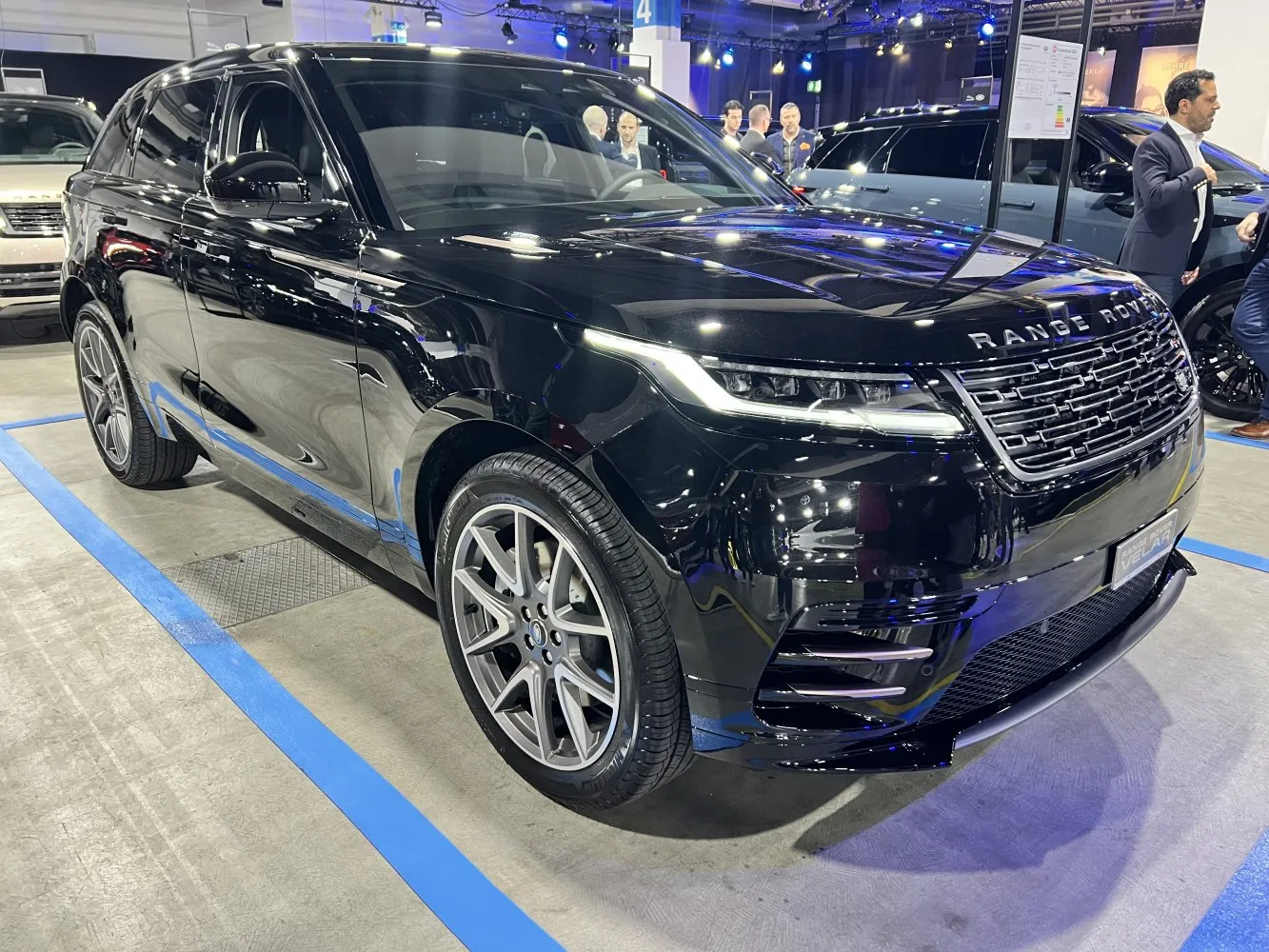
Land Rover Range Rover Velar facelift 2020 2.0 P400e (404 Hp) Plug-in Hybrid AWD Automatic
People\'s Opinion
N/A / 5
Land Rover Range Rover Velar:
The Land Rover Range Rover Velar, generally known as the Range Rover Velar, is a crossover SUV produced by British automotive company Jaguar Land Rover under their Land Rover marque. The fourth model in the Range Rover line, the Velar was unveiled on 1 March 2017 in London, England. The Velar was released in the summer of 2017. The name Velar had previously been used for a series of pre-production first-generation Range Rovers in 1969.
The Range Rover Velar was named "World's Most Beautiful Car" in 2018, receiving the design award at the 2018 World Car Awards....(Read more on Wikipedia)
facelift 2020 Overview:
Land Rover Range Rover Velar (facelift 2020). With 400 Nm of torque, it offers ample pulling power. At around 2158 kg, it’s on the heavier side. All‑wheel drive provides excellent grip, ideal for off‑road use. Acceleration is excellent (0–100 km/h in 5.4 s). The top speed reaches 240 km/h. A sport utility vehicle offering higher ground clearance and versatile cargo space. Seating for 5 makes it ideal for daily use.
Performance Verdict
Impressive combined power output delivers rapid acceleration and strong overall performance, blending electric and petrol power seamlessly.
Fuel Economy
Outstanding fuel economy potential with regular charging, offering significant electric-only range for urban commutes.
Best Use Case:
City / Eco-conscious / Mixed
Pros and Cons:
Pros:
- • Stunning design and luxurious interior
- • Refined ride quality and comfort
- • Strong engine lineup with hybrid options
- • Excellent off-road capability for its class
- • Advanced technology and infotainment
Cons:
- • High purchase price and running costs
- • Rear visibility can be limited
- • Infotainment can be slow at times
- • Some reliability concerns reported
- • Limited practicality compared to larger SUVs
Specifications:
Specifications are compared to those of the previous generation(facelift 2023: February, 2023 - ).
| General: |
| Brand: | Land Rover |
|---|
| Model: | Range Rover Velar |
|---|
| Generation: | facelift 2020 |
|---|
| Modification (Engine): | 2.0 P400e (404 Hp) Plug-in Hybrid AWD Automatic |
|---|
| Start of production: | September, 2020 |
|---|
| End of production: | February, 2023 |
|---|
| Powertrain Architecture: | PHEV (Plug-in Hybrid Electric Vehicle) |
|---|
| Body type: | SUV |
|---|
| Seats: | 5 |
|---|
| Doors: | 5 |
|---|
| Engine: |
| Engine systems: | Start & Stop System |
|---|
| Power: | 300 Hp Same horsepower |
|---|
| Power per litre: | 150.2 Hp/l [Same length.] |
|---|
| Torque: | 400 Nm |
|---|
| Engine Model/Code: | Ingenium / PT204 More details about the engine Ingenium / PT204 |
|---|
| Engine displacement: | 1997 |
|---|
| Number of cylinders: | 4 |
|---|
| Engine configuration: | Inline |
|---|
| Number of valves per cylinder: | 4 |
|---|
| Fuel injection system: | Direct injection |
|---|
| Engine aspiration: | Turbocharger, Intercooler |
|---|
| Valvetrain: | DOHC |
|---|
| Engine oil capacity: | 7 l |
|---|
| Coolant: | 16.8 l |
|---|
| Engine layout: | Front, Longitudinal |
|---|
| Cylinder Bore: | 83.01 mm mm |
|---|
| Piston Stroke: | 92.28 mm mm |
|---|
| Compression ratio: | 9.5:1 |
|---|
| Performance: |
| Fuel Type: | Petrol / electricity |
|---|
| Combined fuel consumption (WLTP): | 2.2-2.6 l/100 km |
|---|
| Fuel consumption (economy) - combined (NEDC, WLTP equivalent): | 2.3 l/100 km |
|---|
| Fuel consumption (economy) - combined: | 2.3 l/100 km |
|---|
| Emission standard: | Euro 6d |
|---|
| Acceleration 0 - 100 km/h: | 5.4 sec |
|---|
| Acceleration 0 - 62 mph: | 5.4 sec |
|---|
| Maximum speed: | 240 km/h |
|---|
| Weight-to-power ratio: | 5.3 kg/Hp, 187.2 Hp/tonne |
|---|
| Weight-to-torque ratio: | 3.4 kg/Nm, 296.6 Nm/tonne |
|---|
| Max speed (electric): | 140 km/h |
|---|
| Acceleration 0 - 60 mph: | 5.1 sec |
|---|
| Space: |
| Kerb Weight: | 2158 |
|---|
| Max. weight: | 2720 |
|---|
| Max. roof load: | 79 kg |
|---|
| Max load: | 562 |
|---|
| Trunk (boot) space - maximum: | 1693 l |
|---|
| Trunk (boot) space - minimum: | 625 l |
|---|
| Permitted trailer load with brakes (12%): | 2000 kg |
|---|
| Fuel tank capacity: | 69 l |
|---|
| Permitted trailer load without brakes: | 750 kg |
|---|
| Permitted towbar download: | 175 kg |
|---|
| Size: |
| Ramp-over (brakeover) angle: | 19.1° |
|---|
| Wading depth: | 530 mm |
|---|
| Length: | 4797 mm mm [Same length.] |
|---|
| Width: | 2041 mm mm [Same width.] |
|---|
| Height: | 1683 mm mm [5mm more] |
|---|
| Wheelbase: | 2874 mm mm [Same wheelbase.] |
|---|
| Width with mirrors folded: | 2041 mm |
|---|
| Width including mirrors: | 2147 mm |
|---|
| Front track: | 1640 mm |
|---|
| Rear (Back) track: | 1657 mm |
|---|
| Front overhang: | 834 mm |
|---|
| Rear overhang: | 1089 mm |
|---|
| Ride height (ground clearance): | 214 mm |
|---|
| Minimum turning circle (turning diameter): | 12.35 m [above average] |
|---|
| Approach angle: | 23.6° |
|---|
| Departure angle: | 25° |
|---|
| Powertrain: |
| Drivetrain Architecture | The Internal combustion engine (ICE) and the electric motor permanently drive the rear wheels of the vehicle, capable of running in full electric or mixed mode, and if necessary through the electrically or mechanically controlled clutch, the front wheels |
|---|
| Drive wheel | All wheel drive (4x4) |
|---|
| Number of gears | 8 |
|---|
| Transmission type | Automatic |
|---|
| Front brakes | Ventilated discs, 370 mm [Best for performance and cooling.] |
|---|
| Rear brakes | Ventilated discs, 325 mm [Best for performance and cooling.] |
|---|
| Assisting systems | ABS (Anti-lock braking system) |
|---|
| Steering type | Steering rack and pinion |
|---|
| Power steering | Electric Steering |
|---|
| Tires size | 235/65 R18; 255/55 R19; 255/50 R20; 265/45 R21; 265/40 R22 |
|---|
| Wheel rims size | 18; 19; 20; 21; 22 |
|---|
| Front suspension | Coil spring, Double wishbone, Transverse stabilizer |
|---|
| Rear suspension | Independent multi-link suspension, Transverse stabilizer, Coil spring |
|---|
| Electric: |
| Net (usable) battery capacity: | 13.7 kWh |
|---|
| Gross battery capacity: | 17.1 kWh |
|---|
| Battery technology: | Lithium-ion (Li-Ion) |
|---|
| Battery location: | Under the trunk |
|---|
| System power: | 404 Hp @ 5500 rpm. |
|---|
| System torque: | 640 Nm @ 1500-4400 rpm. |
|---|
| All-electric range: | 53 km |
|---|
| Electric motor power: | 143 Hp |
|---|
| Electric motor Torque: | 275 Nm |
|---|
| Average Energy consumption: | 17.1-17.2 kWh/100 km |
|---|
| Electric motor location: | Between the combustion engine and the transmission |
|---|
| All-electric range (WLTP): | 53 km |
|---|
| Average Energy consumption (NEDC, WLTP equivalent): | 17.1-17.2 kWh/100 km |
|---|
| All-electric range (NEDC, WLTP equivalent): | 61 km |
|---|















Your first impression of the Land Rover Range Rover Velar in one word? Go!