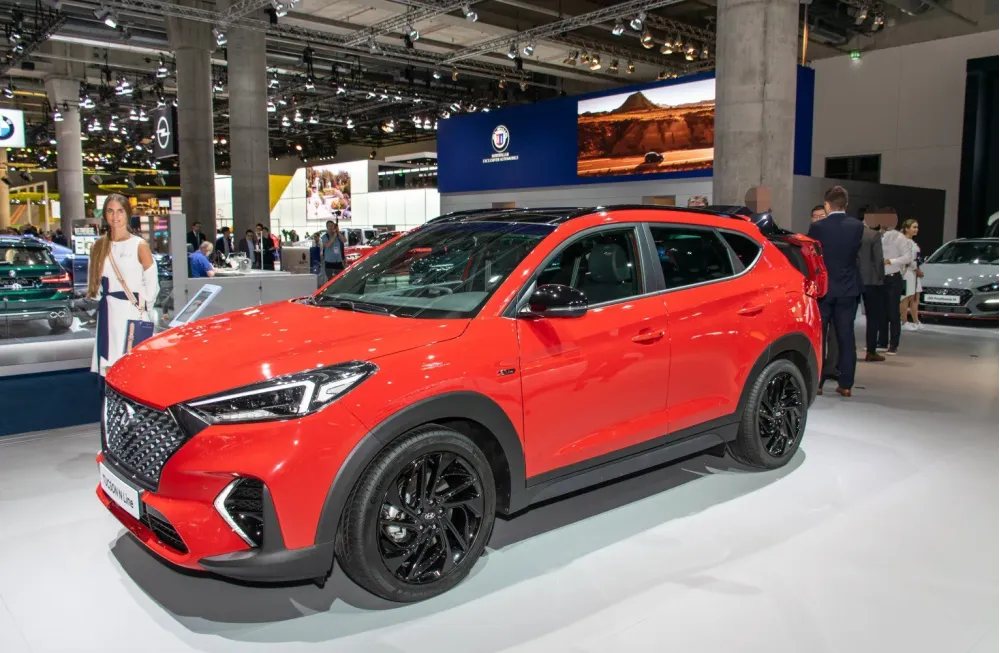
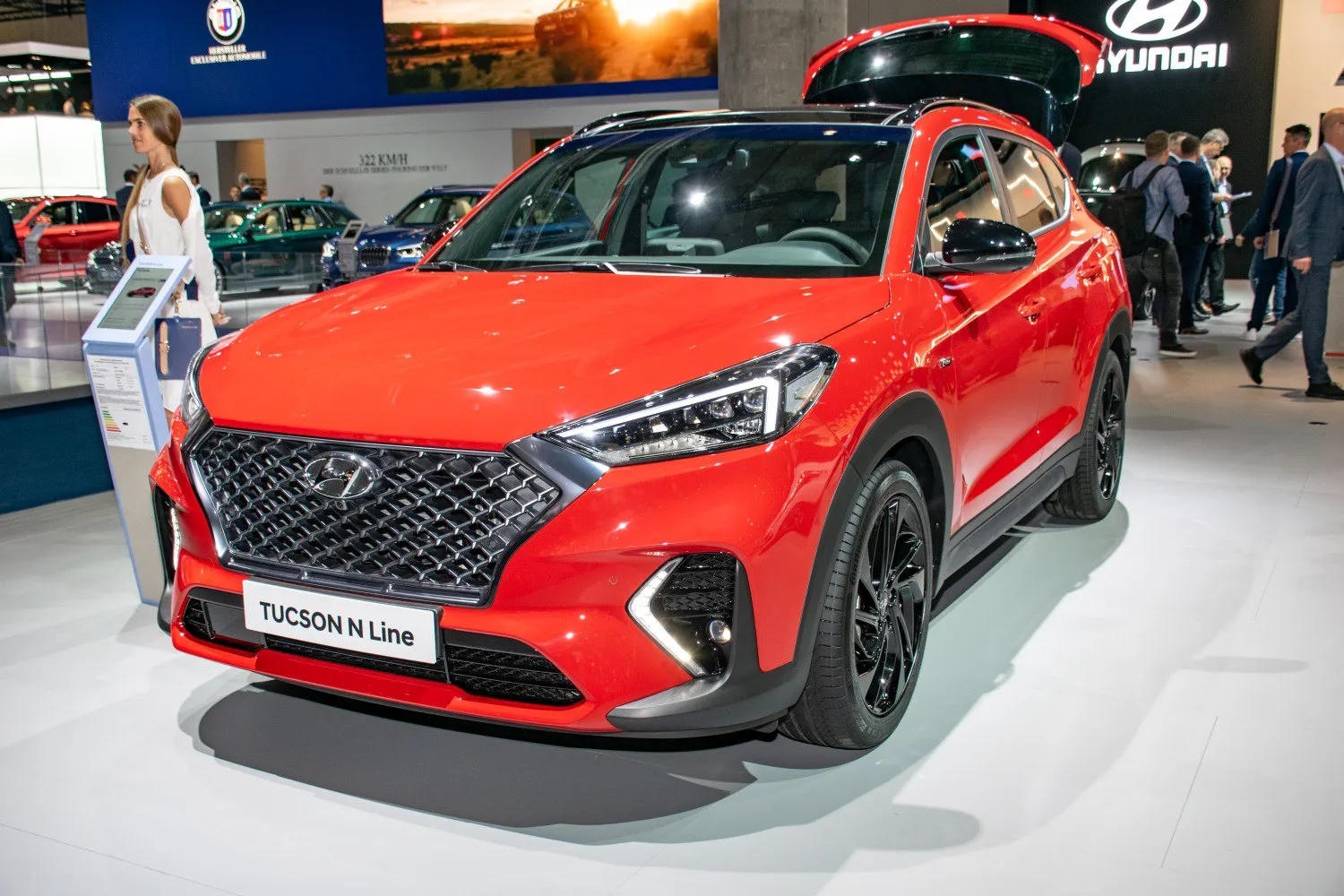
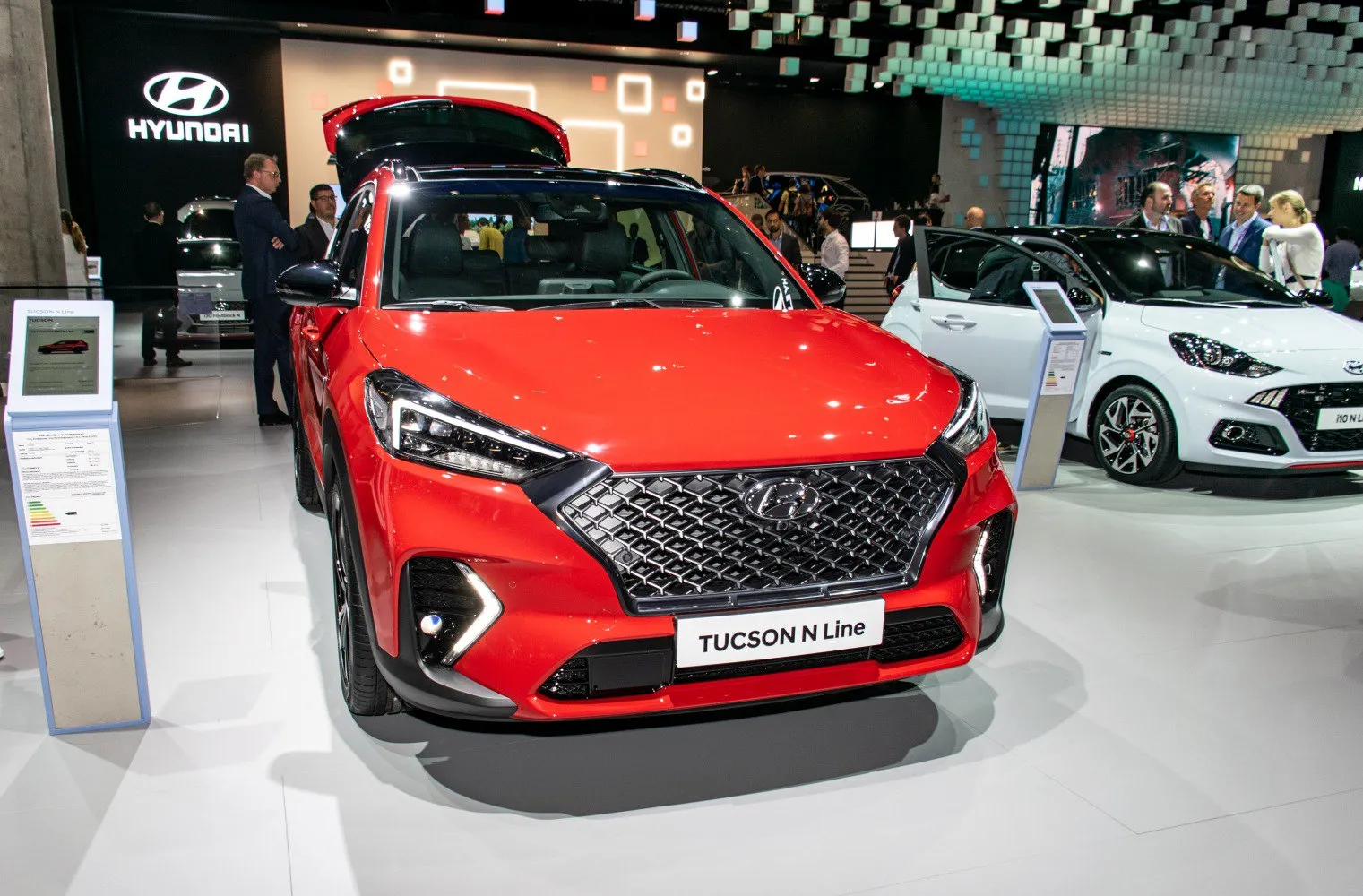
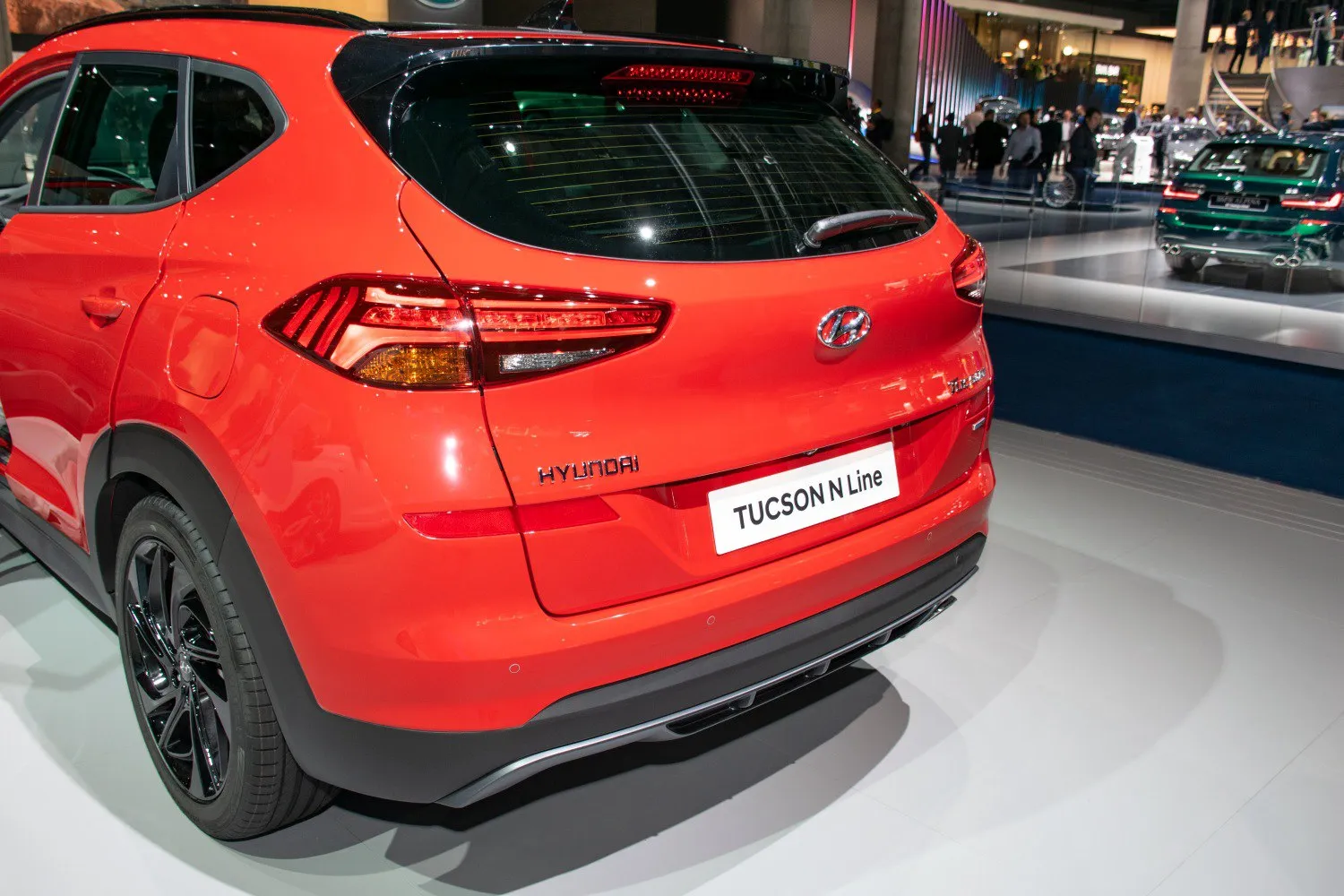
Hyundai Tucson III (facelift 2018) 2.0 CRDi (185 Hp) Mild Hybrid AWD
People\'s Opinion
N/A / 5
Hyundai Tucson:
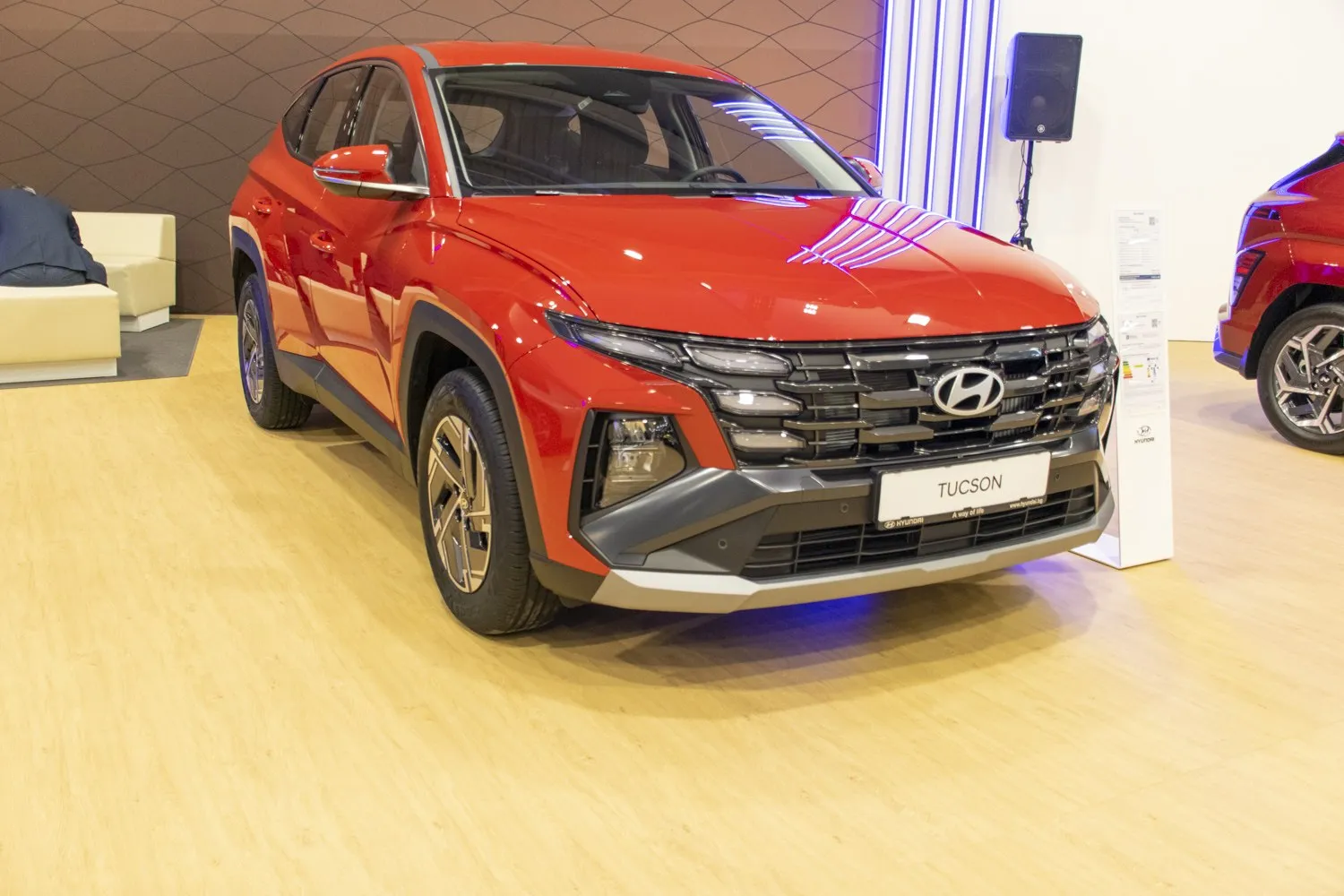
The Hyundai Tucson is a compact crossover SUV produced by the South Korean manufacturer Hyundai. It is named after the city of Tucson, Arizona, U. S.
The second-generation model was marketed as the Hyundai ix35 in several markets, including Europe, Australia and China, before reverting to Tucson for the third-generation. Since its first-generation, the Tucson has been developed alongside the Kia Sportage, sharing platforms and engines.
The Tucson is the best-selling Hyundai model, with more than 7 million units sold globally since it launched in 2004. Of these, 1. 4 million units have been sold in Europe....(Read more on Wikipedia)
III (facelift 2018) Overview:
Hyundai Tucson (III (facelift 2018)). With 400 Nm of torque, it offers ample pulling power. It boasts low fuel consumption (~5.35 l/100km). With a weight of 1705 kg, it falls in the mid‑range. All‑wheel drive provides excellent grip, ideal for off‑road use. Acceleration is relatively slow (0–100 km/h in 9.9 s). The top speed reaches 201 km/h. A sport utility vehicle offering higher ground clearance and versatile cargo space. Seating for 5 makes it ideal for daily use.
Performance Verdict
Strong and torquey diesel performance, enhanced by the mild-hybrid system for better low-end response. AWD provides confident traction.
Fuel Economy
Very good fuel efficiency for a powerful AWD diesel SUV, benefiting significantly from the mild-hybrid technology.
Best Use Case:
Highway cruising, rural driving, and light off-roading where power and efficiency are both valued.
Pros and Cons:
Pros:
- • Refreshed modern design and improved interior ergonomics
- • Wide range of efficient engines, including new mild-hybrid options
- • Comfortable ride quality, suitable for long journeys
- • Good standard feature set and competitive pricing
- • Excellent warranty coverage from Hyundai
Cons:
- • Some naturally aspirated engines can feel underpowered
- • Interior materials, while improved, still trail some premium rivals
- • Infotainment system can be less intuitive on base models
- • Not the most engaging driving experience compared to sportier competitors
- • Higher fuel consumption on larger petrol engines
Specifications:
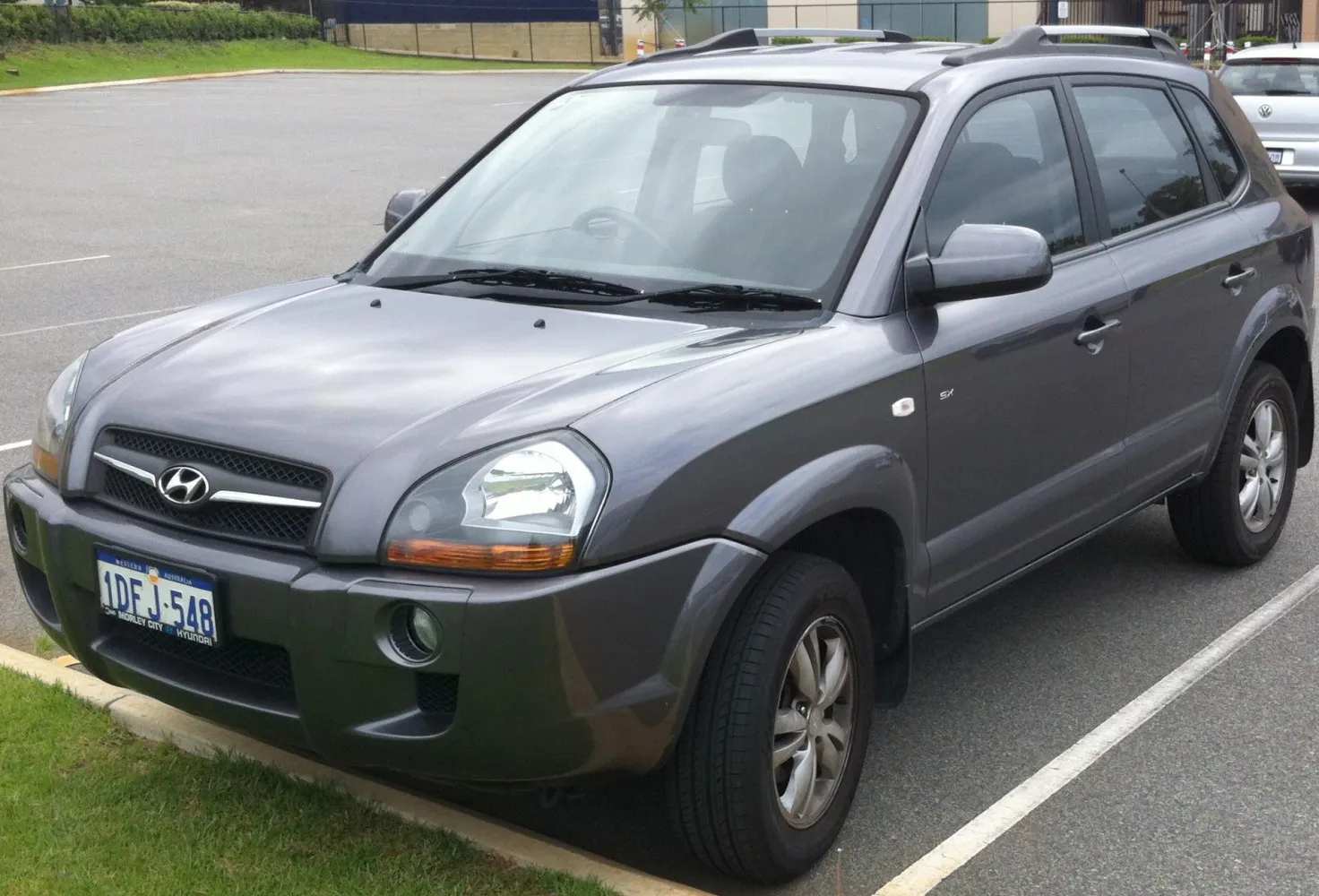
Specifications are compared to those of the previous generation(III: 2016 - 2018).
| General: |
| Brand: | Hyundai |
|---|
| Model: | Tucson |
|---|
| Generation: | III (facelift 2018) |
|---|
| Modification (Engine): | 2.0 CRDi (185 Hp) Mild Hybrid AWD |
|---|
| Start of production: | 2018 |
|---|
| End of production: | 2020 |
|---|
| Powertrain Architecture: | MHEV (Mild Hybrid Electric Vehicle, power-assist hybrid, battery-assisted hybrid vehicles, BAHV) |
|---|
| Body type: | SUV |
|---|
| Seats: | 5 |
|---|
| Doors: | 5 |
|---|
| Engine: |
| Engine systems: | Start & Stop System |
|---|
| Power: | 185 Hp @ 4000 rpm. Same horsepower |
|---|
| Power per litre: | 92.7 Hp/l [5mm more] |
|---|
| Torque: | 400 Nm @ 1750-2750 rpm. |
|---|
| Engine Model/Code: | R II / D4HA More details about the engine R II / D4HA |
|---|
| Engine displacement: | 1995 |
|---|
| Number of cylinders: | 4 |
|---|
| Engine configuration: | Inline |
|---|
| Number of valves per cylinder: | 4 |
|---|
| Fuel injection system: | Diesel Commonrail |
|---|
| Engine aspiration: | Turbocharger, Intercooler |
|---|
| Valvetrain: | DOHC |
|---|
| Engine oil capacity: | 7.6 l |
|---|
| Coolant: | 8.5 l |
|---|
| Engine layout: | Front, Transverse |
|---|
| Cylinder Bore: | 84 mm |
|---|
| Piston Stroke: | 90 mm |
|---|
| Compression ratio: | 16:1 |
|---|
| Performance: |
| Fuel Type: | Diesel |
|---|
| Fuel consumption (economy) - urban: | 5.3-5.4 l/100 km |
|---|
| Fuel consumption (economy) - extra urban: | 5.1-5.2 l/100 km |
|---|
| Combined fuel consumption (WLTP): | 6.9 l/100 km |
|---|
| Fuel consumption (economy) - urban (NEDC, WLTP equivalent): | 5.3-5.4 l/100 km |
|---|
| Fuel consumption (economy) - extra urban (NEDC, WLTP equivalent): | 5.1-5.2 l/100 km |
|---|
| Fuel consumption (economy) - combined (NEDC, WLTP equivalent): | 5.2-5.4 l/100 km |
|---|
| Fuel consumption (economy) - combined: | 5.2-5.4 l/100 km |
|---|
| Emission standard: | Euro 6d-TEMP-EVAP-ISC |
|---|
| Acceleration 0 - 100 km/h: | 9.9 sec |
|---|
| Acceleration 0 - 62 mph: | 9.9 sec |
|---|
| Maximum speed: | 201 km/h |
|---|
| Weight-to-power ratio: | 8.8 kg/Hp, 114.1 Hp/tonne |
|---|
| Weight-to-torque ratio: | 4.1 kg/Nm, 246.8 Nm/tonne |
|---|
| Acceleration 0 - 60 mph: | 9.4 sec |
|---|
| Space: |
| Kerb Weight: | 1621-1789 |
|---|
| Max. weight: | 2230 |
|---|
| Max. roof load: | 100 kg |
|---|
| Max load: | 441-609 |
|---|
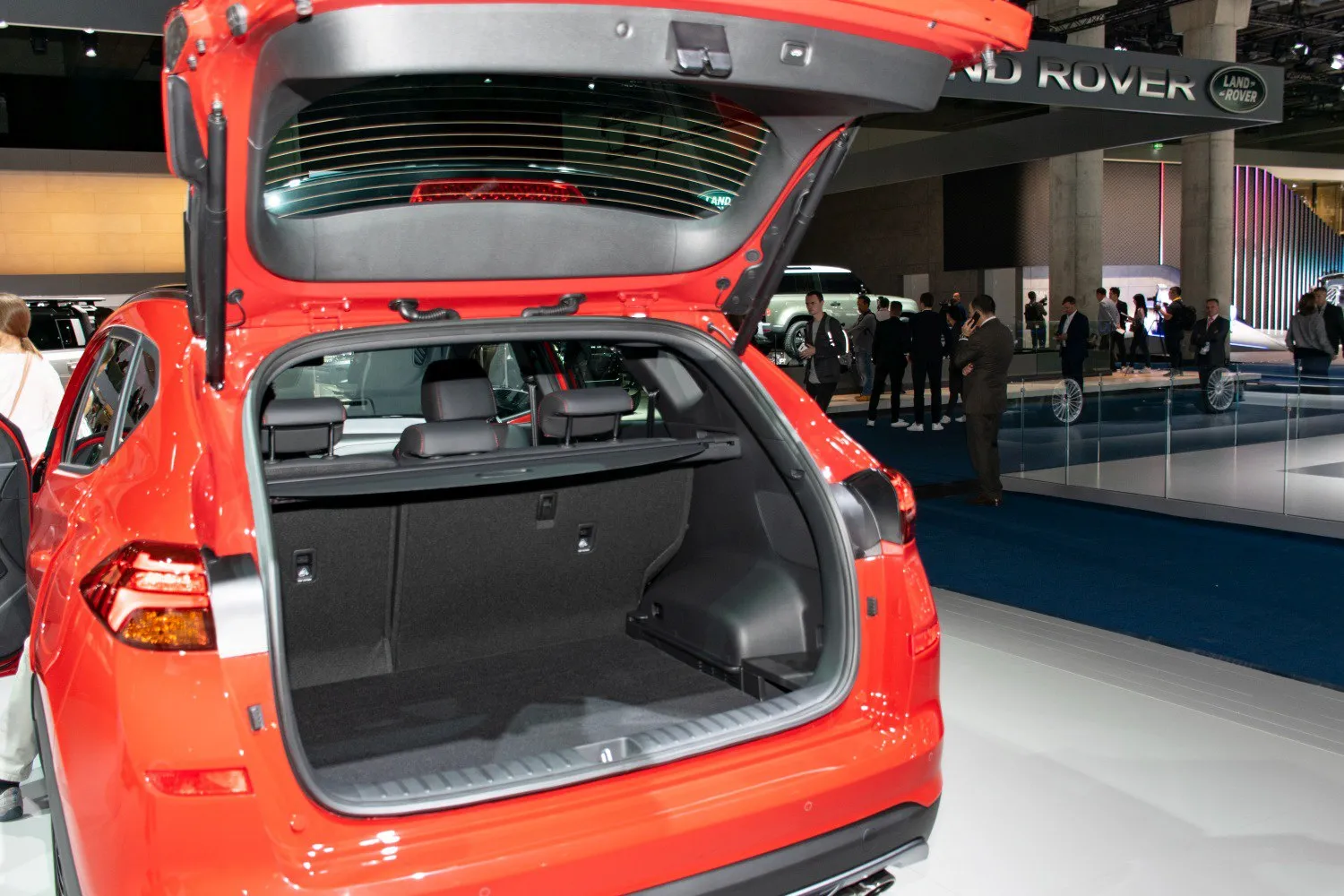
| Trunk (boot) space - maximum: | 1449 l |
|---|
| Trunk (boot) space - minimum: | 459 l |
|---|
| Permitted trailer load with brakes (12%): | 2200 kg |
|---|
| Fuel tank capacity: | 62 l |
|---|
| AdBlue tank: | 14 l |
|---|
| Permitted trailer load without brakes: | 750 kg |
|---|
| Permitted towbar download: | 100 kg |
|---|
| Size: |
| Length: | 4480 mm [5mm more] |
|---|
| Width: | 1850 mm [Same width.] |
|---|
| Height: | 1655 mm [Same height.] |
|---|
| Wheelbase: | 2670 mm [Same wheelbase.] |
|---|
| Width including mirrors: | 2065 mm |
|---|
| Front track: | 1604-1608 mm |
|---|
| Rear (Back) track: | 1615-1620 mm |
|---|
| Ride height (ground clearance): | 172 mm |
|---|
| Minimum turning circle (turning diameter): | 10.6 m [above average] |
|---|
| Powertrain: |
| Drivetrain Architecture | The Internal combustion engine (ICE) and the electric motor permanently drive the front wheels of the vehicle, capable of running only in mixed mode, and if necessary through the electrically or mechanically controlled clutch, the rear wheels are driven. |
|---|
| Drive wheel | All wheel drive (4x4) |
|---|
| Number of gears | 6 |
|---|
| Transmission type | Manual |
|---|
| Front brakes | Ventilated discs [Best for performance and cooling.] |
|---|
| Rear brakes | Disc [above average] |
|---|
| Assisting systems | ABS (Anti-lock braking system) |
|---|
| Steering type | Steering rack and pinion |
|---|
| Power steering | Electric Steering |
|---|
| Tires size | 225/55 R18; 245/45 R19 |
|---|
| Wheel rims size | 7J x 18; 7.5J x 19 |
|---|
| Front suspension | Independent, type McPherson with coil spring and anti-roll bar |
|---|
| Rear suspension | Independent multi-link spring suspension with stabilizer |
|---|
| Electric: |
| Gross battery capacity: | 0.44 kWh |
|---|
| Battery technology: | Lithium-polymer (LiPo) |
|---|
| Battery location: | Under the trunk |
|---|
| Electric motor power: | 16 Hp |
|---|
| Electric motor Torque: | 55 Nm |
|---|
| Electric motor location: | Front, Transverse |
|---|
| Battery voltage: | 48 V |
|---|
| Recuperation output: | 12 kW |
|---|









The hidden gems or the annoying flaws? Expose the truth about the Hyundai Tucson!