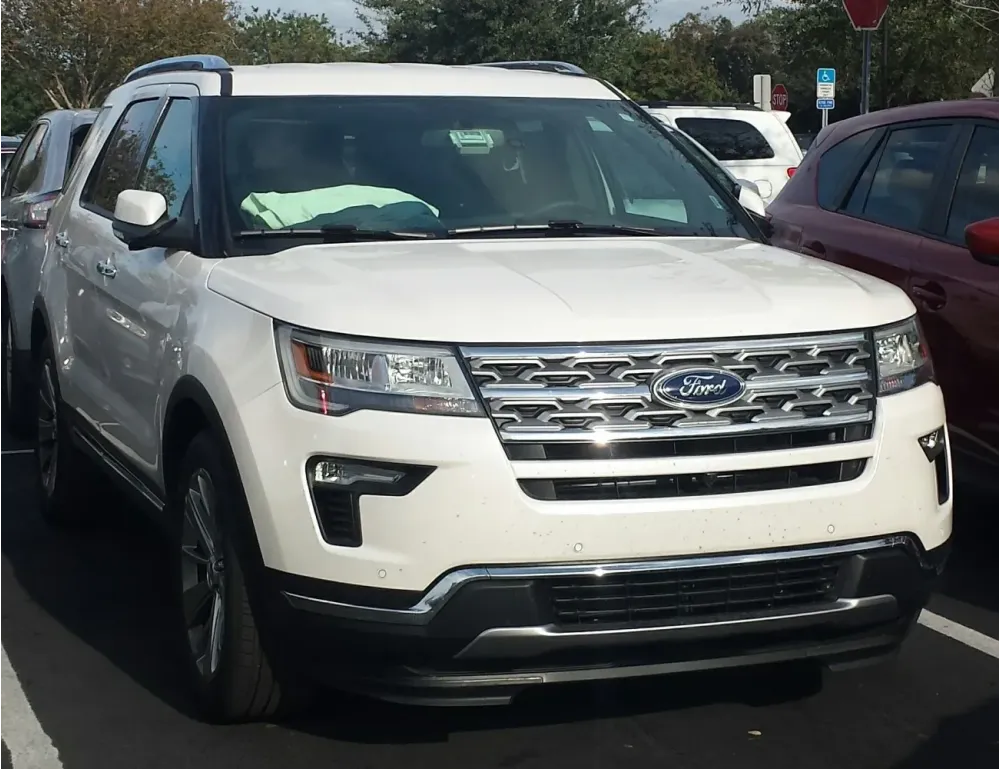
Click on image to view the full photo gallery
Ford Explorer V (facelift 2018) 2.3 EcoBoost (280 Hp) Automatic
Overall Rating
Ford Explorer:
The Ford Explorer is a range of SUVs manufactured by the Ford Motor Company since the 1991 model year. The first five-door SUV produced by Ford, the Explorer, was introduced as a replacement for the three-door Bronco II. As with the Ford Ranger, the model line derives its name from a trim package previously offered on Ford F-Series pickup trucks. In 2020, the Explorer became the best-selling SUV in the American market.
Currently in its sixth generation, the Explorer has featured a five-door wagon body style since its 1991 introduction. During the first two generations, the model line included a three-door wagon. The Ford Explorer Sport Trac is a crew-cab mid-size pickup truck derived from the second-generation Explorer. The fifth and sixth generations of the Explorer have been produced as the Ford Police Interceptor Utility....(Read more on Wikipedia)
V (facelift 2018) Overview:
Ford Explorer (V (facelift 2018)). With 420 Nm of torque, it offers ample pulling power. With a weight of 2000 kg, it falls in the mid‑range. Front‑wheel drive delivers efficiency and easy handling. A sport utility vehicle offering higher ground clearance and versatile cargo space. With seating for 7, it’s perfect for larger families.
2.3 EcoBoost (280 Hp) Automatic Verdict:

Performance Verdict
Surprisingly capable for a four-cylinder, offering strong low-end torque thanks to the EcoBoost turbocharging. It feels more powerful than its displacement suggests.
Fuel Economy
The most fuel-efficient option in the lineup, providing a good balance of power and economy for a large SUV. A smart choice for those prioritizing MPG.
Pros and Cons:
Pros:
- • Spacious three-row interior with ample cargo capacity.
- • Wide range of powerful and efficient engine options.
- • Comfortable ride quality suitable for long journeys.
- • Available intelligent 4WD system for enhanced traction.
- • Modern infotainment and safety technology (post-facelift).
Cons:
- • Interior materials can feel less premium than some rivals.
- • Fuel economy, especially with V6 engines, can be a concern for some.
- • Third-row access can be a bit tight for adults.
- • Large exterior dimensions can make city parking challenging.
- • Some common issues reported with infotainment or transmission over time.
Specifications:
Specifications are compared to those of the previous generation(V (facelift 2016): 2016 - 2018).
| General: | |
|---|---|
| Brand: | Ford |
| Model: | Explorer |
| Generation: | V (facelift 2018) |
| Modification (Engine): | 2.3 EcoBoost (280 Hp) Automatic |
| Start of production: | 2018 |
| End of production: | 2019 |
| Powertrain Architecture: | Internal Combustion engine |
| Body type: | SUV |
| Seats: | 7 |
| Doors: | 5 |
| Engine: | |
|---|---|
| Power: | 280 Hp @ 5600 rpm. |
| Power per litre: | 123.8 Hp/l |
| Torque: | 420 Nm @ 3000 rpm. |
| Engine displacement: | 2261 |
| Number of cylinders: | 4 |
| Engine configuration: | Inline |
| Number of valves per cylinder: | 4 |
| Fuel injection system: | Direct injection |
| Engine aspiration: | Turbocharger, Intercooler |
| Valvetrain: | Ti-VCT, DOHC |
| Engine oil capacity: | 5.4 l |
| Coolant: | 11 l |
| Engine layout: | Front, Transverse |
| Cylinder Bore: | 87.5 mm mm |
| Piston Stroke: | 94 mm mm |
| Compression ratio: | 9.5:1 |
| Performance: | |
|---|---|
| Fuel Type: | Petrol (Gasoline) |
| Fuel consumption (economy) - urban: | 12.3 l/100 km |
| Fuel consumption (economy) - extra urban: | 8.7 l/100 km |
| Fuel consumption (economy) - combined: | 10.6 l/100 km |
| Weight-to-power ratio: | 7.1 kg/Hp, 140 Hp/tonne |
| Weight-to-torque ratio: | 4.8 kg/Nm, 210 Nm/tonne |
| Space: | |
|---|---|
| Kerb Weight: | 2000 |
| Trunk (boot) space - maximum: | 2313 l |
| Trunk (boot) space - minimum: | 595 l |
| Fuel tank capacity: | 70 l |
| Size: | |
|---|---|
| Ramp-over (brakeover) angle: | 16.9° |
| Length: | 5047 mm mm [28mm more] |
| Width: | 2004 mm mm [16mm more] |
| Height: | 1778 mm mm [10mm less] |
| Wheelbase: | 2865 mm mm [5mm more] |
| Width with mirrors folded: | 2096 mm |
| Width including mirrors: | 2291 mm |
| Front track: | 1702 mm |
| Rear (Back) track: | 1702 mm |
| Ride height (ground clearance): | 198 mm |
| Approach angle: | 15.6° |
| Departure angle: | 20.9° |
| Powertrain: | |
|---|---|
| Drivetrain Architecture | The Internal combustion engine (ICE) drives the front wheels of the vehicle. |
| Drive wheel | Front wheel drive |
| Number of gears | 6 |
| Transmission type | Automatic |
| Front brakes | Ventilated discs [Best for performance and cooling.] |
| Rear brakes | Ventilated discs [Best for performance and cooling.] |
| Assisting systems | ABS (Anti-lock braking system) |
| Steering type | Steering rack and pinion |
| Power steering | Electric Steering |
| Tires size | 245/60 R18 |
| Wheel rims size | 18 |
| Front suspension | Independent, type McPherson with coil spring and anti-roll bar |
| Rear suspension | Independent multi-link spring suspension with stabilizer |










How many miles have you covered in your Ford Explorer? Share your journey!