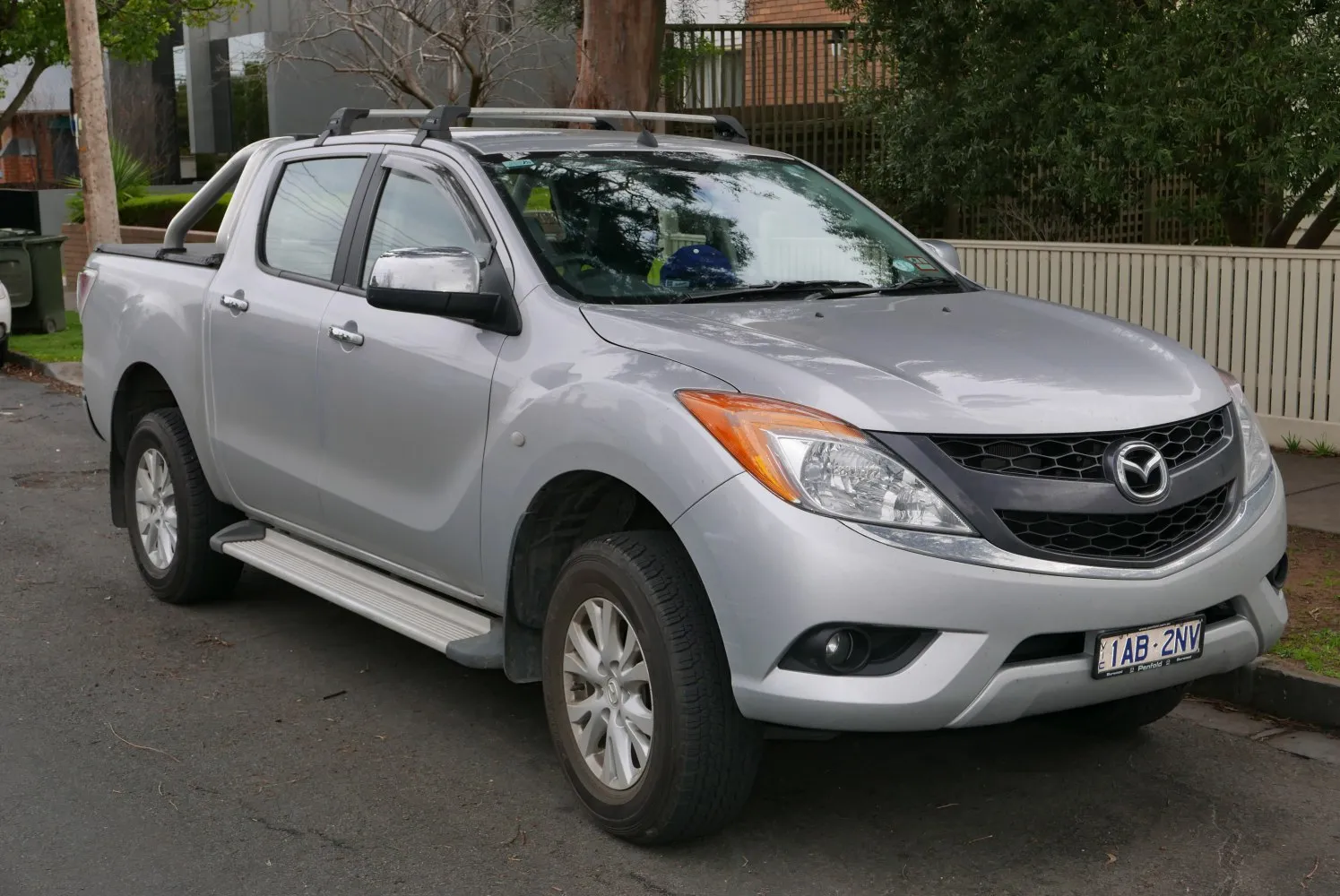
Mazda BT-50 Dual Cab II (facelift 2015) 3.2 (200 Hp) 4x4
Mazda BT-50:
The Mazda BT-50 is a compact pickup truck / mid-size pickup truck marketed by the Japanese manufacturer Mazda since 2006. It is a larger version of the predecessor B-Series pickup and is not sold in the Japanese and North American markets. The second-generation Ranger has been designed by Ford Australia, with a Mazda derivative sold as the BT-50. The third-generation BT-50 was revealed in 2020, based on the Isuzu D-Max.
The BT-50 was launched at the Bangkok International Motor Show on 22 March 2006. It shares its Duratorq/MZR-CD 2. 5- and 3. 0-liter diesel inline-four engines with the Ranger. In late November 2006, the new five-speed automatic transmission with Borg Warner transfer case has been added, as well as side airbags....(Read more on Wikipedia)
Dual Cab II (facelift 2015) Overview:
Mazda BT-50 (Dual Cab II (facelift 2015)). With 470 Nm of torque, it offers ample pulling power. At around 2022 kg, it’s on the heavier side. All‑wheel drive provides excellent grip, ideal for off‑road use. A vehicle with an open cargo bed at the back, suitable for transporting goods. Seating for 5 makes it ideal for daily use.
Pros and Cons:
Pros:
- • Adequate and balanced power output (200 hp) for versatile driving.
- • All-wheel drive for superior traction in all conditions.
- • Ventilated disc brakes for reliable cooling and stopping power.
- • Turbocharged engine ensures better torque delivery at low RPMs.
Cons:
- • Relatively high fuel consumption: 8.9 L/100 km combined.
- • Meets EURO 4 emission standard; check for local urban restriction zones.
Specifications:
Specifications are compared to those of the previous generation(Dual Cab II: 2011 - 2014).
| General: |
| Brand: | Mazda |
|---|
| Model: | BT-50 |
|---|
| Generation: | Dual Cab II (facelift 2015) |
|---|
| Modification (Engine): | 3.2 (200 Hp) 4x4 |
|---|
| Start of production: | 2015 |
|---|
| End of production: | 2018 |
|---|
| Powertrain Architecture: | Internal Combustion engine |
|---|
| Body type: | Pick-up |
|---|
| Seats: | 5 |
|---|
| Doors: | 4 |
|---|
| Engine: |
| Power: | 200 Hp @ 3000 rpm. |
|---|
| Power per litre: | 62.5 Hp/l |
|---|
| Torque: | 470 Nm @ 1750-2500 rpm. |
|---|
| Engine displacement: | 3198 |
|---|
| Number of cylinders: | 5 |
|---|
| Engine configuration: | Inline |
|---|
| Number of valves per cylinder: | 4 |
|---|
| Fuel injection system: | Diesel Commonrail |
|---|
| Engine aspiration: | Turbocharger, Intercooler |
|---|
| Valvetrain: | DOHC |
|---|
| Engine oil capacity: | 9.75 l |
|---|
| Coolant: | 12.9 l |
|---|
| Engine layout: | Front, Longitudinal |
|---|
| Cylinder Bore: | 89.9 mm mm |
|---|
| Piston Stroke: | 100.7 mm mm |
|---|
| Compression ratio: | 15.5:1 |
|---|
| Performance: |
| Fuel Type: | Diesel |
|---|
| Fuel consumption (economy) - combined: | 8.9 l/100 km |
|---|
| Emission standard: | Euro 4 |
|---|
| Weight-to-power ratio: | 10.1 kg/Hp, 98.9 Hp/tonne |
|---|
| Weight-to-torque ratio: | 4.3 kg/Nm, 232.4 Nm/tonne |
|---|
| Space: |
| Kerb Weight: | 2022 |
|---|
| Max. weight: | 3200 |
|---|
| Max load: | 1178 |
|---|
| Permitted trailer load with brakes (12%): | 3500 kg |
|---|
| Fuel tank capacity: | 80 l |
|---|
| Permitted trailer load without brakes: | 750 kg |
|---|
| Permitted towbar download: | 350 kg |
|---|
| Size: |
| Ramp-over (brakeover) angle: | 24.4° |
|---|
| Wading depth: | 800 mm |
|---|
| Length: | 5373 mm mm [Same length.] |
|---|
| Width: | 1850 mm mm [Same width.] |
|---|
| Height: | 1815 mm mm [Same height.] |
|---|
| Wheelbase: | 3220 mm mm [Same wheelbase.] |
|---|
| Front track: | 1560 mm |
|---|
| Rear (Back) track: | 1560 mm |
|---|
| Front overhang: | 919 mm |
|---|
| Rear overhang: | 1234 mm |
|---|
| Ride height (ground clearance): | 200-205 mm |
|---|
| Minimum turning circle (turning diameter): | 12.4 m [above average] |
|---|
| Approach angle: | 27.6° |
|---|
| Departure angle: | 27.1° |
|---|
| Powertrain: |
| Drivetrain Architecture | The Internal combustion engine (ICE) drives permanently the four wheels of the vehicle. |
|---|
| Drive wheel | All wheel drive (4x4) |
|---|
| Number of gears | 6 |
|---|
| Transmission type | Manual |
|---|
| Front brakes | Ventilated discs, 302 mm [Best for performance and cooling.] |
|---|
| Rear brakes | Drum, 295 mm [bad for performance and cooling.] |
|---|
| Assisting systems | ABS (Anti-lock braking system) |
|---|
| Steering type | Steering rack and pinion |
|---|
| Power steering | Hydraulic Steering |
|---|
| Tires size | 255/70 R16 111T |
|---|
| Wheel rims size | 7.0J x 16 |
|---|
| Front suspension | Double wishbone |
|---|
| Rear suspension | Leaf spring |
|---|






Help others decide – share your experience!