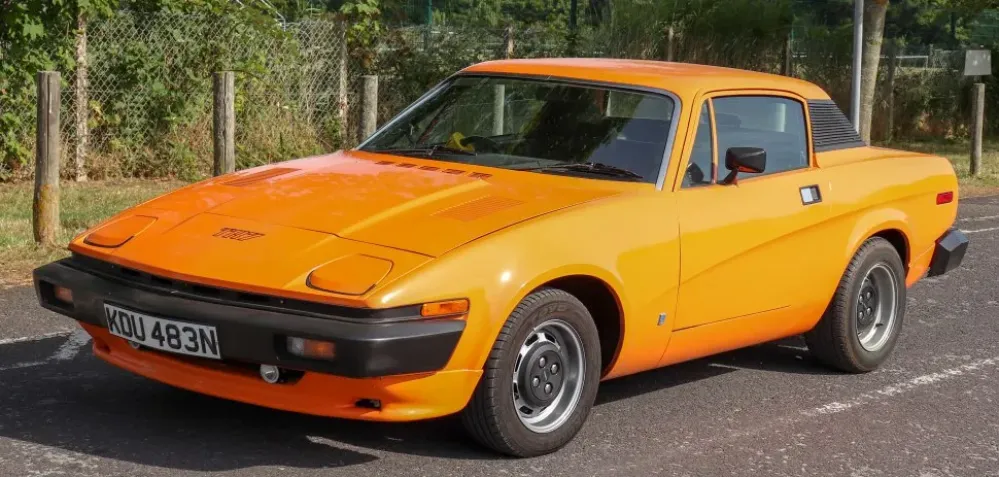
Triumph TR 7 Coupe 2.0 (105 Hp)
People\'s Opinion
N/A / 5
Triumph TR 7:
The Triumph TR7 is a sports car that was manufactured in the United Kingdom from September 1974 to October 1981 by British Leyland Motor Corporation , which changed its name to British Leyland in 1975. The car was launched in the United States in January 1975, with its UK home market debut in May 1976. The UK launch was delayed at least twice because of high demand for the vehicle in the US, with final sales of new TR7s continuing into 1982.
It was initially produced at the Speke, Liverpool, factory, moving to Canley, Coventry, in 1978 and then finally to the Rover Solihull plant in 1980....(Read more on Wikipedia)
Coupe Overview:
Triumph TR 7 (Coupe). With 161 Nm of torque, it offers ample pulling power. Weighing only 1000 kg, it’s quite light. Rear‑wheel drive offers dynamic handling and sporty feedback. A two-door car with a fixed roof, known for its sporty design and dynamic performance. Seating for 2 makes it ideal for daily use.
Performance Verdict
The 2.0L 105 Hp engine provided adequate performance for its era, offering a lively but not blistering acceleration. It was well-suited for spirited driving on winding roads rather than outright speed.
Fuel Economy
Equipped with carburettors, the 2.0L engine's fuel economy was typical for a 1970s sports car, meaning it was not particularly efficient by modern standards, but acceptable for its time.
Best Use Case:
Weekend / Enthusiast Driving
Pros and Cons:
Pros:
- • Distinctive and unique 'wedge' styling
- • Relatively affordable entry into classic car ownership
- • Engaging driving experience on B-roads
- • Good parts availability for restoration
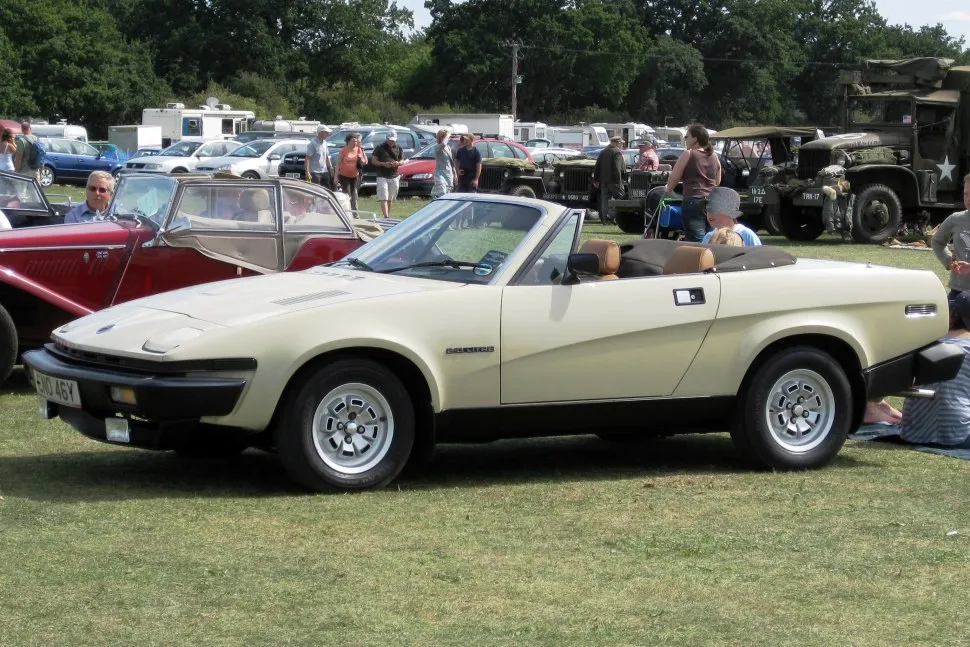
- • Convertible option (though this is a Coupe, it's part of the TR7 appeal)
Cons:
- • Early models suffered from significant build quality issues
- • Prone to rust, especially in critical areas
- • Performance is modest by modern standards
- • Interior design is dated and plasticky
- • Some electrical gremlins reported
Specifications:
| General: |
| Brand: | Triumph |
|---|
| Model: | TR 7 |
|---|
| Generation: | Coupe |
|---|
| Modification (Engine): | 2.0 (105 Hp) |
|---|
| Start of production: | 1977 |
|---|
| End of production: | 1981 |
|---|
| Powertrain Architecture: | Internal Combustion engine |
|---|
| Body type: | Coupe |
|---|
| Seats: | 2 |
|---|
| Doors: | 2 |
|---|
| Engine: |
| Power: | 105 Hp @ 5500 rpm. |
|---|
| Power per litre: | 52.6 Hp/l |
|---|
| Torque: | 161 Nm @ 3500 rpm. |
|---|
| Engine displacement: | 1998 |
|---|
| Number of cylinders: | 4 |
|---|
| Engine configuration: | Inline |
|---|
| Fuel injection system: | Carburettor |
|---|
| Engine aspiration: | Naturally aspirated engine |
|---|
| Valvetrain: | SOHC |
|---|
| Engine oil capacity: | 4.5 l |
|---|
| Coolant: | 7.9 l |
|---|
| Engine layout: | Front, Longitudinal |
|---|
| Cylinder Bore: | 90.3 mm mm |
|---|
| Piston Stroke: | 78 mm mm |
|---|
| Compression ratio: | 9.25:1 |
|---|
| Performance: |
| Fuel Type: | Petrol (Gasoline) |
|---|
| Weight-to-power ratio: | 9.5 kg/Hp, 105 Hp/tonne |
|---|
| Weight-to-torque ratio: | 6.2 kg/Nm, 161 Nm/tonne |
|---|
| Space: |
| Kerb Weight: | 1000 |
|---|
| Fuel tank capacity: | 54.5 l |
|---|
| Size: |
| Length: | 4065 mm mm |
|---|
| Width: | 1681 mm mm |
|---|
| Height: | 1254 mm mm |
|---|
| Wheelbase: | 2160 mm mm |
|---|
| Front track: | 1409 mm |
|---|
| Rear (Back) track: | 1404 mm |
|---|
| Minimum turning circle (turning diameter): | 8.8 m |
|---|
| Powertrain: |
| Drivetrain Architecture | The Internal combustion engine (ICE) drives the rear wheels of the vehicle. |
|---|
| Drive wheel | Rear wheel drive |
|---|
| Number of gears | 5 |
|---|
| Transmission type | Manual |
|---|
| Front brakes | Disc, 248 mm |
|---|
| Rear brakes | Drum, 204 mm |
|---|
| Steering type | Steering rack and pinion |
|---|
| Tires size | Front wheel tires: 175/70 R13 |
|---|
| Wheel rims size | Front wheel rims: 5.5J x 13 |
|---|
| Front suspension | Several levers and rods, Transverse stabilizer |
|---|
| Rear suspension | Independent multi-link suspension, Transverse stabilizer |
|---|






Real owners, real reviews. Tell us about your Triumph TR 7.