
Click on image to view the full photo gallery
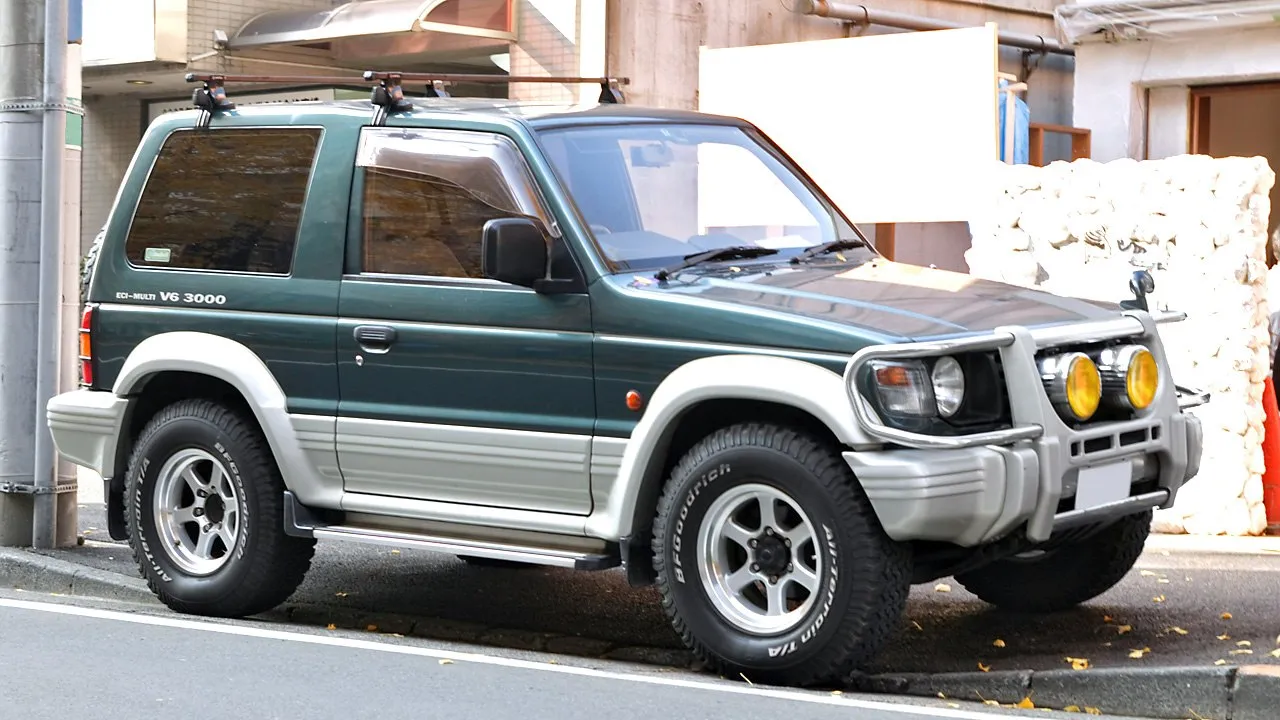
Mitsubishi Pajero IV 3.0i V6 (178 Hp) 5-doors
Overall Rating
Mitsubishi Pajero:
The Mitsubishi Pajero is a full-size SUV manufactured and marketed globally by Mitsubishi over four generations—introduced in 1981 and discontinued in 2021.
The Pajero nameplate derives from Leopardus pajeros, the Pampas cat. Mitsubishi marketed the SUV as the Montero in North America, Spain, and Latin America due to the term "pajero" being derogatory in Spanish. In the United Kingdom, it was known as the Shogun, named after the Japanese word for "General. " The model was discontinued in North America in 2006....(Read more on Wikipedia)
IV Overview:
Mitsubishi Pajero (IV). With 261 Nm of torque, it offers ample pulling power. At around 2310 kg, it’s on the heavier side. All‑wheel drive provides excellent grip, ideal for off‑road use. The top speed reaches 177 km/h. A sport utility vehicle offering higher ground clearance and versatile cargo space. With seating for 7, it’s perfect for larger families.
The Pajero IV (tested as Shogun) achieved a respectable 4-star Euro NCAP rating for adult occupant protection in 2006, indicating solid crashworthiness for its time, though pedestrian protection was limited.
3.0i V6 (178 Hp) 5-doors Verdict:

Performance Verdict
Offers a smoother V6 experience with adequate power for daily driving, though likely not as brisk as the 3.8L. Acceleration data is unavailable.
Fuel Economy
Fuel consumption is expected to be moderate for a petrol V6, likely better than the 3.8L but worse than the diesels. Specific data is unavailable.
Pros and Cons:
Pros:
- • Legendary off-road capability with Super Select 4WD-II system
- • Robust and durable build quality, known for reliability
- • Spacious and versatile interior, especially in 5-door variants
- • Strong diesel torque for towing and challenging terrain
- • Good value for money in the used SUV market
Cons:
- • High fuel consumption for petrol engine variants
- • Somewhat dated interior design and technology compared to rivals
- • Firm ride quality on paved roads due to off-road suspension
- • Slow acceleration for some diesel variants, especially with manual transmission
- • Large turning circle can make urban maneuvering challenging
Specifications:
Specifications are compared to those of the previous generation(III: 2000 - 2006).
| General: | |
|---|---|
| Brand: | Mitsubishi |
| Model: | Pajero |
| Generation: | IV |
| Modification (Engine): | 3.0i V6 (178 Hp) 5-doors |
| Start of production: | 2006 |
| End of production: | 2011 |
| Powertrain Architecture: | Internal Combustion engine |
| Body type: | SUV |
| Seats: | 7 |
| Doors: | 5 |
| Engine: | |
|---|---|
| Power: | 178 Hp @ 5250 rpm. Same horsepower |
| Power per litre: | 59.9 Hp/l [620mm more] |
| Torque: | 261 Nm @ 4000 rpm. |
| Engine Model/Code: | 6G72 More details about the engine 6G72 |
| Engine displacement: | 2972 |
| Number of cylinders: | 6 |
| Engine configuration: | V-engine |
| Number of valves per cylinder: | 2 |
| Fuel injection system: | Multi-port manifold injection |
| Engine aspiration: | Naturally aspirated engine |
| Valvetrain: | OHC |
| Engine oil capacity: | 4.9 l |
| Coolant: | 9 l |
| Engine layout: | Front, Longitudinal |
| Cylinder Bore: | 91.1 mm |
| Piston Stroke: | 76 mm |
| Compression ratio: | 10:1 |
| Performance: | |
|---|---|
| Fuel Type: | Petrol (Gasoline) |
| Maximum speed: | 177 km/h |
| Weight-to-power ratio: | 13 kg/Hp, 77.1 Hp/tonne |
| Weight-to-torque ratio: | 8.9 kg/Nm, 113 Nm/tonne |
| Space: | |
|---|---|
| Kerb Weight: | 2310 |
| Max. weight: | 3030 |
| Max load: | 720 |
| Trunk (boot) space - maximum: | 1790 l |
| Trunk (boot) space - minimum: | 215 l |
| Fuel tank capacity: | 88 l |
| Size: | |
|---|---|
| Length: | 4900 mm [620mm more] |
| Width: | 1875 mm [Same width.] |
| Height: | 1870 mm [25mm more] |
| Wheelbase: | 2780 mm [235mm more] |
| Front overhang: | 765 mm |
| Rear overhang: | 1355 mm |
| Powertrain: | |
|---|---|
| Drive wheel | All wheel drive (4x4) |
| Number of gears | 5 |
| Transmission type | Automatic |
| Front brakes | Ventilated discs [Best for performance and cooling.] |
| Rear brakes | Ventilated discs [Best for performance and cooling.] |
| Assisting systems | ABS (Anti-lock braking system) |
| Steering type | Steering rack and pinion |
| Tires size | 265/65 R17 |
| Wheel rims size | 7.5J X 17 |
| Front suspension | Double wishbone |
| Rear suspension | Transverse stabilizer |















Behind the wheel of the Mitsubishi Pajero. How does it handle on the road?