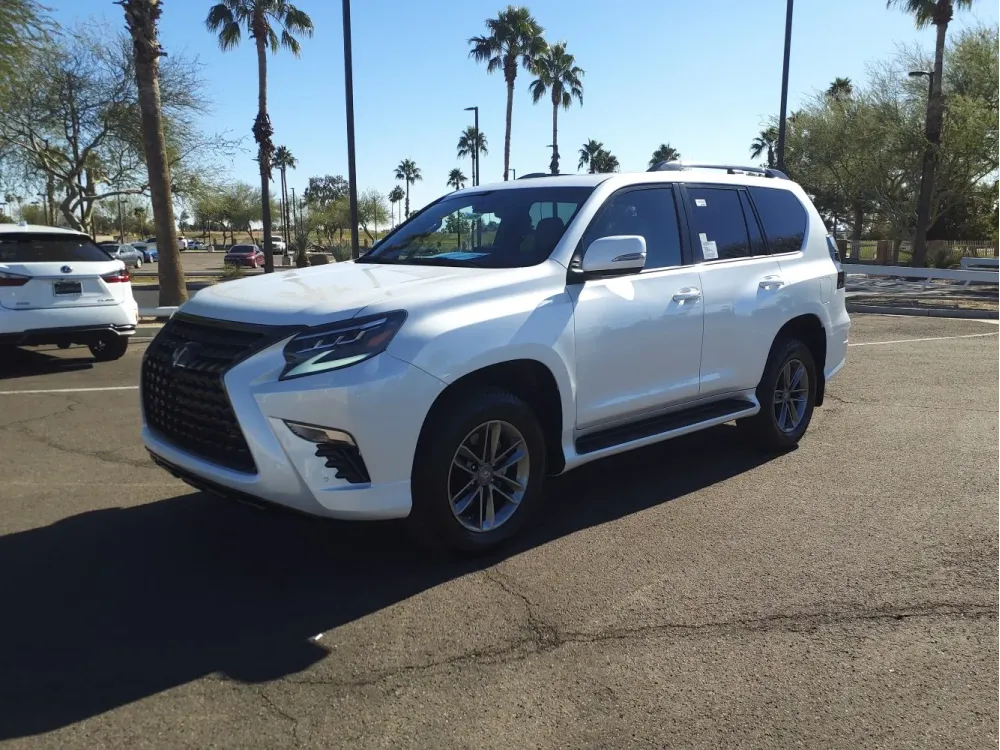
Click on image to view the full photo gallery
Lexus GX J150, facelift 2019 460 V8 (301 Hp) 4WD ECT
Overall Rating
Lexus GX:
The Lexus GX is a mid/full-size luxury SUV sold in North American and Eurasian markets by Lexus, a luxury division of Toyota. The GX is based on the Toyota Land Cruiser Prado, from which it derives its off-road capability.
Lexus introduced the first generation, known as the GX 470 in 2002, and subsequently became the third SUV to enter the Lexus lineup. A full-time four-wheel drive system is standard with low-range gearing. The 4. 7-liter V8 engine in the GX 470 was the same as used on the larger LX 470. The firm next introduced the second-generation model in 2009, badged GX 460 to reflect the switch to a 4. 6-liter V8 engine. Lexus later released a lower displacement GX 400 in 2012 for the Chinese market, with a 4. 0-liter V6 engine. The third-generation model introduced in 2023 uses the GX 550 moniker with a twin-turbocharged 3. 4-liter V6 engine and GX 550h with a turbocharged hybrid electric 2. 4-liter four-cylinder engine....(Read more on Wikipedia)
J150, facelift 2019 Overview:
Lexus GX (J150, facelift 2019). With 446 Nm of torque, it offers ample pulling power. At around 2342 kg, it’s on the heavier side. All‑wheel drive provides excellent grip, ideal for off‑road use. The top speed reaches 177 km/h. A sport utility vehicle offering higher ground clearance and versatile cargo space. With seating for 7, it’s perfect for larger families.
460 V8 (301 Hp) 4WD ECT Verdict:

Performance Verdict
The 4.6L V8 provides strong, smooth power delivery, making it capable for highway cruising, towing, and light off-roading. While not a performance SUV, its 301 Hp is adequate for its size and intended use.
Fuel Economy
Fuel economy is a significant drawback, with a combined 13.8 l/100 km (approx. 17 MPG US). This V8 is thirsty, especially in urban environments, reflecting its older design and the vehicle's substantial weight.
Pros and Cons:
Pros:
- • Exceptional reliability and durability
- • Strong V8 engine for towing and off-road
- • Luxurious and comfortable interior ride quality
- • Impressive off-road capability with advanced 4WD system
- • High resale value
Cons:
- • Poor fuel economy due to V8 engine and weight
- • Dated infotainment system and interior design compared to rivals
- • Modest on-road handling and acceleration for a luxury SUV
- • High curb weight impacts agility
- • Limited cargo space with third row in use
Specifications:
Specifications are compared to those of the previous generation(J150, facelift 2013: 2013 - 2019).
| General: | |
|---|---|
| Brand: | Lexus |
| Model: | GX |
| Generation: | J150, facelift 2019 |
| Modification (Engine): | 460 V8 (301 Hp) 4WD ECT |
| Start of production: | 2019 |
| End of production: | 2023 |
| Powertrain Architecture: | Internal Combustion engine |
| Body type: | SUV |
| Seats: | 7 |
| Doors: | 5 |
| Engine: | |
|---|---|
| Engine systems: | Start & Stop System |
| Power: | 301 Hp @ 5500 rpm. |
| Power per litre: | 65.3 Hp/l |
| Torque: | 446 Nm @ 3500 rpm. |
| Engine Model/Code: | 1UR-FE [Same engine] More details about the engine 1UR-FE |
| Engine displacement: | 4606 |
| Number of cylinders: | 8 |
| Engine configuration: | V-engine |
| Number of valves per cylinder: | 4 |
| Fuel injection system: | Multi-port manifold injection |
| Engine aspiration: | Naturally aspirated engine |
| Valvetrain: | DOHC, VVT-i |
| Engine oil capacity: | 7.8 l |
| Coolant: | 13.7 l |
| Engine layout: | Front, Longitudinal |
| Cylinder Bore: | 93.98 mm mm |
| Piston Stroke: | 83.06 mm mm |
| Compression ratio: | 10.2:1 |
| Performance: | |
|---|---|
| Fuel Type: | Petrol (Gasoline) |
| Fuel consumption (economy) - urban: | 15.7 l/100 km |
| Fuel consumption (economy) - extra urban: | 11.8 l/100 km |
| Fuel consumption (economy) - combined: | 13.8 l/100 km |
| Emission standard: | ULEV-II |
| Maximum speed: | 177 km/h |
| Weight-to-power ratio: | 7.7 kg/Hp, 129.4 Hp/tonne |
| Weight-to-torque ratio: | 5.2 kg/Nm, 191.7 Nm/tonne |
| Space: | |
|---|---|
| Kerb Weight: | 2327-2358 |
| Max. weight: | 2994 |
| Max load: | 636-667 |
| Trunk (boot) space - maximum: | 1832 l |
| Permitted trailer load with brakes (12%): | 2948 kg |
| Fuel tank capacity: | 87 l |
| Size: | |
|---|---|
| Ramp-over (brakeover) angle: | 21° |
| Length: | 4879 mm mm [1mm less] |
| Width: | 1885 mm mm [Same width.] |
| Height: | 1875-1885 mm mm [10mm less] |
| Wheelbase: | 2789 mm mm [1mm less] |
| Front track: | 1585 mm |
| Rear (Back) track: | 1585 mm |
| Ride height (ground clearance): | 206 mm |
| Minimum turning circle (turning diameter): | 12.6 m [above average] |
| Approach angle: | 21° |
| Departure angle: | 23° |
| Powertrain: | |
|---|---|
| Drivetrain Architecture | The Internal combustion engine (ICE) drives permanently the four wheels of the vehicle. |
| Drive wheel | All wheel drive (4x4) |
| Number of gears | 6 |
| Transmission type | Automatic |
| Gearbox type | ECT |
| Front brakes | Ventilated discs, 338 mm [Best for performance and cooling.] |
| Rear brakes | Ventilated discs, 312 mm [Best for performance and cooling.] |
| Assisting systems | ABS (Anti-lock braking system) |
| Steering type | Steering rack and pinion |
| Power steering | Electric Steering |
| Tires size | 265/60 R18 |
| Wheel rims size | 7.5J x 18 |
| Front suspension | Double wishbone |
| Rear suspension | Independent multi-link spring suspension with stabilizer |












How many miles have you covered in your Lexus GX? Share your journey!