
Click on image to view the full photo gallery
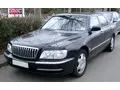
Hyundai Centennial 3.5 V6 (210 Hp)
Overall Rating
Hyundai Centennial:
The Hyundai Equus is a full-sized, front-engine, rear-wheel-drive luxury sedan manufactured and marketed by Hyundai Motor Company from 1999 to 2016. It was produced over two generations in a four-door, five passenger configuration. The nameplate derives from the Latin equus, meaning "horse. "
A second generation was released in 2009. As of August 2014, it was sold in South Korea, Russia, China, United States, Canada, Central America, and South America — as well as in the Middle East under the Hyundai Centennial nameplate....(Read more on Wikipedia)
Centennial Overview:
Hyundai Centennial (Centennial). With 314 Nm of torque, it offers ample pulling power. With a weight of 1940 kg, it falls in the mid‑range. Front‑wheel drive delivers efficiency and easy handling. The top speed reaches 180 km/h. A four-door car with a separate trunk, ideal for families and daily commuting. Seating for 5 makes it ideal for daily use.
The Hyundai Centennial generation was not officially tested by Euro NCAP. Safety features for its era included ABS, but modern safety standards and ratings are not applicable.
3.5 V6 (210 Hp) Verdict:

Performance Verdict
Adequate performance for a large luxury sedan of its time, offering smooth power delivery suitable for cruising, though not particularly sporty. Top speed limited to 180 km/h.
Fuel Economy
Fuel economy is a significant drawback, especially in urban settings, reflecting older V6 technology and the vehicle's substantial weight. Expect high running costs.
Pros and Cons:
Pros:
- • Spacious and comfortable interior for its class
- • Smooth and refined ride quality
- • Good value proposition compared to European rivals (new)
- • Reliable powertrains for the era
- • Generous standard features
Cons:
- • High fuel consumption across all engine options
- • Outdated styling and interior compared to later luxury sedans
- • Limited brand prestige outside of Asian markets
- • Lack of advanced safety features by modern standards
- • Soft suspension might not appeal to all drivers
Specifications:
| General: | |
|---|---|
| Brand: | Hyundai |
| Model: | Centennial |
| Generation: | Centennial |
| Modification (Engine): | 3.5 V6 (210 Hp) |
| Start of production: | 1999 |
| End of production: | 2008 |
| Powertrain Architecture: | Internal Combustion engine |
| Body type: | Sedan |
| Seats: | 5 |
| Doors: | 4 |
| Engine: | |
|---|---|
| Power: | 210 Hp @ 5500 rpm. |
| Power per litre: | 60.1 Hp/l |
| Torque: | 314 Nm @ 3500 rpm. |
| Engine Model/Code: | Sigma / G6CU |
| Engine displacement: | 3497 |
| Number of cylinders: | 6 |
| Engine configuration: | V-engine |
| Number of valves per cylinder: | 4 |
| Fuel injection system: | Multi-port manifold injection |
| Engine aspiration: | Naturally aspirated engine |
| Valvetrain: | DOHC |
| Engine layout: | Front, Transverse |
| Cylinder Bore: | 93 mm |
| Piston Stroke: | 85.8 mm |
| Compression ratio: | 10:1 |
| Performance: | |
|---|---|
| Fuel Type: | Petrol (Gasoline) |
| Fuel consumption (economy) - urban: | 16 l/100 km |
| Fuel consumption (economy) - extra urban: | 9 l/100 km |
| Maximum speed: | 180 km/h |
| Weight-to-power ratio: | 9.2 kg/Hp, 108.2 Hp/tonne |
| Weight-to-torque ratio: | 6.2 kg/Nm, 161.9 Nm/tonne |
| Space: | |
|---|---|
| Kerb Weight: | 1940 |
| Max. weight: | 2265 |
| Max load: | 325 |
| Trunk (boot) space - minimum: | 505 l |
| Fuel tank capacity: | 80 l |
| Size: | |
|---|---|
| Length: | 5065 mm |
| Width: | 1870 mm |
| Height: | 1465 mm |
| Wheelbase: | 2830 mm |
| Front track: | 1615 mm |
| Rear (Back) track: | 1615 mm |
| Powertrain: | |
|---|---|
| Drivetrain Architecture | The Internal combustion engine (ICE) drives the front wheels of the vehicle. |
| Drive wheel | Front wheel drive |
| Number of gears | 5 |
| Transmission type | Automatic |
| Front brakes | Ventilated discs |
| Rear brakes | Disc |
| Assisting systems | ABS (Anti-lock braking system) |
| Steering type | Steering rack and pinion |
| Power steering | Hydraulic Steering |
| Tires size | 225/60 R16 |
| Front suspension | Wishbone |
| Rear suspension | Coil spring |









Every driver has a story. What’s yours with the Hyundai Centennial?