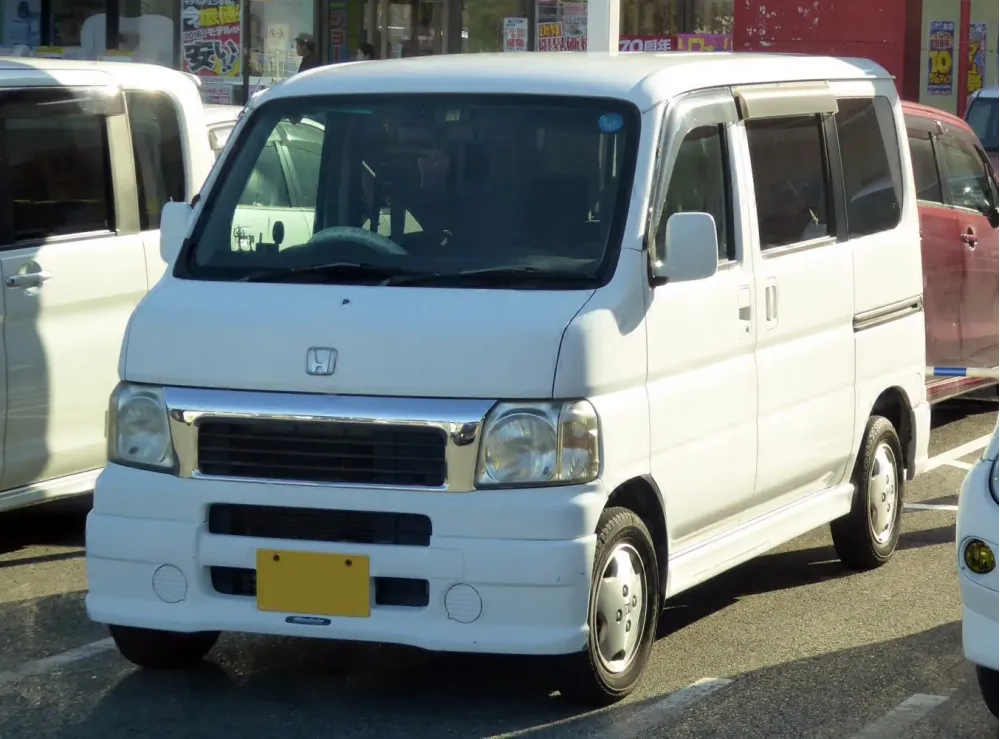
Click on image to view the full photo gallery
Honda Vamos HM1 0.7i 12V (46 Hp)
Overall Rating
Honda Vamos:
The Honda Vamos is a leisure vehicle originally produced by Japanese automaker Honda from 1970 to 1973, and reintroduced again as a trim level of the Honda Acty microvan starting in 1999. Its name, "Vamos", is Spanish and Portuguese for "let's go".
Technically speaking a kei truck, the Vamos leisure vehicle was based on the Honda TN360. Introduced in November 1970, the Vamos used a 354 cc 2-cylinder, mid mounted, air-cooled, overhead camshaft gasoline engine shared with the Honda TN360, N360, and the Z360. Its official name was actually "Vamos Honda"; meaning "let's go, Honda" in Spanish. The Vamos was a competitor at the time to the Suzuki Jimny and the Daihatsu Fellow buggy. Honda had hoped the popularity of the Honda Dax minibike with its off-road image would be associated with the Vamos, and had planned on a monthly production rate of 2,000 units. Because of the installation of the spare tire on the front of the vehicle and the sound from the air-cooled engine, it had an appearance somewhat similar to the Volkswagen Type 2. There are no doors; instead, it offered swing-out guard rails to keep the occupants secure. The Vamos' open cabin design and lack of four-wheel drive combined to make it a slow seller....(Read more on Wikipedia)
HM1 Overview:
Honda Vamos (HM1). With 59 Nm of torque, it offers ample pulling power. It has moderate fuel consumption (~10 l/100km). Weighing only 950 kg, it’s quite light. Rear‑wheel drive offers dynamic handling and sporty feedback. The top speed reaches 130 km/h. A spacious vehicle designed to transport passengers comfortably, often with sliding doors. Seating for 4 makes it ideal for daily use.
The Honda Vamos HM1, being a kei car primarily for the Japanese domestic market, was not subjected to Euro NCAP testing. Its safety features are typical for its class and era, focusing on basic occupant protection rather than advanced crash structures.
0.7i 12V (46 Hp) Verdict:

Performance Verdict
Provides adequate, albeit modest, performance for city driving and light loads. Lacks the punch of the turbocharged variant, requiring more effort for acceleration, especially with passengers or on inclines.
Fuel Economy
Likely offers slightly better fuel economy than the turbo variant under light loads due to its naturally aspirated nature, making it a cost-effective option for urban commutes.
Pros and Cons:
Pros:
- • Extremely compact and maneuverable for urban environments
- • Practical and versatile interior space for its size
- • Good fuel economy, especially the naturally aspirated variant
- • Available 4WD option enhances utility and all-weather capability
- • Honda's reputation for reliability and low maintenance
Cons:
- • Limited power, especially the non-turbo engine, struggles on highways
- • Basic interior and ride comfort, typical for a kei van
- • Older safety standards compared to modern vehicles
- • Small fuel tank capacity limits range
- • High-speed stability can be affected by its tall, narrow design
Specifications:
| General: | |
|---|---|
| Brand: | Honda |
| Model: | Vamos |
| Generation: | HM1 |
| Modification (Engine): | 0.7i 12V (46 Hp) |
| Start of production: | 1999 |
| End of production: | 2018 |
| Powertrain Architecture: | Internal Combustion engine |
| Body type: | Minivan |
| Seats: | 4 |
| Doors: | 4 |
| Engine: | |
|---|---|
| Power: | 46 Hp @ 5500 rpm. |
| Power per litre: | 70.1 Hp/l |
| Torque: | 59 Nm @ 5000 rpm. |
| Engine displacement: | 656 |
| Number of cylinders: | 3 |
| Engine configuration: | Inline |
| Number of valves per cylinder: | 4 |
| Fuel injection system: | Multi-port manifold injection |
| Engine aspiration: | Naturally aspirated engine |
| Valvetrain: | OHC |
| Engine layout: | Middle, Transverse |
| Cylinder Bore: | 66 mm mm |
| Piston Stroke: | 64 mm mm |
| Compression ratio: | 10:1 |
| Performance: | |
|---|---|
| Fuel Type: | Petrol (Gasoline) |
| Fuel consumption (economy) - urban: | 10 l/100 km |
| Fuel consumption (economy) - extra urban: | 6 l/100 km |
| Maximum speed: | 130 km/h |
| Weight-to-power ratio: | 20.7 kg/Hp, 48.4 Hp/tonne |
| Weight-to-torque ratio: | 16.1 kg/Nm, 62.1 Nm/tonne |
| Space: | |
|---|---|
| Kerb Weight: | 950 |
| Max. weight: | 1170 |
| Max load: | 220 |
| Fuel tank capacity: | 37 l |
| Size: | |
|---|---|
| Length: | 3395 mm mm |
| Width: | 1475 mm mm |
| Height: | 1775 mm mm |
| Wheelbase: | 2420 mm mm |
| Front track: | 1295 mm |
| Rear (Back) track: | 1310 mm |
| Minimum turning circle (turning diameter): | 9 m |
| Powertrain: | |
|---|---|
| Drivetrain Architecture | The Internal combustion engine (ICE) drives the rear wheels of the vehicle. |
| Drive wheel | Rear wheel drive |
| Number of gears | 5 |
| Transmission type | Manual |
| Front brakes | Disc |
| Rear brakes | Drum |
| Assisting systems | ABS (Anti-lock braking system) |
| Steering type | Steering rack and pinion |
| Power steering | Hydraulic Steering |
| Tires size | 145/80 R12 S |
| Front suspension | Wishbone |
| Rear suspension | Suspension De-Dion |


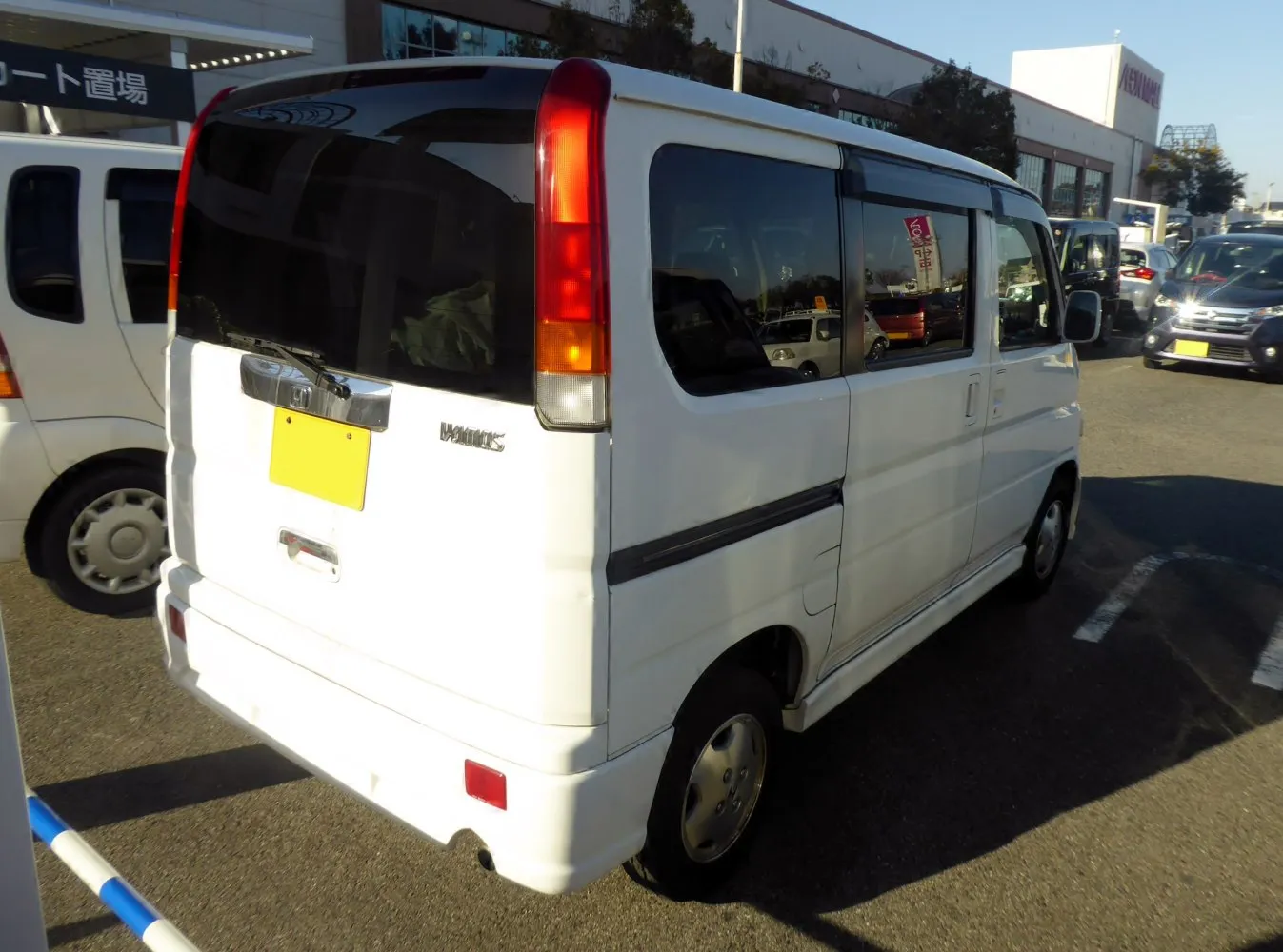
Fuel, speed, and comfort: How does the Honda Vamos rank in your book?