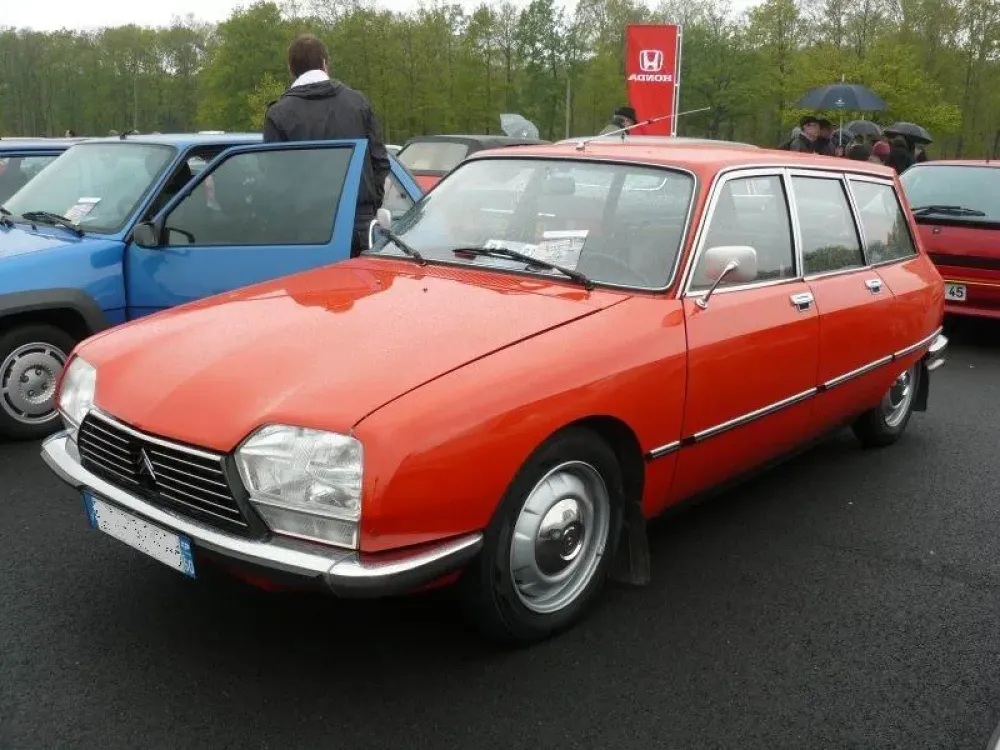
Click on image to view the full photo gallery
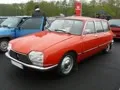
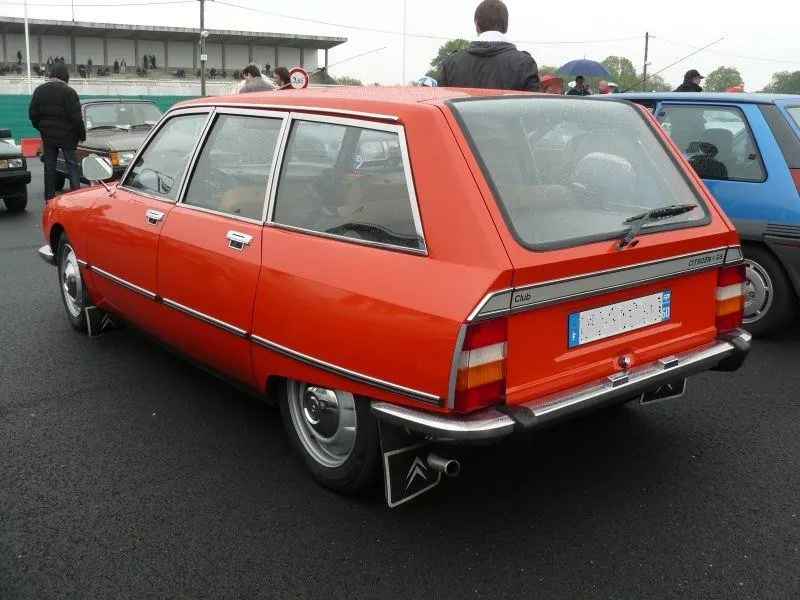
Citroen GS Break 1.1 (56 Hp)
Overall Rating
Citroen GS:
The Citroën GS is a small family car manufactured and marketed by Citroën from 1970 to 1986 across two series. From 1970 to 1979 it was built as a fastback four-door saloon car and as a five-door estate car. A revised version, the GSA, was produced from late 1979 until 1986 in five-door hatchback or estate body styles – the latter after a facelift. Combined production reached approximately 2. 5 million. It has a front-engine, front-wheel-drive layout and has seating for five passengers.
Noted for its aerodynamic body shape with a drag coefficient of 0. 318, fully independent hydro-pneumatic brakes and self-levelling suspension, and air-cooled flat-four engine, the GS was styled by Robert Opron, with a low nose, a two-box silhouette, semi-enclosed rear wheels and a sharply vertical Kamm-tail....(Read more on Wikipedia)
Break Overview:
Citroen GS (Break). With 80 Nm of torque, it offers ample pulling power. Weighing only 935 kg, it’s quite light. Front‑wheel drive delivers efficiency and easy handling. The top speed reaches 146 km/h. A car with an extended rear cargo area, combining passenger comfort with increased storage. Seating for 5 makes it ideal for daily use.
The Citroen GS Break was produced before the establishment of Euro NCAP (1997), and therefore, no official crash test ratings are available. Safety features are rudimentary by modern standards.
1.1 (56 Hp) Verdict:

Performance Verdict
Modest performance, best suited for city driving and relaxed rural journeys where high speeds are not a priority.
Fuel Economy
Likely offers slightly better economy than the 1.2L, making it a practical and more economical choice for daily commutes.
Pros and Cons:
Pros:
- • Exceptional ride comfort due to hydropneumatic suspension
- • Spacious and practical station wagon body
- • Distinctive and aerodynamic design for its time
- • Good handling characteristics for a family car
- • Unique Boxer engine configuration
Cons:
- • Modest engine performance across the lineup
- • Complexity and potential maintenance costs of the hydropneumatic system
- • Susceptibility to rust in older models
- • Limited parts availability for some components
- • Lack of modern safety features (common for its era)
Specifications:
Specifications are compared to those of the previous generation(GS: 1975 - 1979).
| General: | |
|---|---|
| Brand: | Citroen |
| Model: | GS |
| Generation: | Break |
| Modification (Engine): | 1.1 (56 Hp) |
| Start of production: | 1977 |
| End of production: | 1979 |
| Powertrain Architecture: | Internal Combustion engine |
| Body type: | Station wagon (estate) |
| Seats: | 5 |
| Doors: | 5 |
| Engine: | |
|---|---|
| Power: | 56 Hp @ 5750 rpm. Same horsepower |
| Power per litre: | 49.6 Hp/l [Same length.] |
| Torque: | 80 Nm @ 3500 rpm. |
| Engine Model/Code: | G11/631 More details about the engine G11/631 |
| Engine displacement: | 1129 |
| Number of cylinders: | 4 |
| Engine configuration: | Boxer |
| Fuel injection system: | Carburettor |
| Engine aspiration: | Naturally aspirated engine |
| Engine oil capacity: | 3.5 l |
| Cylinder Bore: | 74 mm mm |
| Piston Stroke: | 65.6 mm mm |
| Compression ratio: | 9:1 |
| Performance: | |
|---|---|
| Fuel Type: | Petrol (Gasoline) |
| Maximum speed: | 146 km/h |
| Weight-to-power ratio: | 16.7 kg/Hp, 59.9 Hp/tonne |
| Weight-to-torque ratio: | 11.7 kg/Nm, 85.6 Nm/tonne |
| Space: | |
|---|---|
| Kerb Weight: | 935 |
| Max. weight: | 1340 |
| Max. roof load: | 80 kg |
| Max load: | 405 |
| Trunk (boot) space - maximum: | 1500 l |
| Trunk (boot) space - minimum: | 645 l |
| Permitted trailer load with brakes (12%): | 800 kg |
| Fuel tank capacity: | 43 l |
| Permitted trailer load without brakes: | 460 kg |
| Size: | |
|---|---|
| Length: | 4120 mm mm [Same length.] |
| Width: | 1608 mm mm [Same width.] |
| Height: | 1349 mm mm [Same height.] |
| Wheelbase: | 2550 mm mm [Same wheelbase.] |
| Front track: | 1378 mm |
| Rear (Back) track: | 1328 mm |
| Front overhang: | 818 mm |
| Rear overhang: | 752 mm |
| Minimum turning circle (turning diameter): | 9.7 m [above average] |
| Powertrain: | |
|---|---|
| Drivetrain Architecture | The Internal combustion engine (ICE) drives the front wheels of the vehicle. |
| Drive wheel | Front wheel drive |
| Number of gears | 4 |
| Transmission type | Manual |
| Front brakes | Disc [above average] |
| Rear brakes | Disc [above average] |
| Steering type | Steering rack and pinion |
| Front suspension | Hydro-pneumatic element, Double wishbone |
| Rear suspension | Hydro-pneumatic element, Trailing arm |






Show off your Citroen GS knowledge – drop a review below!