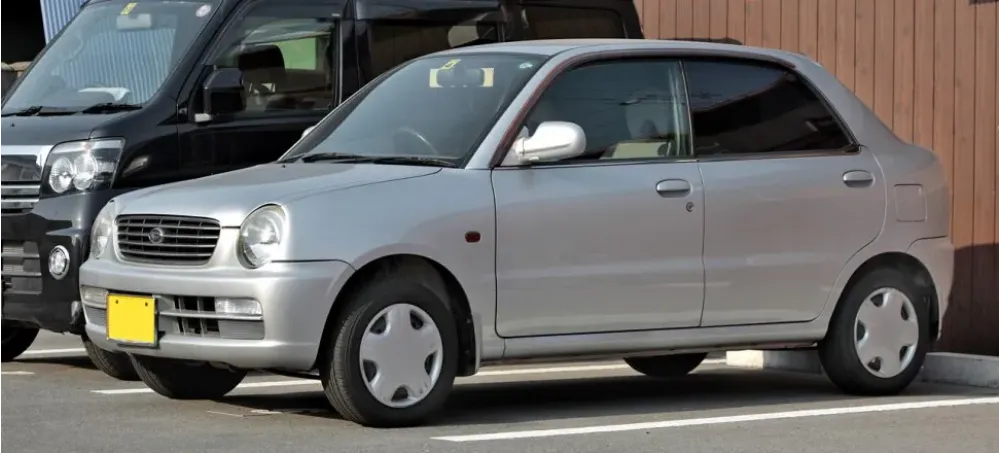
Click on image to view the full photo gallery
Daihatsu Opti L8 0.7 i (58 Hp)
Overall Rating
Daihatsu Opti:
The Daihatsu Opti is a kei car produced by Japanese automaker Daihatsu from 1992 to 2002, which replaced the Leeza. It was available with a 658 cc petrol engine and either front- or four-wheel drive, and marketed as a more upmarket variant of the Mira. The name "Opti" refers to both "optimistic" and "optimum".
The first-generation Opti was launched in Japan in January 1992, after having been previewed at the 1991 Tokyo Motor Show as the "X-409". The Opti was built on the L200 series Mira chassis. The round appearance was conceived around an "ultra lovely" theme and was aimed at female buyers. Specifications were also higher than usual in the kei class, with ample sound insulation and additional rust protection. All models originally came with the EF-EL engine, a fuel-injected, SOHC, 12-valve three-cylinder engine with 55 PS. It was available as a three-door hatchback with an electrically operated canvas top was also available. A 4WD model was also available. In September 1992, the Ox, Ax, and Aℓ-4 trim levels were joined by the low-priced Ad, a sportier Ad-S and the luxurious Ad-I which also has a driver's side airbag. The Ad model got a two-valve version of the EF engine with 42 PS....(Read more on Wikipedia)
L8 Overview:
Daihatsu Opti (L8). With 64 Nm of torque, it offers ample pulling power. Weighing only 760 kg, it’s quite light. Front‑wheel drive delivers efficiency and easy handling. A compact car with a rear door that swings upward to provide access to the cargo area. Seating for 4 makes it ideal for daily use.
The Daihatsu Opti L8, being a Kei car primarily for the Japanese domestic market from the late 90s, was not subjected to Euro NCAP testing. Safety features are basic for its era, typical of compact city cars of that period.
0.7 i (58 Hp) Verdict:

Performance Verdict
The 0.7i (58 Hp) engine provides adequate performance for city driving, thanks to the Opti's light kerb weight. It's nimble and responsive in urban traffic, though highway acceleration and sustained speeds will be modest.
Fuel Economy
With a small 659cc naturally aspirated engine, this trim is designed for excellent fuel economy, making it very cost-effective for daily commuting and short trips.
Pros and Cons:
Pros:
- • Excellent fuel efficiency for city driving
- • Extremely compact and easy to maneuver in tight spaces
- • Reliable and simple mechanicals (typical Daihatsu)
- • Low running costs and maintenance
- • Good value for money as a used city car
Cons:
- • Limited power for highway speeds or steep inclines
- • Basic interior comfort and features
- • Minimal safety features by modern standards
- • Small luggage capacity and rear passenger space
- • Can feel unrefined at higher RPMs
Specifications:
Specifications are compared to those of the previous generation(L3: 1992 - 1998).
| General: | |
|---|---|
| Brand: | Daihatsu |
| Model: | Opti |
| Generation: | L8 |
| Modification (Engine): | 0.7 i (58 Hp) |
| Start of production: | 1998 |
| End of production: | 2002 |
| Powertrain Architecture: | Internal Combustion engine |
| Body type: | Hatchback |
| Seats: | 4 |
| Doors: | 4 |
| Engine: | |
|---|---|
| Power: | 58 Hp @ 7600 rpm. |
| Power per litre: | 88 Hp/l |
| Torque: | 64 Nm @ 4000 rpm. |
| Engine displacement: | 659 |
| Number of cylinders: | 3 |
| Engine configuration: | Inline |
| Number of valves per cylinder: | 4 |
| Fuel injection system: | Multi-port manifold injection |
| Engine aspiration: | Naturally aspirated engine |
| Engine layout: | Front, Transverse |
| Cylinder Bore: | 68 mm mm |
| Piston Stroke: | 60.3 mm mm |
| Compression ratio: | 10.5:1 |
| Performance: | |
|---|---|
| Fuel Type: | Petrol (Gasoline) |
| Weight-to-power ratio: | 13.1 kg/Hp, 76.3 Hp/tonne |
| Weight-to-torque ratio: | 11.9 kg/Nm, 84.2 Nm/tonne |
| Space: | |
|---|---|
| Kerb Weight: | 760 |
| Fuel tank capacity: | 40 l |
| Size: | |
|---|---|
| Length: | 3395 mm mm [100mm more] |
| Width: | 1475 mm mm [80mm more] |
| Height: | 1405 mm mm [10mm more] |
| Wheelbase: | 2360 mm mm [80mm more] |
| Front track: | 1300 mm |
| Rear (Back) track: | 1280 mm |
| Powertrain: | |
|---|---|
| Drivetrain Architecture | The Internal combustion engine (ICE) drives the front wheels of the vehicle. |
| Drive wheel | Front wheel drive |
| Front brakes | Disc [bad for performance and cooling.] |
| Rear brakes | Drum [bad for performance and cooling.] |
| Assisting systems | ABS (Anti-lock braking system) |
| Tires size | 155/65 R13 |
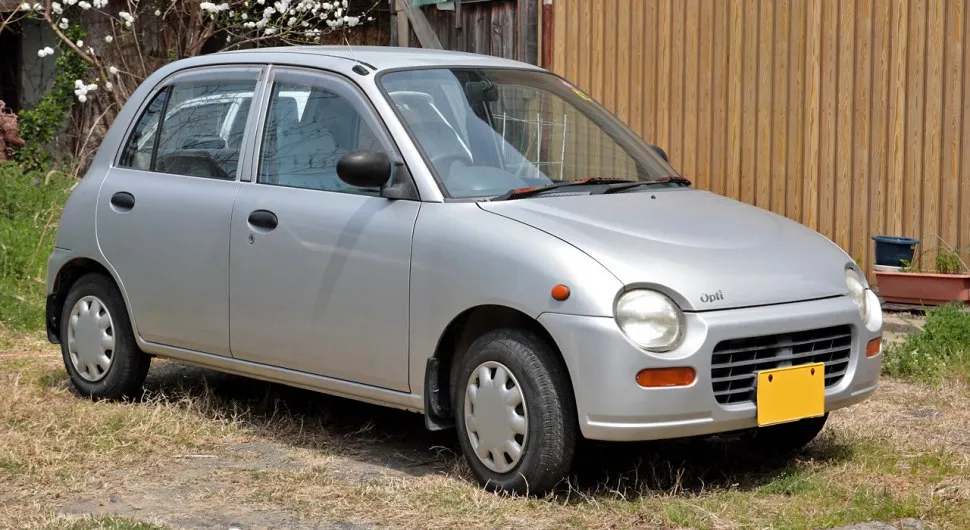




How many miles have you covered in your Daihatsu Opti? Share your journey!