
Click on image to view the full photo gallery
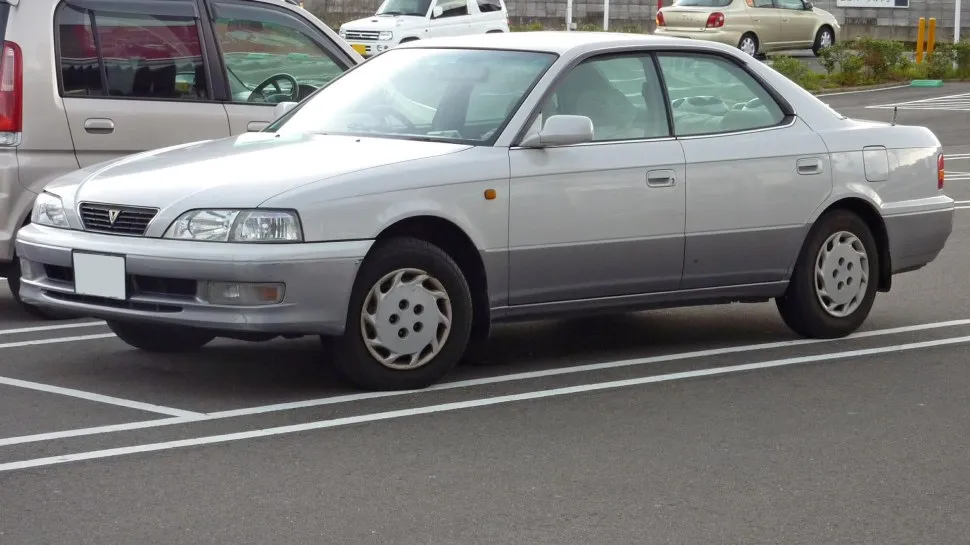
Toyota Vista V50 2.0 i 16V 4 WD (135 Hp)
Overall Rating
Toyota Vista:
The Toyota Camry is an automobile sold internationally by the Japanese auto manufacturer Toyota since 1982, spanning multiple generations. Originally compact in size , the Camry has grown since the 1990s to fit the mid-size classification —although the two widths co-existed in that decade. Since the release of the wide-bodied versions, Camry has been extolled by Toyota as the firm's second "world car" after the Corolla. As of 2022, the Camry is positioned above the Corolla and below the Avalon or Crown in several markets....(Read more on Wikipedia)
V50 Overview:
Toyota Vista (V50). With 181 Nm of torque, it offers ample pulling power. It has moderate fuel consumption (~12 l/100km). With a weight of 1390 kg, it falls in the mid‑range. All‑wheel drive provides excellent grip, ideal for off‑road use. The top speed reaches 200 km/h. A four-door car with a separate trunk, ideal for families and daily commuting. Seating for 5 makes it ideal for daily use.
The Toyota Vista V50 was primarily a Japanese domestic market vehicle and was not officially tested by Euro NCAP. Safety features for its era were standard, but it would likely not meet modern safety standards.
2.0 i 16V 4 WD (135 Hp) Verdict:

Performance Verdict
Offers adequate power for daily driving and highway cruising, especially with the added traction of 4WD. Acceleration is respectable for a family sedan of its era.
Fuel Economy
Fuel economy is average for a 2.0L 4WD sedan from the late 90s, with urban consumption around 12 L/100km and extra-urban at 7 L/100km.
Pros and Cons:
Pros:
- • Excellent reliability and durability
- • Comfortable and spacious interior
- • Good fuel economy for its class (especially 1.8L)
- • Smooth ride quality
- • Low maintenance costs
Cons:
- • Uninspired driving dynamics
- • Dated interior design by modern standards
- • Limited availability outside Japan
- • Lack of advanced safety features compared to newer cars
- • Road noise at higher speeds
Specifications:
Specifications are compared to those of the previous generation(V40: 1995 - 1998).
| General: | |
|---|---|
| Brand: | Toyota |
| Model: | Vista |
| Generation: | V50 |
| Modification (Engine): | 2.0 i 16V 4 WD (135 Hp) |
| Start of production: | 1998 |
| End of production: | 2003 |
| Powertrain Architecture: | Internal Combustion engine |
| Body type: | Sedan |
| Seats: | 5 |
| Doors: | 4 |
| Engine: | |
|---|---|
| Power: | 135 Hp @ 6000 rpm. |
| Power per litre: | 67.6 Hp/l |
| Torque: | 181 Nm @ 4000 rpm. |
| Engine displacement: | 1998 |
| Number of cylinders: | 4 |
| Engine configuration: | Inline |
| Number of valves per cylinder: | 4 |
| Fuel injection system: | Multi-port manifold injection |
| Engine aspiration: | Naturally aspirated engine |
| Valvetrain: | DOHC |
| Engine layout: | Front, Transverse |
| Cylinder Bore: | 86 mm mm |
| Piston Stroke: | 86 mm mm |
| Compression ratio: | 10:1 |
| Performance: | |
|---|---|
| Fuel Type: | Petrol (Gasoline) |
| Fuel consumption (economy) - urban: | 12 l/100 km |
| Fuel consumption (economy) - extra urban: | 7 l/100 km |
| Maximum speed: | 200 km/h |
| Weight-to-power ratio: | 10.3 kg/Hp, 97.1 Hp/tonne |
| Weight-to-torque ratio: | 7.7 kg/Nm, 130.2 Nm/tonne |
| Space: | |
|---|---|
| Kerb Weight: | 1390 |
| Fuel tank capacity: | 60 l |
| Size: | |
|---|---|
| Length: | 4670 mm mm [45mm more] |
| Width: | 1695 mm mm [Same width.] |
| Height: | 1510 mm mm [100mm more] |
| Wheelbase: | 2700 mm mm [50mm more] |
| Front track: | 1475 mm |
| Rear (Back) track: | 1460 mm |
| Powertrain: | |
|---|---|
| Drive wheel | All wheel drive (4x4) |
| Number of gears | 4 |
| Transmission type | Automatic |
| Front brakes | Ventilated discs [Best for performance and cooling.] |
| Rear brakes | Disc |
| Assisting systems | ABS (Anti-lock braking system) |
| Steering type | Steering rack and pinion |
| Power steering | Hydraulic Steering |
| Tires size | 185/70 R14 |
| Front suspension | Spring Strut |
| Rear suspension | Coil spring |







Every driver has a story. What’s yours with the Toyota Vista?