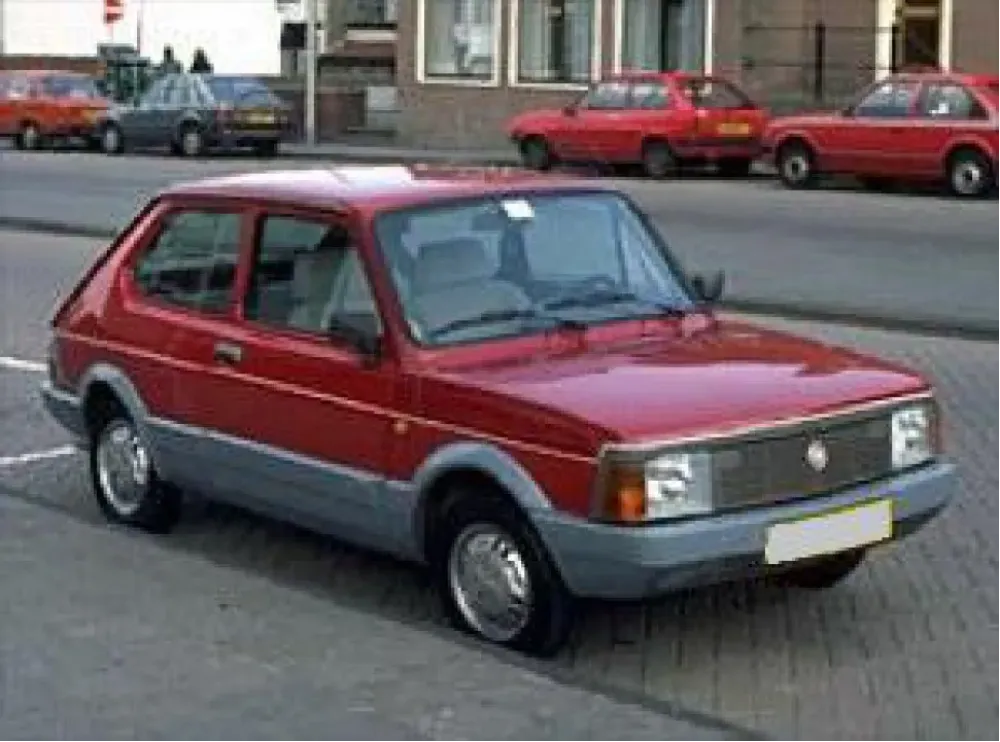
Click on image to view the full photo gallery
Seat Fura 025A 0.9 (40 Hp)
Overall Rating
Seat Fura:
The SEAT Fura is a supermini car which was produced by Spanish car manufacturer SEAT between 1981 and 1986, and based on the Fiat 127, which had been built by the firm since April 1972.
In November 1981, the last evolution of the SEAT 127 was presented as "SEAT 127 Fura". The 127 Fura was nearly identical to the Italian Fiat 127 series 3. Once the license to the 127 had expired, SEAT was forced to develop a new version which was introduced in end of 1981 for the model year of 1982. The model lost the "127" nomenclature, officially being renamed simply as "SEAT Fura". It was available in three and five door hatchback body styles. Sales commenced in January 1982....(Read more on Wikipedia)
025A Overview:
Seat Fura (025A). With 63 Nm of torque, it offers ample pulling power. It has moderate fuel consumption (~8.5 l/100km). Weighing only 720 kg, it’s quite light. Front‑wheel drive delivers efficiency and easy handling. Acceleration is relatively slow (0–100 km/h in 19.6 s). The top speed reaches 130 km/h. A compact car with a rear door that swings upward to provide access to the cargo area. Seating for 5 makes it ideal for daily use.
The Seat Fura (025A) was produced before the establishment of Euro NCAP (1997) and therefore was not tested. Safety features are rudimentary by modern standards, lacking airbags, ABS, or advanced driver-assistance systems.
0.9 (40 Hp) Verdict:

Performance Verdict
Extremely modest performance, even weaker than the 43 Hp variant, making it suitable only for very light, strictly urban driving.
Fuel Economy
Similar to the 43 Hp version, offering basic economy for minimal use. Not designed for long journeys or spirited driving.
Pros and Cons:
Pros:
- • Compact size and easy to maneuver in urban environments
- • Simple, robust mechanicals (Fiat-derived) for easier maintenance
- • Affordable to purchase and run as a classic car
- • Classic supermini charm and distinctive styling
- • The 1.4 (75 Hp) offers surprising performance for its class and era
Cons:
- • Very basic safety features, typical of its era
- • Limited comfort and refinement, especially on longer journeys
- • Prone to rust, like many cars of the period
- • Underpowered base engines struggle outside of city limits
- • Interior quality and features are rudimentary
Specifications:
Specifications are compared to those of the previous generation(025A: 1981 - 1986).
| General: | |
|---|---|
| Brand: | Seat |
| Model: | Fura |
| Generation: | 025A |
| Modification (Engine): | 0.9 (40 Hp) |
| Start of production: | March, 1984 |
| End of production: | June, 1986 |
| Powertrain Architecture: | Internal Combustion engine |
| Body type: | Hatchback |
| Seats: | 5 |
| Doors: | 3 |
| Engine: | |
|---|---|
| Power: | 40 Hp @ 5800 rpm. |
| Power per litre: | 44.3 Hp/l [worst than previous generation] |
| Torque: | 63 Nm @ 3000 rpm. |
| Engine displacement: | 903 |
| Number of cylinders: | 4 |
| Engine configuration: | Inline |
| Number of valves per cylinder: | 2 |
| Fuel injection system: | Carburettor |
| Engine aspiration: | Naturally aspirated engine |
| Valvetrain: | OHV |
| Engine layout: | Front, Transverse |
| Cylinder Bore: | 65 mm mm |
| Piston Stroke: | 68 mm mm |
| Compression ratio: | 7.8:1 |
| Performance: | |
|---|---|
| Fuel Type: | Petrol (Gasoline) |
| Fuel consumption (economy) - urban: | 8.5 l/100 km |
| Fuel consumption (economy) - extra urban: | 6.1 l/100 km |
| Acceleration 0 - 100 km/h: | 19.6 sec |
| Acceleration 0 - 62 mph: | 19.6 sec |
| Maximum speed: | 130 km/h |
| Weight-to-power ratio: | 18 kg/Hp, 55.6 Hp/tonne |
| Weight-to-torque ratio: | 11.4 kg/Nm, 87.5 Nm/tonne |
| Acceleration 0 - 60 mph: | 18.6 sec |
| Space: | |
|---|---|
| Kerb Weight: | 720 |
| Max. weight: | 1130 |
| Max load: | 410 |
| Trunk (boot) space - maximum: | 1070 l |
| Trunk (boot) space - minimum: | 365 l |
| Permitted trailer load with brakes (12%): | 780 kg |
| Fuel tank capacity: | 30 l |
| Permitted trailer load without brakes: | 370 kg |
| Size: | |
|---|---|
| Length: | 3711 mm mm |
| Width: | 1536 mm mm |
| Height: | 1370 mm mm |
| Wheelbase: | 2225 mm mm |
| Minimum turning circle (turning diameter): | 9.6 m [above average] |
| Powertrain: | |
|---|---|
| Drivetrain Architecture | The Internal combustion engine (ICE) drives the front wheels of the vehicle. |
| Drive wheel | Front wheel drive |
| Number of gears | 4 |
| Transmission type | Manual |
| Front brakes | Disc [bad for performance and cooling.] |
| Rear brakes | Drum [bad for performance and cooling.] |
| Steering type | Steering rack and pinion |
| Wheel rims size | 4.5J x 13 |
| Front suspension | Independent type McPherson |
| Rear suspension | Independent coil spring, Leaf spring |


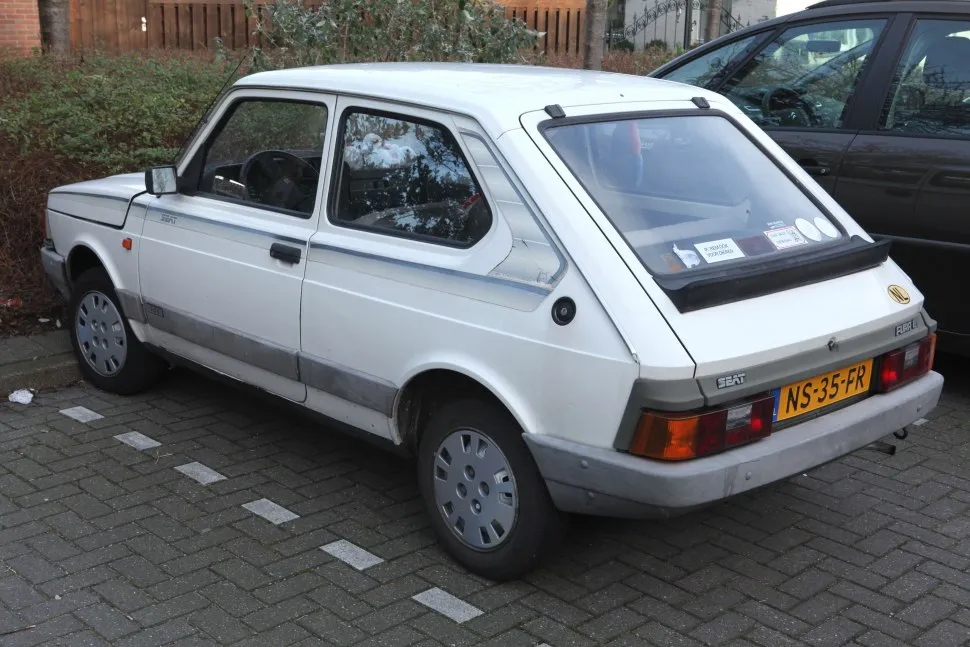
What’s the best feature of the Seat Fura? Tell us in the comments!