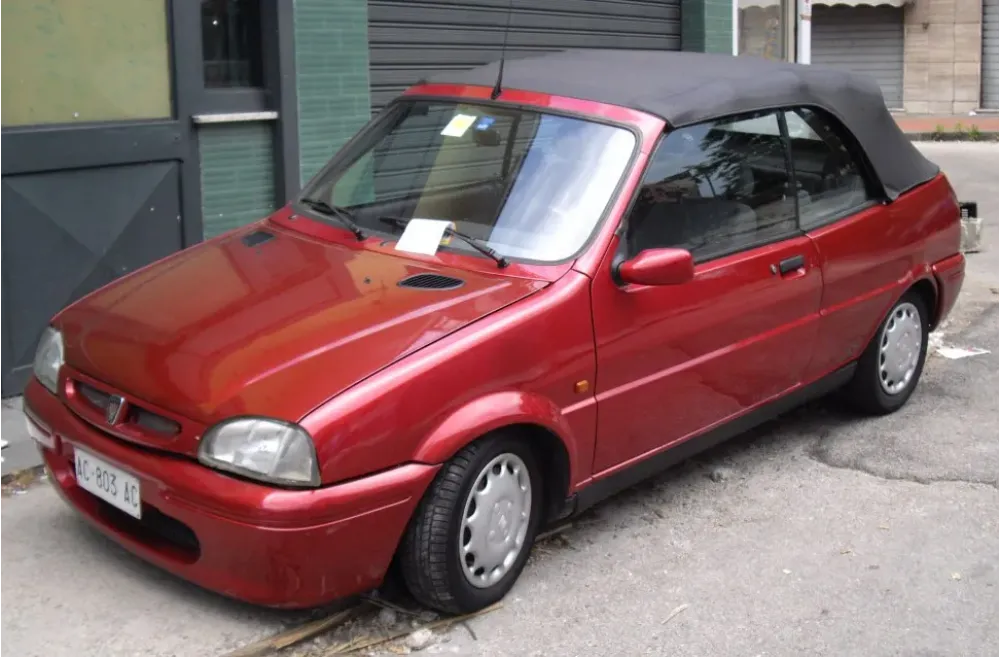
Click on image to view the full photo gallery
Rover 100 Cabrio (XP) 114 (75 Hp)
Overall Rating
Rover 100:
The name Rover 100 may refer to one of two different British motor vehicles:....(Read more on Wikipedia)
Cabrio (XP) Overview:
Rover 100 (Cabrio (XP)). With 117 Nm of torque, it offers ample pulling power. Weighing only 890 kg, it’s quite light. Front‑wheel drive delivers efficiency and easy handling. Acceleration is relatively slow (0–100 km/h in 12.1 s). The top speed reaches 160 km/h. A convertible car with a retractable roof, offering open-air driving experiences. Seating for 4 makes it ideal for daily use.
114 (75 Hp) Verdict:

Performance Verdict
The 1.4L 75 Hp engine offers a noticeable improvement in performance over the 1.1L, making it more capable for mixed driving and occasional highway use. Acceleration is adequate for its class.
Fuel Economy
With a stated 6.6 l/100 km, this engine strikes a good balance between performance and fuel efficiency, making it a practical choice for daily driving.
Pros and Cons:
Pros:
- • Affordable open-top motoring
- • Lightweight and agile handling (especially 102 Hp)
- • Simple, easy-to-maintain mechanics
- • Compact size for city driving
Cons:
- • Very poor Euro NCAP safety rating
- • Infamous K-series head gasket issues
- • Basic interior and build quality
- • Limited luggage space with the roof down
Specifications:
Specifications are compared to those of the previous generation(METRO) (XP: 1991 - 1998).
| General: | |
|---|---|
| Brand: | Rover |
| Model: | 100 |
| Generation: | Cabrio (XP) |
| Modification (Engine): | 114 (75 Hp) |
| Start of production: | 1994 |
| End of production: | 2000 |
| Powertrain Architecture: | Internal Combustion engine |
| Body type: | Cabriolet |
| Seats: | 4 |
| Doors: | 2 |
| Engine: | |
|---|---|
| Power: | 75 Hp @ 5500 rpm. Same horsepower |
| Power per litre: | 53.7 Hp/l [Same length.] |
| Torque: | 117 Nm @ 4000 rpm. |
| Engine Model/Code: | K8 More details about the engine K8 |
| Engine displacement: | 1396 |
| Number of cylinders: | 4 |
| Engine configuration: | Inline |
| Number of valves per cylinder: | 2 |
| Fuel injection system: | Single-point injection |
| Engine aspiration: | Naturally aspirated engine |
| Valvetrain: | OHC |
| Engine oil capacity: | 4.5 l |
| Coolant: | 4.5 l |
| Engine layout: | Front, Transverse |
| Cylinder Bore: | 75 mm mm |
| Piston Stroke: | 79 mm mm |
| Compression ratio: | 9.7:1 |
| Performance: | |
|---|---|
| Fuel Type: | Petrol (Gasoline) |
| Fuel consumption (economy) - combined: | 6.6 l/100 km |
| Acceleration 0 - 100 km/h: | 12.1 sec |
| Acceleration 0 - 62 mph: | 12.1 sec |
| Maximum speed: | 160 km/h |
| Weight-to-power ratio: | 11.9 kg/Hp, 84.3 Hp/tonne |
| Weight-to-torque ratio: | 7.6 kg/Nm, 131.5 Nm/tonne |
| Acceleration 0 - 60 mph: | 11.5 sec |
| Space: | |
|---|---|
| Kerb Weight: | 890 |
| Max. weight: | 1310 |
| Max load: | 420 |
| Trunk (boot) space - minimum: | 222 l |
| Fuel tank capacity: | 35 l |
| Size: | |
|---|---|
| Length: | 3521 mm mm [Same length.] |
| Width: | 1550 mm mm [Same width.] |
| Height: | 1395 mm mm [18mm more] |
| Wheelbase: | 2270 mm mm [1mm more] |
| Front track: | 1340 mm |
| Rear (Back) track: | 1294 mm |
| Powertrain: | |
|---|---|
| Drivetrain Architecture | The Internal combustion engine (ICE) drives the front wheels of the vehicle. |
| Drive wheel | Front wheel drive |
| Number of gears | 5 |
| Transmission type | Manual |
| Front brakes | Disc [bad for performance and cooling.] |
| Rear brakes | Drum [bad for performance and cooling.] |
| Assisting systems | ABS (Anti-lock braking system) |
| Steering type | Steering rack and pinion |
| Tires size | 185/55 R13 S |
| Front suspension | Wishbone |
| Rear suspension | Trailing arm |
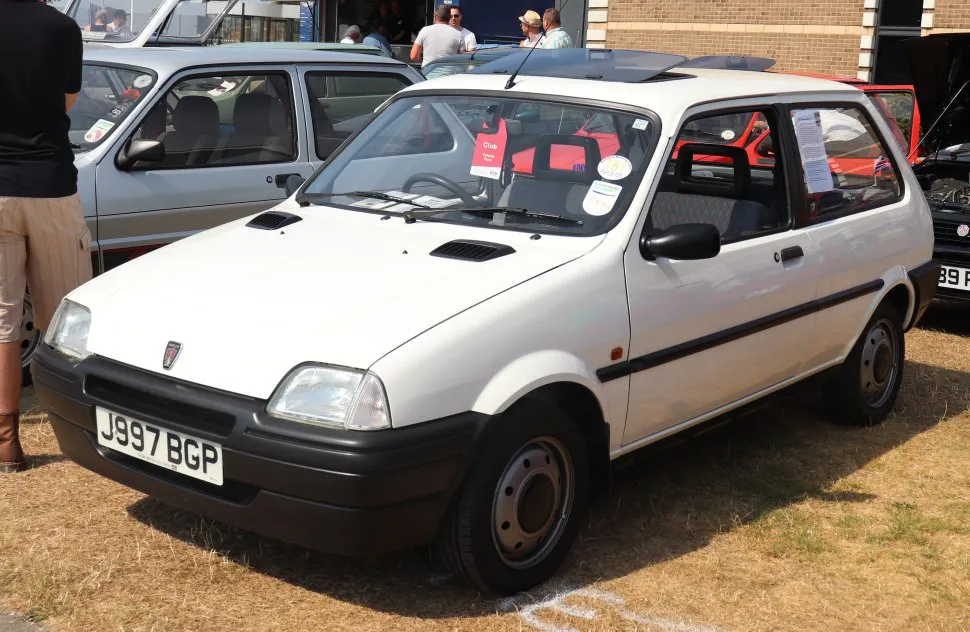






What’s the best feature of the Rover 100? Tell us in the comments!