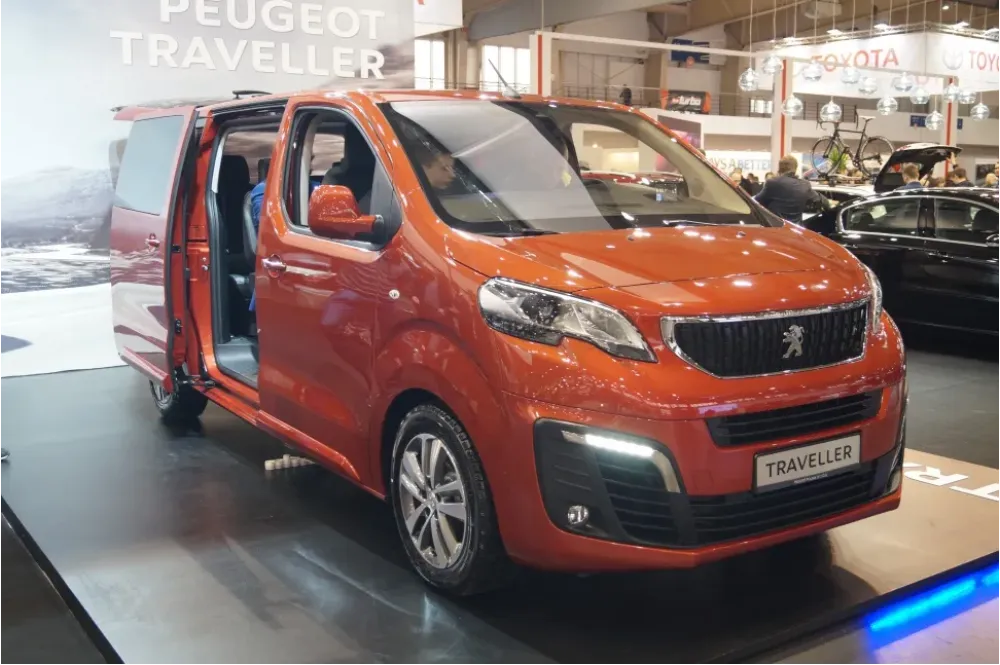
Click on image to view the full photo gallery
Peugeot Traveller L2 1.5 BlueHDi (102 Hp)
Overall Rating
Peugeot Traveller:
The Citroën Jumpy is a light commercial van jointly developed by FCA Italy and PSA Group , and previously manufactured by Sevel, a joint venture between the two companies formed in 1994. The Jumpy is also sold as the Peugeot Expert, Fiat Scudo, Opel Vivaro, and Toyota ProAce.
All three models were facelifted in March 2004 before being replaced by new, second-generation models in 2007. The redesigned models again shared the same design and engineering, with subtle trim changes between each brand. The second generation received a small facelift in February 2012 and from July 2013, Toyota began sales of a rebadged version called the Toyota Proace....(Read more on Wikipedia)
L2 Overview:
Peugeot Traveller (L2). With 270 Nm of torque, it offers ample pulling power. It boasts low fuel consumption (~5.9 l/100km). With a weight of 1585 kg, it falls in the mid‑range. Front‑wheel drive delivers efficiency and easy handling. The top speed reaches 157 km/h. A spacious vehicle designed to transport passengers comfortably, often with sliding doors. Seating for 5 makes it ideal for daily use.
The Peugeot Traveller (tested as a platform twin with Citroën Spacetourer/Toyota Proace Verso) achieved an excellent 5-star Euro NCAP rating, demonstrating strong occupant protection.
1.5 BlueHDi (102 Hp) Verdict:

Performance Verdict
A modest improvement over the 1.6L 95hp, but still on the lower end for a large minivan. Best suited for unhurried driving.
Fuel Economy
Very good fuel efficiency at 5.2 l/100 km, reflecting its modern design and smaller displacement.
Pros and Cons:
Pros:
- • Extremely spacious and versatile interior with flexible seating options
- • Comfortable ride quality, especially on longer journeys
- • Wide range of efficient diesel engines, including powerful 2.0L options
- • Availability of all-electric e-Traveller variants for urban and eco-conscious buyers
- • Strong Euro NCAP safety rating (5 stars)
- • Practical for both large families and business shuttle services
Cons:
- • Entry-level 1.5L and 1.6L diesel engines can feel underpowered for a vehicle of this size
- • Interior materials, while durable, may not feel as premium as some rivals
- • Electric range of the e-Traveller (especially 50 kWh) might be limiting for long-distance travel
- • Some road and wind noise can be noticeable at higher speeds
- • Infotainment system can be less intuitive than competitors
Specifications:
Specifications are compared to those of the previous generation(L2 (facelift 2024): April, 2024 - ).
| General: | |
|---|---|
| Brand: | Peugeot |
| Model: | Traveller |
| Generation: | L2 |
| Modification (Engine): | 1.5 BlueHDi (102 Hp) |
| Start of production: | June, 2018 |
| End of production: | December, 2021 |
| Powertrain Architecture: | Internal Combustion engine |
| Body type: | Minivan |
| Seats: | 5-8 |
| Doors: | 5 |
| Engine: | |
|---|---|
| Engine systems: | Particulate filter |
| Power: | 102 Hp @ 3500 rpm. Same horsepower |
| Power per litre: | 68 Hp/l [24mm less] |
| Torque: | 270 Nm @ 1600 rpm. |
| Engine Model/Code: | DV5RUCD More details about the engine DV5RUCD |
| Engine displacement: | 1499 |
| Number of cylinders: | 4 |
| Engine configuration: | Inline |
| Number of valves per cylinder: | 4 |
| Fuel injection system: | Diesel Commonrail |
| Engine aspiration: | Turbocharger, Intercooler |
| Engine oil capacity: | 5.75 l |
| Engine layout: | Front, Transverse |
| Performance: | |
|---|---|
| Fuel Type: | Diesel |
| Fuel consumption (economy) - urban: | 5.9 l/100 km |
| Fuel consumption (economy) - extra urban: | 4.8 l/100 km |
| Fuel consumption (economy) - urban (NEDC, WLTP equivalent): | 5.9 l/100 km |
| Fuel consumption (economy) - extra urban (NEDC, WLTP equivalent): | 4.8 l/100 km |
| Fuel consumption (economy) - combined (NEDC, WLTP equivalent): | 5.2 l/100 km |
| Fuel consumption (economy) - combined: | 5.2 l/100 km |
| Emission standard: | Euro 6d-TEMP |
| Maximum speed: | 157 km/h |
| Weight-to-power ratio: | 15.5 kg/Hp, 64.4 Hp/tonne |
| Weight-to-torque ratio: | 5.9 kg/Nm, 170.3 Nm/tonne |
| Space: | |
|---|---|
| Kerb Weight: | 1585 |
| Max. weight: | 2685 |
| Max load: | 1100 |
| Trunk (boot) space - maximum: | 2700 l |
| Trunk (boot) space - minimum: | 603-798 l |
| Permitted trailer load with brakes (12%): | 1800 kg |
| Fuel tank capacity: | 70 l |
| Size: | |
|---|---|
| Length: | 4959 mm [24mm less] |
| Width: | 1920 mm [Same width.] |
| Height: | 1877 mm [13mm less] |
| Wheelbase: | 3275 mm [Same wheelbase.] |
| Width including mirrors: | 2204 mm |
| Front track: | 1630 mm |
| Rear (Back) track: | 1618 mm |
| Front overhang: | 881 mm |
| Rear overhang: | 803 mm |
| Minimum turning circle (turning diameter): | 12.9 m [above average] |
| Powertrain: | |
|---|---|
| Drivetrain Architecture | The Internal combustion engine (ICE) drives the front wheels of the vehicle. |
| Drive wheel | Front wheel drive |
| Number of gears | 6 |
| Transmission type | Manual |
| Front brakes | Ventilated discs [Best for performance and cooling.] |
| Rear brakes | Disc [above average] |
| Assisting systems | ABS (Anti-lock braking system) |
| Steering type | Steering rack and pinion |
| Power steering | Electric Steering |
| Tires size | 215/60 R17 |
| Wheel rims size | 17 |
| Front suspension | Independent type McPherson |
| Rear suspension | Independent coil spring |




What’s the best feature of the Peugeot Traveller? Tell us in the comments!