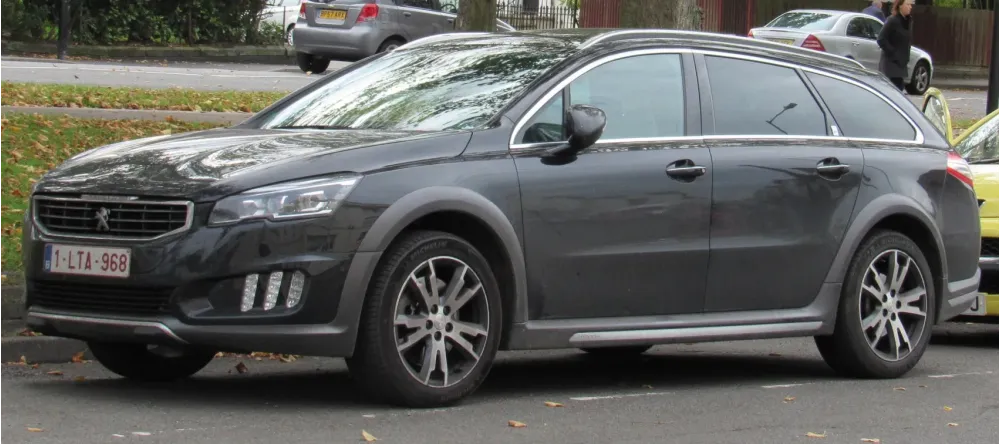
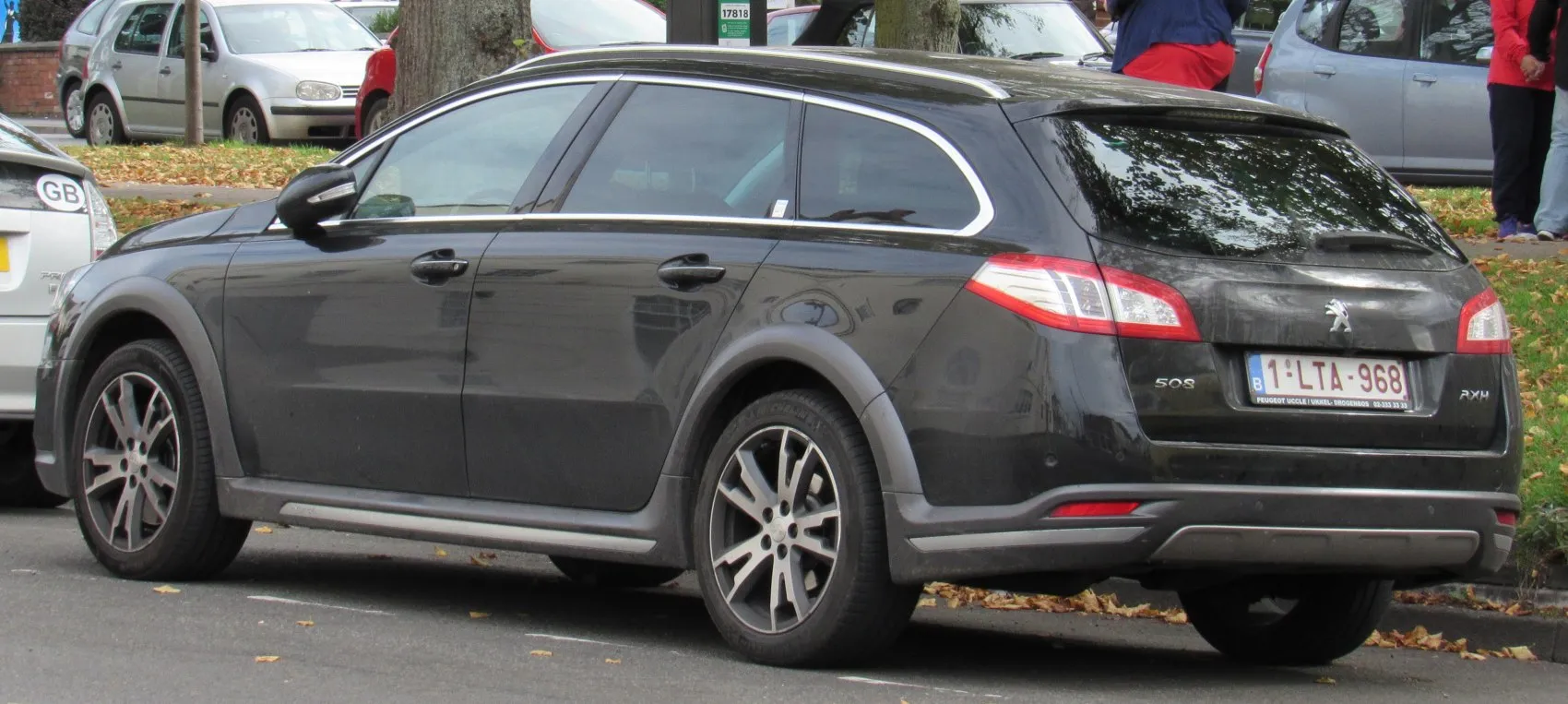
Peugeot 508 I RXH (Phase II, 2014) 2.0 HDi (200 Hp) Hybrid4 4x4 ETG6
People\'s Opinion
N/A / 5
Peugeot 508:
The Peugeot 508 is a mid-size/large family car produced by the French automaker Peugeot since 2010, and followed by the 508 SW, an estate version, in 2011. Since 2012, the 508 has been the flagship model by Peugeot, slotted above the 208 and 308 in size.
The 508 serves as the successor to both the 407 and 607 model lines, replacing both vehicles under a single nameplate for which no direct replacement was scheduled. It shares its platform and most engine options with the second generation Citroën C5: the two cars are produced alongside one another at the company's Rennes Plant, and in Wuhan, China, for sales inside China....(Read more on Wikipedia)
I RXH (Phase II, 2014) Overview:
Peugeot 508 (I RXH (Phase II, 2014)). It boasts low fuel consumption (~3.8 l/100km). With a weight of 1770 kg, it falls in the mid‑range. All‑wheel drive provides excellent grip, ideal for off‑road use. Acceleration is good (0–100 km/h in 8.8 s). The top speed reaches 213 km/h. A vehicle that combines characteristics of SUVs and hatchbacks for versatility. Seating for 5 makes it ideal for daily use.
Performance Verdict
Offers a respectable 200 Hp system output, providing decent acceleration (8.8s 0-100km/h) for a hybrid 4x4. The electric motor adds immediate torque, enhancing responsiveness, though the ETG6 gearbox can be a point of contention for some drivers.
Fuel Economy
Exceptional fuel economy for a 4x4 crossover, achieving a combined 4 l/100 km. The hybrid system significantly contributes to its efficiency, especially in urban driving, making it a very economical choice.
Best Use Case:
Mixed driving, particularly for those requiring all-wheel-drive capability and prioritizing outstanding fuel efficiency. Ideal for varied terrain and long-distance cruising with an emphasis on economy.
Pros and Cons:
Pros:
- • Excellent fuel economy, especially with the Hybrid4 system
- • Unique crossover styling and raised ride height
- • Comfortable and refined ride quality
- • Practical all-wheel-drive capability (RXH)
- • Spacious and well-appointed interior
Cons:
- • ETG6 gearbox in Hybrid4 can be clunky and slow
- • Infotainment system feels somewhat dated compared to rivals
- • Not as engaging to drive as some competitors
- • Limited all-electric range on the Hybrid4 model
- • Rear visibility can be restricted due to design
Specifications:
Specifications are compared to those of the previous generation(I (Phase I, 2010): 2012 - 2014).
| General: |
| Brand: | Peugeot |
|---|
| Model: | 508 |
|---|
| Generation: | I RXH (Phase II, 2014) |
|---|
| Modification (Engine): | 2.0 HDi (200 Hp) Hybrid4 4x4 ETG6 |
|---|
| Start of production: | 2014 |
|---|
| End of production: | 2018 |
|---|
| Powertrain Architecture: | FHEV (Full Hybrid Electric Vehicle) |
|---|
| Body type: | Crossover |
|---|
| Seats: | 5 |
|---|
| Doors: | 5 |
|---|
| Engine: |
| Engine systems: | Particulate filter |
|---|
| Power: | 163 Hp Same horsepower |
|---|
| Power per litre: | 81.6 Hp/l [36mm more] |
|---|
| Engine Model/Code: | RHC DW10CTED4 More details about the engine RHC DW10CTED4 |
|---|
| Engine displacement: | 1997 |
|---|
| Number of cylinders: | 4 |
|---|
| Engine configuration: | Inline |
|---|
| Number of valves per cylinder: | 4 |
|---|
| Fuel injection system: | Diesel Commonrail |
|---|
| Engine aspiration: | Turbocharger, Intercooler |
|---|
| Engine oil capacity: | 5 l |
|---|
| Coolant: | 10 l |
|---|
| Engine layout: | Front, Transverse |
|---|
| Cylinder Bore: | 85 mm mm |
|---|
| Piston Stroke: | 88 mm mm |
|---|
| Performance: |
| Fuel Type: | Diesel |
|---|
| Fuel consumption (economy) - urban: | 3.8 l/100 km |
|---|
| Fuel consumption (economy) - extra urban: | 4.1 l/100 km |
|---|
| Fuel consumption (economy) - combined: | 4 l/100 km |
|---|
| Emission standard: | Euro 5 |
|---|
| Acceleration 0 - 100 km/h: | 8.8 sec |
|---|
| Acceleration 0 - 62 mph: | 8.8 sec |
|---|
| Maximum speed: | 213 km/h |
|---|
| Weight-to-power ratio: | 8.9 kg/Hp, 113 Hp/tonne |
|---|
| Weight-to-torque ratio: | 3.9 kg/Nm, 254.2 Nm/tonne |
|---|
| Max speed (electric): | 85 km/h |
|---|
| Acceleration 0 - 60 mph: | 8.4 sec |
|---|
| Space: |
| Kerb Weight: | 1770 |
|---|
| Max. weight: | 2325 |
|---|
| Max load: | 555 |
|---|
| Trunk (boot) space - maximum: | 1360 l |
|---|
| Trunk (boot) space - minimum: | 400 l |
|---|
| Permitted trailer load with brakes (12%): | 800 kg |
|---|
| Fuel tank capacity: | 70 l |
|---|
| Permitted trailer load without brakes: | 750 kg |
|---|
| Permitted towbar download: | 75 kg |
|---|
| Size: |
| Length: | 4828 mm mm [36mm more] |
|---|
| Width: | 1864 mm mm [56mm less] |
|---|
| Height: | 1521 mm mm [65mm more] |
|---|
| Wheelbase: | 2817 mm mm [Same wheelbase.] |
|---|
| Width including mirrors: | 2068 mm |
|---|
| Front track: | 1592 mm |
|---|
| Rear (Back) track: | 1564 mm |
|---|
| Front overhang: | 992 mm |
|---|
| Rear overhang: | 1019 mm |
|---|
| Ride height (ground clearance): | 184 mm |
|---|
| Powertrain: |
| Drivetrain Architecture | The Internal combustion engine (ICE) permanently drives the front wheels of the vehicle, the electric motor drives the rear wheels of the vehicle, capable of running in full electric mode, only by the Internal combustion engine (ICE) or in mixed mode. |
|---|
| Drive wheel | All wheel drive (4x4) |
|---|
| Number of gears | 6 |
|---|
| Transmission type | Automatic |
|---|
| Gearbox type | ETG |
|---|
| Front brakes | Ventilated discs [Best for performance and cooling.] |
|---|
| Rear brakes | Disc |
|---|
| Assisting systems | ABS (Anti-lock braking system) |
|---|
| Steering type | Steering rack and pinion |
|---|
| Power steering | Electric Steering |
|---|
| Tires size | 245/45 R18 93V; 225/55 R17 93V |
|---|
| Wheel rims size | 18; 17 |
|---|
| Front suspension | Independent, type McPherson with coil spring and anti-roll bar |
|---|
| Rear suspension | Independent multi-link suspension |
|---|
| Electric: |
| Gross battery capacity: | 1.1 kWh |
|---|
| Battery technology: | Nickel-metal hydride (NiMH) |
|---|
| Battery location: | Under the trunk |
|---|
| System power: | 200 Hp @ 3750 rpm. |
|---|
| System torque: | 450 Nm @ 1750 rpm. |
|---|
| All-electric range: | 1.2 km |
|---|
| Electric motor power: | 37 Hp @ 2000-7500 rpm. |
|---|
| Electric motor Torque: | 200 Nm @ 800-1290 rpm. |
|---|
| Electric motor location: | Rear axle, Transverse |
|---|
| Electric motor type: | Synchronous |
|---|
| Battery voltage: | 200 V |
|---|







Was the Peugeot 508 what you expected? Let us know!