
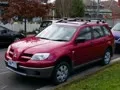
Click on image to view the full photo gallery
Mitsubishi Outlander IV 2.4 MIVEC (252 Hp) Plug-in Hybrid 4WD
Overall Rating
Mitsubishi Outlander:
The Mitsubishi Outlander is a compact crossover SUV manufactured by Japanese automaker Mitsubishi Motors since 2001. It was originally known as the Mitsubishi Airtrek when it was introduced in Japan.
The original Airtrek name was chosen to "describe the vehicle's ability to transport its passengers on adventure-packed journeys in a 'free-as-a-bird' manner", and was "coined from Air and Trek to express the idea of footloose, adventure-filled motoring pleasure. " The Outlander nameplate which replaced it evoked a "feeling of journeying to distant, unexplored lands in search of adventure. "....(Read more on Wikipedia)
IV Overview:
Mitsubishi Outlander (IV). With 195 Nm of torque, it offers ample pulling power. At around 2020 kg, it’s on the heavier side. All‑wheel drive provides excellent grip, ideal for off‑road use. A sport utility vehicle offering higher ground clearance and versatile cargo space. A vehicle that combines characteristics of SUVs and hatchbacks for versatility. Seating for 5 makes it ideal for daily use.
The Mitsubishi Outlander IV demonstrates excellent safety performance, achieving a top 5-star Euro NCAP rating, with strong scores across all categories, ensuring high occupant protection.
2.4 MIVEC (252 Hp) Plug-in Hybrid 4WD Verdict:

Performance Verdict
Combines strong acceleration with the instant torque of electric motors, providing a more dynamic driving experience than the petrol-only variants. Total system output is impressive.
Fuel Economy
Exceptional fuel economy for an SUV, especially when regularly charged. The quoted 6-6.3 l/100 km is excellent, with potential for significant electric-only driving.
Pros and Cons:
Pros:
- • Spacious and versatile 7-seater interior
- • Advanced S-AWC all-wheel-drive system (where equipped)
- • Highly efficient Plug-in Hybrid option
- • Comfortable ride quality for long journeys
- • Strong Euro NCAP safety rating
Cons:
- • Base petrol engine can feel underpowered for its size
- • CVT transmission can sometimes feel unrefined
- • Interior materials in lower trims could be improved
- • Infotainment system can be less intuitive than rivals
Specifications:
Specifications are compared to those of the previous generation(II: October, 2007 - September, 2009).
| General: | |
|---|---|
| Brand: | Mitsubishi |
| Model: | Outlander |
| Generation: | IV |
| Modification (Engine): | 2.4 MIVEC (252 Hp) Plug-in Hybrid 4WD |
| Start of production: | October, 2021 |
| End of production: | December, 2024 |
| Powertrain Architecture: | PHEV (Plug-in Hybrid Electric Vehicle) |
| Body type: | SUV, Crossover |
| Seats: | 5-7 |
| Doors: | 5 |
| Engine: | |
|---|---|
| Power: | 133 Hp @ 5000 rpm. Same horsepower |
| Power per litre: | 56.4 Hp/l [70mm more] |
| Torque: | 195 Nm @ 4300 rpm. |
| Engine Model/Code: | 4B12 More details about the engine 4B12 |
| Engine displacement: | 2360 |
| Number of cylinders: | 4 |
| Engine configuration: | Inline |
| Number of valves per cylinder: | 4 |
| Fuel injection system: | Multi-port manifold injection |
| Engine aspiration: | Naturally aspirated engine |
| Valvetrain: | DOHC |
| Engine oil capacity: | 4.6 l |
| Coolant: | 7.5 l |
| Engine layout: | Front, Transverse |
| Cylinder Bore: | 88 mm mm |
| Piston Stroke: | 97 mm mm |
| Compression ratio: | 11.8:1 |
| Performance: | |
|---|---|
| Fuel Type: | Petrol / electricity |
| Fuel consumption (economy) - combined: | 6-6.3 l/100 km |
| Fuel consumption (economy) - combined (WLTC): | 6-6.3 l/100 km |
| Weight-to-power ratio: | 8 kg/Hp, 124.8 Hp/tonne |
| Weight-to-torque ratio: | 4.5 kg/Nm, 222.8 Nm/tonne |
| Space: | |
|---|---|
| Kerb Weight: | 2020 |
| Max. weight: | 2650 |
| Max. roof load: | 80 kg |
| Max load: | 630 |
| Trunk (boot) space - maximum: | 1478 l |
| Trunk (boot) space - minimum: | 485 l |
| Permitted trailer load with brakes (12%): | 1600 kg |
| Fuel tank capacity: | 56 l |
| Permitted trailer load without brakes: | 750 kg |
| Permitted towbar download: | 160 kg |
| Size: | |
|---|---|
| Ramp-over (brakeover) angle: | 17.6° |
| Length: | 4710 mm mm [70mm more] |
| Width: | 1862 mm mm [62mm more] |
| Height: | 1740 mm mm [20mm more] |
| Wheelbase: | 2706 mm mm [36mm more] |
| Width including mirrors: | 2144 mm |
| Front track: | 1593 mm |
| Rear (Back) track: | 1602 mm |
| Front overhang: | 979 mm |
| Rear overhang: | 1025 mm |
| Ride height (ground clearance): | 199 mm |
| Minimum turning circle (turning diameter): | 11 m [above average] |
| Approach angle: | 18° |
| Departure angle: | 21.9° |
| Powertrain: | |
|---|---|
| Drivetrain Architecture | An Internal combustion engine (ICE) drives the front wheels, one electric motor drives the front wheels, one electric motor drives the rear wheels. There is an ability for running in full electric or mixed mode. There are parallel and serial hybrid modes. |
| Drive wheel | All wheel drive (4x4) |
| Number of gears | 1 |
| Transmission type | Automatic |
| Front brakes | Ventilated discs, 350 mm [Best for performance and cooling.] |
| Rear brakes | Ventilated discs, 330 mm [Best for performance and cooling.] |
| Assisting systems | ABS (Anti-lock braking system) |
| Steering type | Steering rack and pinion |
| Power steering | Electric Steering |
| Tires size | 235/60 R18; 255/45 R20 |
| Wheel rims size | 7J x 18; 8J x 20 |
| Front suspension | Independent, type McPherson with coil spring and anti-roll bar |
| Rear suspension | Independent multi-link spring suspension with stabilizer |
| Electric: | |
|---|---|
| Gross battery capacity: | 20 kWh |
| Battery technology: | Lithium-ion (Li-Ion) |
| Battery location: | Below the floor |
| System power: | 252 Hp |
| System torque: | 450 Nm |
| All-electric range: | 83-87 km |
| Electric motor power: | 116 Hp |
| Electric motor Torque: | 255 Nm |
| Average Energy consumption: | 22.7-23.9 kWh/100 km |
| Electric motor location: | Integrated into the transmission |
| Electric motor type: | Synchronous |
| Electric motor model/code: | S91 |
| Battery voltage: | 350 V |
| All-electric range (WLTC): | 83-87 km |
| Average Energy consumption (WLTC): | 22.7-23.9 kWh/100 km |









Better than its competitors? Tell us why the Mitsubishi Outlander stands out.