
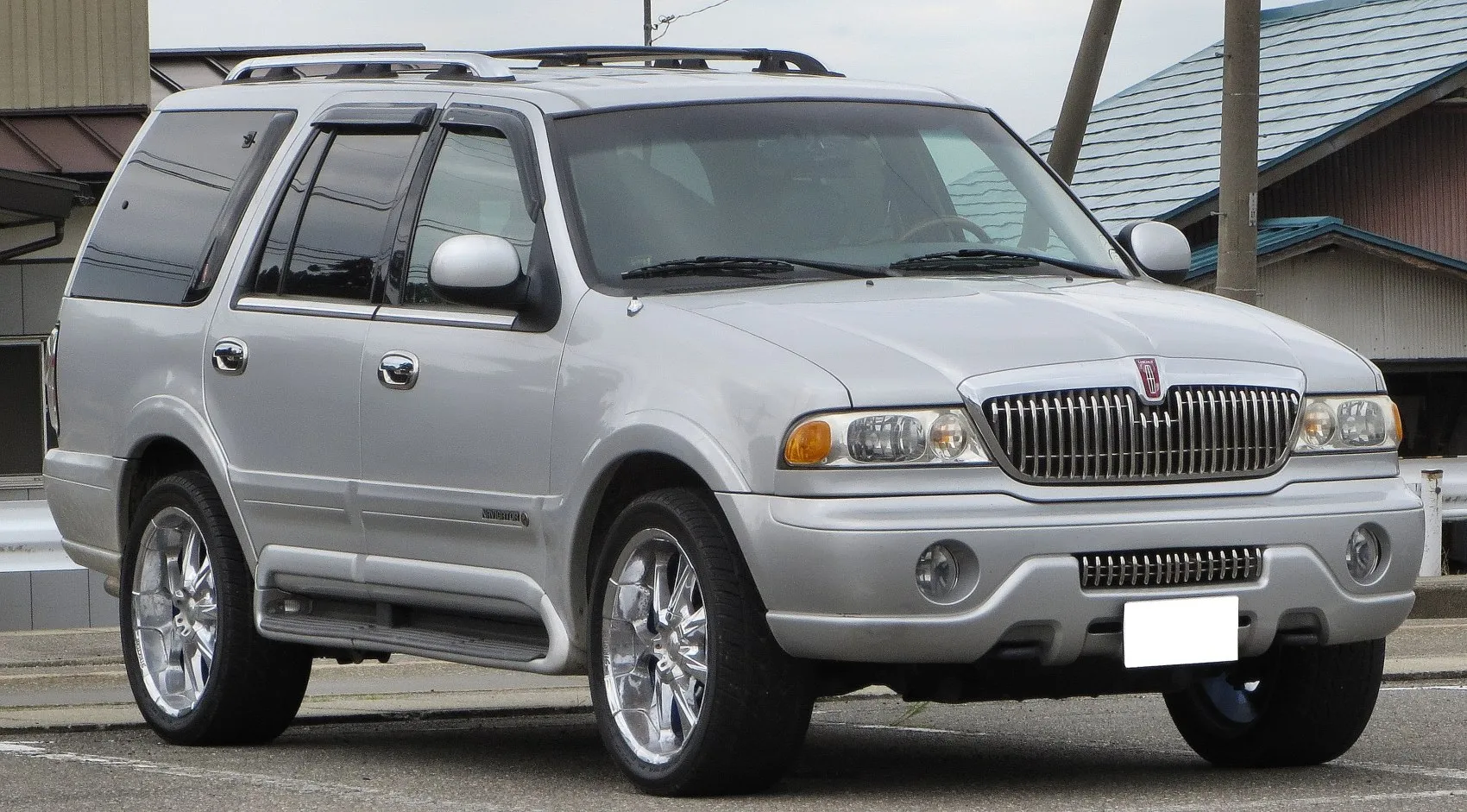
Click on image to view the full photo gallery
Lincoln Navigator II 5.4i V8 32V (300 Hp) 4x4 Automatic
Overall Rating
Lincoln Navigator:
The Lincoln Navigator is a full-size luxury SUV marketed and sold by the Lincoln Motor Company brand of Ford Motor Company since the 1998 model year. Sold primarily in North America, the Navigator is the Lincoln counterpart of the Ford Expedition. It is the heaviest production Lincoln ever built, and is also the Lincoln with the greatest cargo capacity and the first non-limousine Lincoln to offer seating for more than six people.
Lincoln Navigator production was sourced from 1997 to 2009 at the Michigan Assembly Plant in Wayne, Michigan. Since 2009, production has also been sourced from the Kentucky Truck Plant in Louisville, Kentucky....(Read more on Wikipedia)
II Overview:
Lincoln Navigator (II). With 481 Nm of torque, it offers ample pulling power. At around 2718 kg, it’s on the heavier side. All‑wheel drive provides excellent grip, ideal for off‑road use. Acceleration is relatively slow (0–100 km/h in 10 s). The top speed reaches 190 km/h. A sport utility vehicle offering higher ground clearance and versatile cargo space. With seating for 8, it’s perfect for larger families.
The Lincoln Navigator II was not tested by Euro NCAP. As a large American SUV of its era, it typically performed well in US-based crash tests (NHTSA, IIHS) but lacks specific European safety ratings.
5.4i V8 32V (300 Hp) 4x4 Automatic Verdict:

Performance Verdict
The 300 Hp 32V V8 in this 4x4 configuration provides solid power, resulting in a 0-100 km/h time of 10 seconds. It's well-suited for all-weather conditions and moderate off-road use, alongside its primary role as a luxury cruiser.
Fuel Economy
As expected for a large 4x4 SUV, fuel consumption is high at 18.1 l/100 km, reflecting its weight and drivetrain complexity.
Pros and Cons:
Pros:
- • Spacious and luxurious interior with seating for up to eight.
- • Comfortable, quiet ride ideal for long journeys.
- • Strong towing capabilities with the 5.4L V8 engine.
- • Distinctive American luxury styling.
- • Generous cargo space, especially with seats folded.
Cons:
- • High fuel consumption across all engine variants.
- • Large exterior dimensions can make city driving and parking challenging.
- • Some known reliability issues with the Triton V8 (spark plugs, cam phasers).
- • Outdated infotainment and technology compared to newer vehicles.
- • Handling is ponderous, not designed for agility.
Specifications:
Specifications are compared to those of the previous generation(I: 1999 - 2002).
| General: | |
|---|---|
| Brand: | Lincoln |
| Model: | Navigator |
| Generation: | II |
| Modification (Engine): | 5.4i V8 32V (300 Hp) 4x4 Automatic |
| Start of production: | 2002 |
| End of production: | 2004 |
| Powertrain Architecture: | Internal Combustion engine |
| Body type: | SUV |
| Seats: | 8 |
| Doors: | 5 |
| Engine: | |
|---|---|
| Power: | 300 Hp @ 5000 rpm. Same horsepower |
| Power per litre: | 55.5 Hp/l [30mm more] |
| Torque: | 481 Nm @ 2750 rpm. |
| Engine Model/Code: | InTech / T54DSEM More details about the engine InTech / T54DSEM |
| Engine displacement: | 5408 |
| Number of cylinders: | 8 |
| Engine configuration: | V-engine |
| Number of valves per cylinder: | 4 |
| Fuel injection system: | Multi-port manifold injection |
| Engine aspiration: | Naturally aspirated engine |
| Valvetrain: | DOHC |
| Engine oil capacity: | 6.6 l |
| Coolant: | 21 l |
| Engine layout: | Front, Longitudinal |
| Cylinder Bore: | 90.2 mm mm |
| Piston Stroke: | 105.7 mm mm |
| Compression ratio: | 9.5:1 |
| Performance: | |
|---|---|
| Fuel Type: | Petrol (Gasoline) |
| Fuel consumption (economy) - urban: | 21.4 l/100 km |
| Fuel consumption (economy) - extra urban: | 14.7 l/100 km |
| Fuel consumption (economy) - combined: | 18.1 l/100 km |
| Acceleration 0 - 100 km/h: | 10 sec |
| Acceleration 0 - 62 mph: | 10 sec |
| Maximum speed: | 190 km/h |
| Weight-to-power ratio: | 9.1 kg/Hp, 110.4 Hp/tonne |
| Weight-to-torque ratio: | 5.7 kg/Nm, 177 Nm/tonne |
| Acceleration 0 - 60 mph: | 9.5 sec |
| Space: | |
|---|---|
| Kerb Weight: | 2718 |
| Max. weight: | 3380 |
| Max load: | 662 |
| Trunk (boot) space - maximum: | 2966 l |
| Trunk (boot) space - minimum: | 507 l |
| Fuel tank capacity: | 106 l |
| Size: | |
|---|---|
| Ramp-over (brakeover) angle: | 17.1° |
| Length: | 5232 mm mm [30mm more] |
| Width: | 2000 mm mm [30mm less] |
| Height: | 1975 mm mm [65mm more] |
| Wheelbase: | 3018 mm mm [5mm less] |
| Width with mirrors folded: | 2029 mm |
| Width including mirrors: | 2088 mm |
| Front track: | 1701 mm |
| Rear (Back) track: | 1704 mm |
| Ride height (ground clearance): | 218 mm |
| Minimum turning circle (turning diameter): | 11.8 m [above average] |
| Approach angle: | 21.9° |
| Departure angle: | 19.8° |
| Powertrain: | |
|---|---|
| Drive wheel | All wheel drive (4x4) |
| Number of gears | 4 |
| Transmission type | Automatic |
| Front brakes | Ventilated discs [Best for performance and cooling.] |
| Rear brakes | Ventilated discs [Best for performance and cooling.] |
| Assisting systems | ABS (Anti-lock braking system) |
| Steering type | Steering rack and pinion |
| Power steering | Hydraulic Steering |
| Tires size | 255/70 R18 |
| Wheel rims size | 18 |










Is the Lincoln Navigator worth every penny? Give us your honest ROI.