
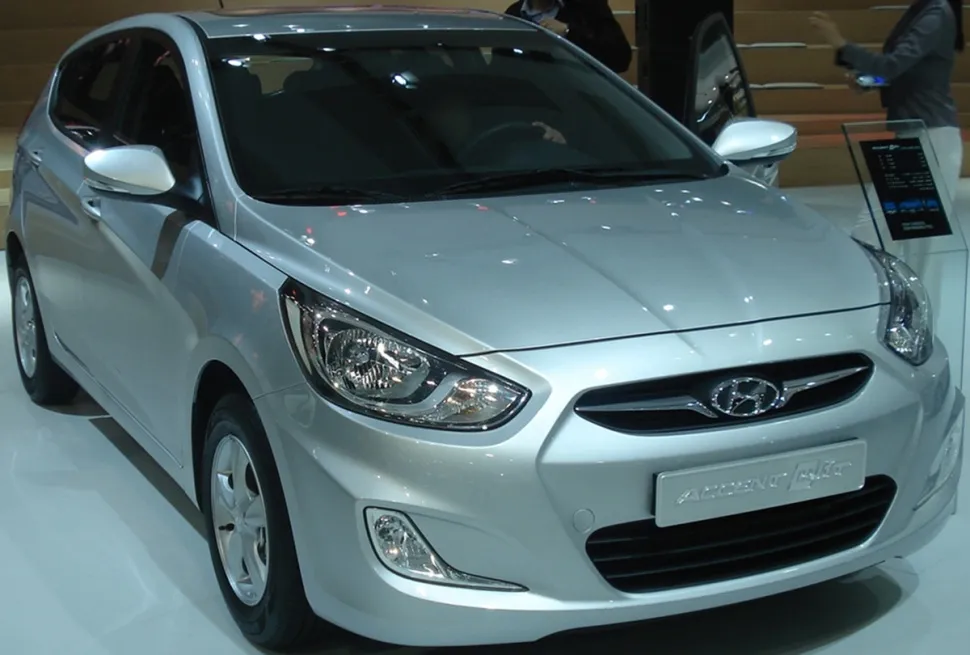
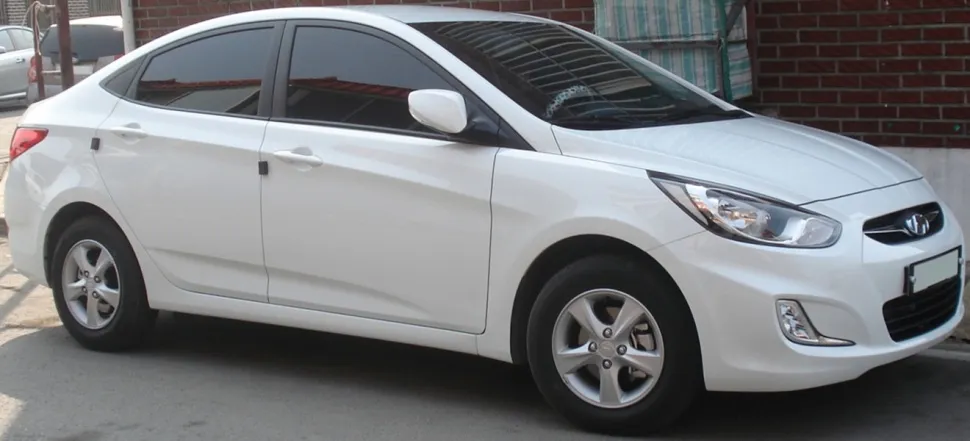
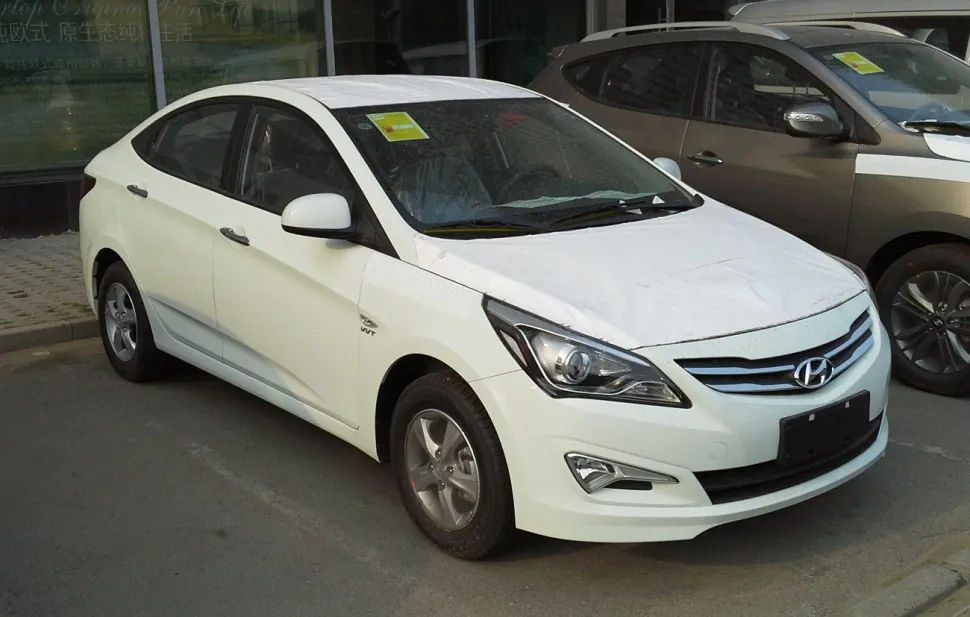
Click on image to view the full photo gallery
Hyundai Solaris II Sedan 1.4 MPI (100 Hp) Automatic
Overall Rating
Hyundai Solaris:
The Hyundai Accent , or Hyundai Verna is a subcompact car produced by Hyundai. In Australia, the first generation models carried over the Hyundai Excel name used by the Accent's predecessor. The Accent was replaced in 2000 by the Hyundai Verna in South Korea, although most international markets, including the US, retained the "Accent" name. The "Accent" name is an acronym of Advanced Compact Car of Epoch-making New Technology.
The Accent is produced for the Chinese market by Beijing Hyundai Co. , a joint venture with Beijing Automotive Industry Corp. For the Russian market it was assembled by the TagAZ plant in Taganrog until 2011, and since 2011 it was assembled by the HMMR plant in Saint Petersburg and sold under the new name Hyundai Solaris. In Mexico, the Accent was marketed until 2014 by Chrysler as the Dodge Attitude, previously known as the Verna by Dodge. In Venezuela, Chrysler marketed these models as the Dodge Brisa until 2006. The Brisa was assembled by Mitsubishi Motors at its plant in Barcelona, Venezuela. Since 2002, the Accent had been the longest-running small family car sold in North America. In Puerto Rico, the second and third generations were sold as the Hyundai Brio....(Read more on Wikipedia)
II Sedan Overview:
Hyundai Solaris (II Sedan). With 132 Nm of torque, it offers ample pulling power. It has moderate fuel consumption (~8.5 l/100km). Weighing only 1182 kg, it’s quite light. Front‑wheel drive delivers efficiency and easy handling. Acceleration is relatively slow (0–100 km/h in 12.9 s). The top speed reaches 183 km/h. A four-door car with a separate trunk, ideal for families and daily commuting. Seating for 5 makes it ideal for daily use.
1.4 MPI (100 Hp) Automatic Verdict:

Performance Verdict
The least powerful and slowest option, offering adequate performance for city driving but feeling strained on highways and during overtakes.
Fuel Economy
Fuel economy of 6.4 l/100 km is acceptable for an automatic, though slightly higher than its manual counterpart and the 1.6L auto.
Pros and Cons:
Pros:
- • Excellent fuel economy on 1.4L manual trim
- • Proven reliability and low maintenance costs
- • Spacious interior and large trunk for its class
- • Good value for money with competitive pricing
- • Comfortable ride quality for daily commuting
Cons:
- • Performance can be uninspiring, especially with 1.4L automatic
- • Interior materials are functional but lack a premium feel
- • Limited advanced safety and tech features compared to rivals
- • Engine noise can be noticeable at higher RPMs
- • Basic styling might not appeal to all buyers
Specifications:
Specifications are compared to those of the previous generation(I (facelift 2014): 2014 - 2016).
| General: | |
|---|---|
| Brand: | Hyundai |
| Model: | Solaris |
| Generation: | II Sedan |
| Modification (Engine): | 1.4 MPI (100 Hp) Automatic |
| Start of production: | 2017 |
| Powertrain Architecture: | Internal Combustion engine |
| Body type: | Sedan |
| Seats: | 5 |
| Doors: | 4 |
| Engine: | |
|---|---|
| Power: | 100 Hp @ 6000 rpm. |
| Power per litre: | 73.1 Hp/l |
| Torque: | 132 Nm @ 4000 rpm. |
| Engine displacement: | 1368 |
| Number of cylinders: | 4 |
| Engine configuration: | Inline |
| Number of valves per cylinder: | 4 |
| Fuel injection system: | Multi-port manifold injection |
| Engine aspiration: | Naturally aspirated engine |
| Engine oil capacity: | 3.5 l |
| Coolant: | 5.6 l |
| Engine layout: | Front, Transverse |
| Performance: | |
|---|---|
| Fuel Type: | Petrol (Gasoline) |
| Fuel consumption (economy) - urban: | 8.5 l/100 km |
| Fuel consumption (economy) - extra urban: | 5.1 l/100 km |
| Fuel consumption (economy) - combined: | 6.4 l/100 km |
| Emission standard: | Euro 5 |
| Acceleration 0 - 100 km/h: | 12.9 sec |
| Acceleration 0 - 62 mph: | 12.9 sec |
| Maximum speed: | 183 km/h |
| Weight-to-power ratio: | 11.8 kg/Hp, 84.6 Hp/tonne |
| Weight-to-torque ratio: | 9 kg/Nm, 111.7 Nm/tonne |
| Acceleration 0 - 60 mph: | 12.3 sec |
| Space: | |
|---|---|
| Kerb Weight: | 1182 |
| Max. weight: | 1600 |
| Max load: | 418 |
| Trunk (boot) space - minimum: | 480 l |
| Permitted trailer load with brakes (12%): | 800 kg |
| Fuel tank capacity: | 50 l |
| Permitted trailer load without brakes: | 450 kg |
| Size: | |
|---|---|
| Length: | 4405 mm mm [285mm more] |
| Width: | 1729 mm mm [29mm more] |
| Height: | 1469 mm mm [1mm less] |
| Wheelbase: | 2600 mm mm [30mm more] |
| Front track: | 1516-1510 mm |
| Rear (Back) track: | 1524-1518 mm |
| Front overhang: | 830 mm |
| Rear overhang: | 975 mm |
| Ride height (ground clearance): | 160 mm |
| Powertrain: | |
|---|---|
| Drivetrain Architecture | The Internal combustion engine (ICE) drives the front wheels of the vehicle. |
| Drive wheel | Front wheel drive |
| Number of gears | 6 |
| Transmission type | Automatic |
| Front brakes | Ventilated discs [Best for performance and cooling.] |
| Rear brakes | Disc |
| Assisting systems | ABS (Anti-lock braking system) |
| Steering type | Steering rack and pinion |
| Tires size | 185/65 R15; 195/55 R16 |
| Wheel rims size | 15; 16 |
| Front suspension | Independent, type McPherson with coil spring and anti-roll bar |
| Rear suspension | Semi-independent, coil spring, Coil spring |





Does the Hyundai Solaris live up to the hype? Give us your verdict!