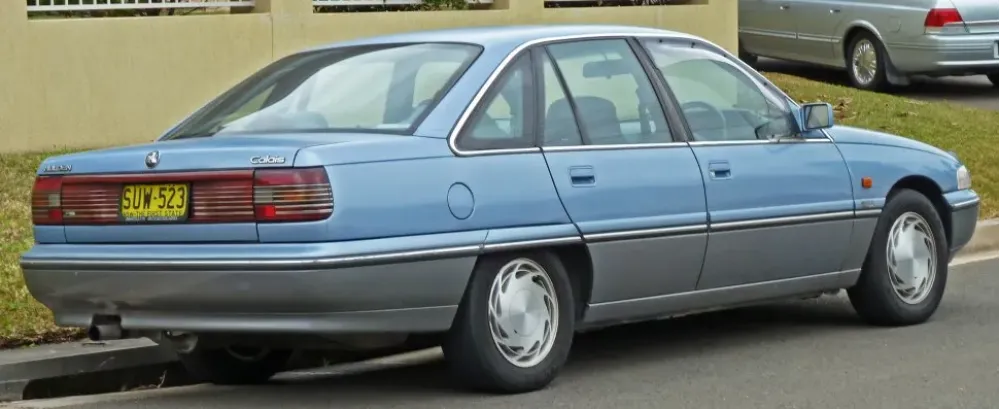
Click on image to view the full photo gallery
Holden Calais VP, facelift 1991 3.8 i V6 (175 Hp)
Holden Calais:
The Holden Commodore is a series of automobiles that were sold by now-defunct Australian manufacturer Holden from 1978 until 2020. They were manufactured from 1978 to 2017 in Australia and from 1979 to 1990 in New Zealand, with production of the locally manufactured versions in Australia ending on 20 October 2017.
The first three generations of Holden produced Commodores were based on the Opel designed V-body rear-wheel drive automotive platform, which was the basis of GM's largest European models, but were structurally strengthened, mechanically modified, and, in time, enlarged by Holden for Australian road conditions, production needs, and market demands. The styling of these cars was generally similar to that of the Opel Commodore C, and later, the Opel Omega A/B and their Vauxhall sister models the Vauxhall Carlton and Omega....(Read more on Wikipedia)
VP, facelift 1991 Overview:
Holden Calais (VP, facelift 1991). With 295 Nm of torque, it offers ample pulling power. With a weight of 1454 kg, it falls in the mid‑range. Rear‑wheel drive offers dynamic handling and sporty feedback. Acceleration is good (0–100 km/h in 8 s). The top speed reaches 200 km/h. A four-door car with a separate trunk, ideal for families and daily commuting. Seating for 5 makes it ideal for daily use.
 Community Verdict
This rating is based on comments found on Reddit, scanned using artificial intelligence, and may not accurately reflect reality.

4.3 / 5
Based on AI analysis of 16 discussions
Read What Owners Say
Pros and Cons:
Pros:
- • Adequate and balanced power output (224 hp) for versatile driving.
- • Respectable acceleration of 8 sec, suitable for most driving situations.
- • Rear-wheel drive layout for enhanced handling and balance.
- • Ventilated disc brakes for reliable cooling and stopping power.
- • Standard trunk space (443 L) suitable for daily needs.
Cons:
- • Relatively high fuel consumption: 13.1 L/100 km combined.
- • Previous generation model; may lack the latest driver-assist technologies.
Overall Rating: 3.5/5
Specifications:
| General: | |
|---|---|
| Brand: | Holden |
| Model: | Calais |
| Generation: | VP, facelift 1991 |
| Modification (Engine): | 3.8 i V6 (175 Hp) |
| Start of production: | 1990 |
| End of production: | 1998 |
| Powertrain Architecture: | Internal Combustion engine |
| Body type: | Sedan |
| Seats: | 5 |
| Doors: | 4 |
| Engine: | |
|---|---|
| Power: | 175 Hp @ 4800 rpm. |
| Power per litre: | 46.2 Hp/l |
| Torque: | 295 Nm @ 3200 rpm. |
| Engine displacement: | 3791 |
| Number of cylinders: | 6 |
| Engine configuration: | V-engine |
| Number of valves per cylinder: | 2 |
| Fuel injection system: | Multi-port manifold injection |
| Engine aspiration: | Naturally aspirated engine |
| Engine layout: | Front, Longitudinal |
| Cylinder Bore: | 96.52 mm mm |
| Piston Stroke: | 86.36 mm mm |
| Compression ratio: | 8.5:1 |
| Performance: | |
|---|---|
| Fuel Type: | Petrol (Gasoline) |
| Fuel consumption (economy) - combined: | 12.3 l/100 km |
| Acceleration 0 - 100 km/h: | 8 sec |
| Acceleration 0 - 62 mph: | 8 sec |
| Maximum speed: | 200 km/h |
| Weight-to-power ratio: | 8.3 kg/Hp, 120.4 Hp/tonne |
| Weight-to-torque ratio: | 4.9 kg/Nm, 202.9 Nm/tonne |
| Acceleration 0 - 60 mph: | 7.6 sec |
| Space: | |
|---|---|
| Kerb Weight: | 1454 |
| Fuel tank capacity: | 63 l |
| Size: | |
|---|---|
| Length: | 4861 mm mm |
| Width: | 1794 mm mm |
| Height: | 1443 mm mm |
| Wheelbase: | 2736 mm mm |
| Front track: | 1491 mm |
| Rear (Back) track: | 1491 mm |
| Powertrain: | |
|---|---|
| Drivetrain Architecture | The Internal combustion engine (ICE) drives the rear wheels of the vehicle. |
| Drive wheel | Rear wheel drive |
| Number of gears | 4 |
| Transmission type | Automatic |
| Front brakes | Ventilated discs |
| Rear brakes | Disc |
| Assisting systems | ABS (Anti-lock braking system) |
| Power steering | Hydraulic Steering |
| Tires size | 205/65 R15 H |
| Front suspension | Coil spring |
| Rear suspension | Coil spring |




Behind the wheel of the Holden Calais. How does it handle on the road?