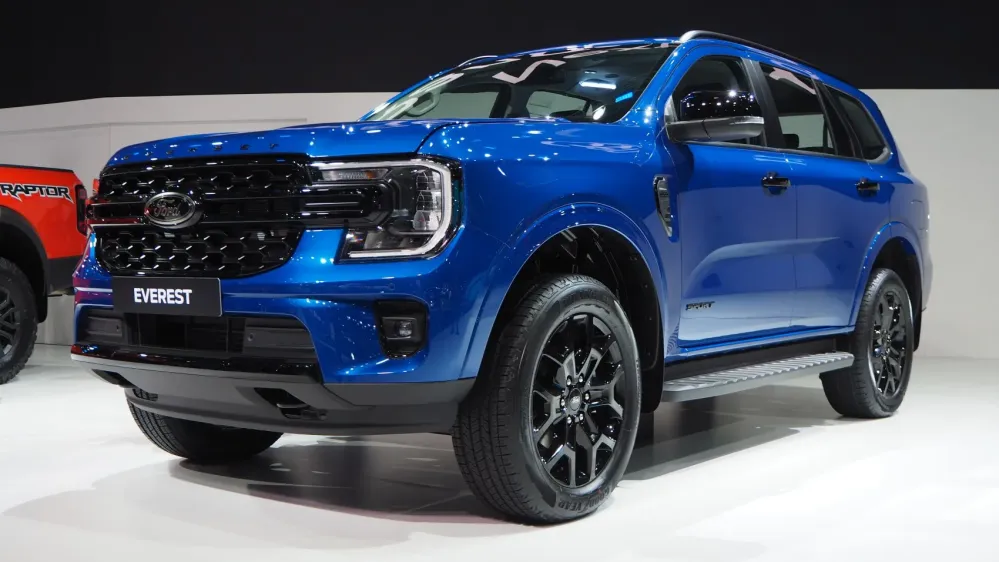
Click on image to view the full photo gallery
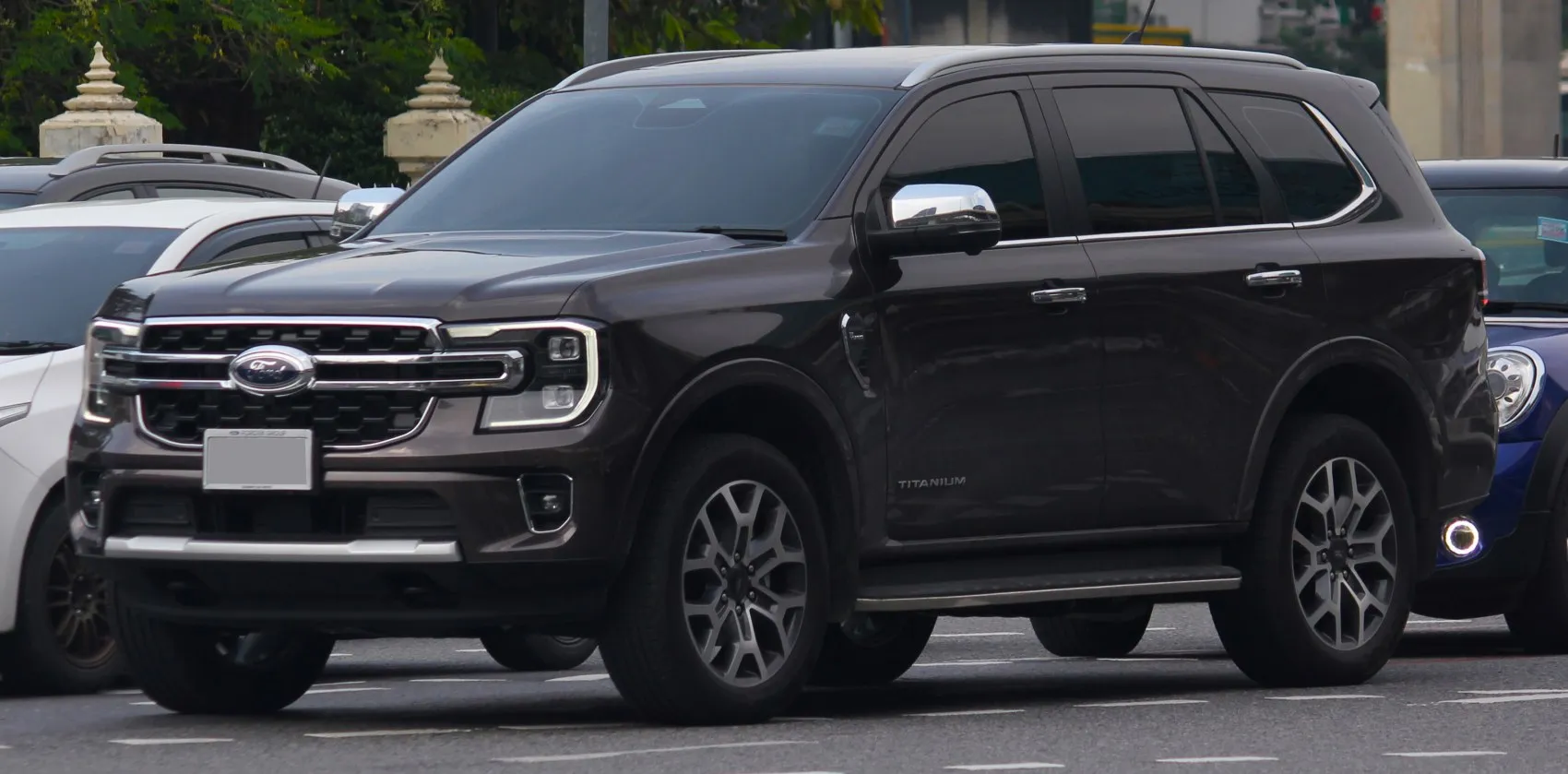
Ford Everest III (U704) 2.0d Bi-Turbo (209 Hp) Automatic
Overall Rating
Ford Everest:
The Ford Everest is a mid-size SUV produced by the Ford Motor Company since 2003. Developed and destined mainly for the Asia-Pacific region with production centered in Thailand, the first-generation Everest is derived from the Mazda-based Ford Ranger pickup truck, while the following generations are based on the globally-marketed T6 Ranger. Unlike the Ranger which was paralleled with the Mazda B series or BT-50 until 2020, the Everest has no Mazda equivalent, as it was seen as unfitting for the brand....(Read more on Wikipedia)
III (U704) Overview:
Ford Everest (III (U704)). With 500 Nm of torque, it offers ample pulling power. At around 2266 kg, it’s on the heavier side. Rear‑wheel drive offers dynamic handling and sporty feedback. A sport utility vehicle offering higher ground clearance and versatile cargo space. Seating for 5 makes it ideal for daily use.
2.0d Bi-Turbo (209 Hp) Automatic Verdict:

Performance Verdict
Delivering identical strong 209 Hp, this variant provides excellent on-road performance and confident overtaking, paired with a smooth automatic transmission.
Fuel Economy
Achieving 7.1 l/100 km, it offers marginally better fuel efficiency than its 4x4 counterpart, making it a more economical choice for predominantly urban and highway driving.
Pros and Cons:
Pros:
- • Robust off-road capability and strong towing capacity.
- • Spacious and versatile 5-7 seat interior.
- • Choice of powerful and efficient diesel engines, including a V6.
- • Modern interior with advanced technology and safety features.
- • Comfortable ride quality for a body-on-frame SUV.
Cons:
- • Higher trims can be expensive.
- • Fuel consumption can be high, especially with the V6 and 4x4.
- • Large dimensions can make urban maneuvering challenging.
- • Some interior materials might feel less premium than direct competitors.
Specifications:
Specifications are compared to those of the previous generation(II (U375/UA, facelift 2018): May, 2018 - September, 2022).
| General: | |
|---|---|
| Brand: | Ford |
| Model: | Everest |
| Generation: | III (U704) |
| Modification (Engine): | 2.0d Bi-Turbo (209 Hp) Automatic |
| Start of production: | September, 2022 |
| Powertrain Architecture: | Internal Combustion engine |
| Body type: | SUV |
| Seats: | 5-7 |
| Doors: | 5 |
| Engine: | |
|---|---|
| Engine systems: | Start & Stop System |
| Power: | 209 Hp @ 3750 rpm. Same horsepower |
| Power per litre: | 104.7 Hp/l [11mm more] |
| Torque: | 500 Nm @ 1750-2000 rpm. |
| Engine Model/Code: | EcoBlue More details about the engine EcoBlue |
| Engine displacement: | 1996 |
| Number of cylinders: | 4 |
| Engine configuration: | Inline |
| Number of valves per cylinder: | 4 |
| Fuel injection system: | Diesel Commonrail |
| Engine aspiration: | BiTurbo, Intercooler |
| Engine oil capacity: | 8.1 l |
| Coolant: | 9 l |
| Engine layout: | Front, Longitudinal |
| Performance: | |
|---|---|
| Fuel Type: | Diesel |
| Fuel consumption (economy) - combined: | 7.1 l/100 km |
| Weight-to-power ratio: | 10.8 kg/Hp, 92.5 Hp/tonne |
| Weight-to-torque ratio: | 4.5 kg/Nm, 221.3 Nm/tonne |
| Space: | |
|---|---|
| Kerb Weight: | 2259-2274 |
| Max. weight: | 3000 |
| Max load: | 726-741 |
| Trunk (boot) space - maximum: | 1823 l |
| Trunk (boot) space - minimum: | 259-898 l |
| Permitted trailer load with brakes (12%): | 3500 kg |
| Fuel tank capacity: | 80 l |
| Size: | |
|---|---|
| Ramp-over (brakeover) angle: | 22.3° |
| Wading depth: | 800 mm |
| Length: | 4914 mm mm [11mm more] |
| Width: | 1923 mm mm [54mm more] |
| Height: | 1842 mm mm [5mm more] |
| Wheelbase: | 2900 mm mm [50mm more] |
| Width with mirrors folded: | 2015 mm |
| Width including mirrors: | 2207 mm |
| Front track: | 1620 mm |
| Rear (Back) track: | 1620 mm |
| Ride height (ground clearance): | 230 mm |
| Minimum turning circle (turning diameter): | 11.8 m [above average] |
| Approach angle: | 30.6° |
| Departure angle: | 25.3° |
| Powertrain: | |
|---|---|
| Drivetrain Architecture | The Internal combustion engine (ICE) drives the rear wheels of the vehicle. |
| Drive wheel | Rear wheel drive |
| Number of gears | 10 |
| Transmission type | Automatic |
| Front brakes | Ventilated discs [Best for performance and cooling.] |
| Rear brakes | Ventilated discs [Best for performance and cooling.] |
| Assisting systems | ABS (Anti-lock braking system) |
| Steering type | Steering rack and pinion |
| Power steering | Electric Steering |
| Wheel rims size | 17; 18 |
| Front suspension | Double wishbone, Transverse stabilizer |
| Rear suspension | Rigid axle suspension, Transverse stabilizer |






If you could change one thing about the Ford Everest, what would it be?