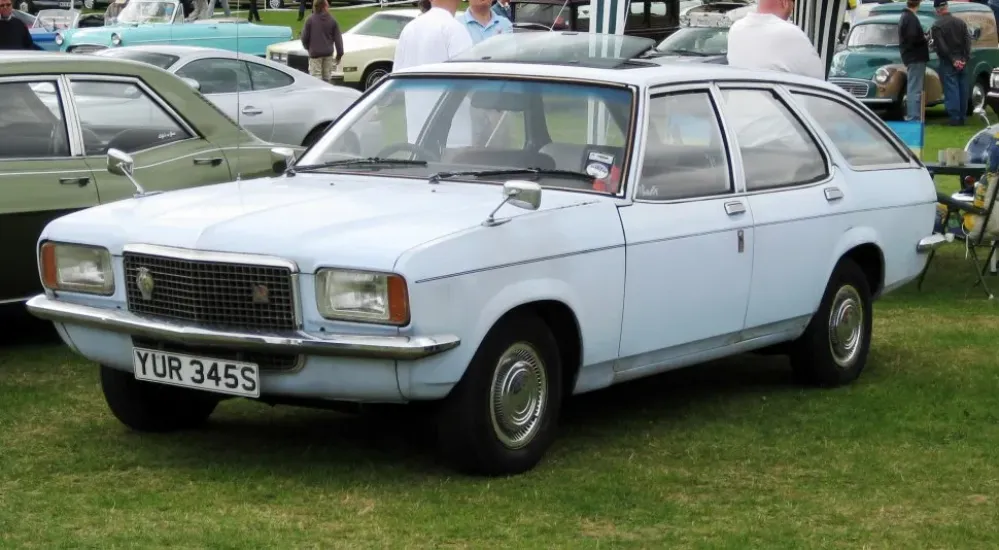
Click on image to view the full photo gallery
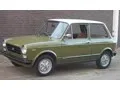
Vauxhall VX Estate 1800 (88 Hp)
Overall Rating
Vauxhall VX:
The Vauxhall Victor is a large family car produced by Vauxhall from 1957 until 1976. The Victor was introduced to replace the outgoing Wyvern model. It was renamed Vauxhall VX Series in 1976 and continued in production until 1978, by which time it had grown significantly and was viewed, at least in its home market, as a larger-than-average family car.
The last Victor, the Victor FE, was also manufactured under licence by Hindustan Motors in India as the Hindustan Contessa, during the 1980s and early 2000s, with an Isuzu engine....(Read more on Wikipedia)
Estate Overview:
Vauxhall VX (Estate). With 134 Nm of torque, it offers ample pulling power. Weighing only 1205 kg, it’s quite light. Rear‑wheel drive offers dynamic handling and sporty feedback. A car with an extended rear cargo area, combining passenger comfort with increased storage. Seating for 5 makes it ideal for daily use.
The Vauxhall VX Estate predates modern Euro NCAP testing standards (established in 1997). Safety features were basic by today's measures, typical for vehicles from the mid-1970s.
1800 (88 Hp) Verdict:

Performance Verdict
The 1.8L engine provided adequate power for daily driving and family duties, though acceleration was more leisurely compared to the larger 2.3L unit. Suitable for urban and suburban use.
Fuel Economy
Offering slightly better fuel economy than its larger sibling, this 1.8L engine was a more economical choice for buyers, though still not particularly frugal by modern standards.
Pros and Cons:
Pros:
- • Spacious and practical estate body style
- • Robust and relatively simple mechanicals
- • Comfortable ride for its era
- • Good visibility
Cons:
- • Outdated safety features by modern standards
- • Fuel economy is poor compared to contemporary vehicles
- • Basic interior amenities
- • Rust can be a significant issue on surviving examples
Specifications:
| General: | |
|---|---|
| Brand: | Vauxhall |
| Model: | VX |
| Generation: | Estate |
| Modification (Engine): | 1800 (88 Hp) |
| Start of production: | 1976 |
| End of production: | 1978 |
| Powertrain Architecture: | Internal Combustion engine |
| Body type: | Station wagon (estate) |
| Seats: | 5 |
| Doors: | 5 |
| Engine: | |
|---|---|
| Power: | 88 Hp @ 5800 rpm. |
| Power per litre: | 50 Hp/l |
| Torque: | 134 Nm @ 3500 rpm. |
| Engine displacement: | 1759 |
| Engine aspiration: | Naturally aspirated engine |
| Valvetrain: | OHC |
| Engine oil capacity: | 4.6 l |
| Coolant: | 7.4 l |
| Cylinder Bore: | 85.72 mm mm |
| Piston Stroke: | 76.2 mm mm |
| Compression ratio: | 8.5:1 |
| Performance: | |
|---|---|
| Fuel Type: | Petrol (Gasoline) |
| Weight-to-power ratio: | 13.7 kg/Hp, 73 Hp/tonne |
| Weight-to-torque ratio: | 9 kg/Nm, 111.2 Nm/tonne |
| Space: | |
|---|---|
| Kerb Weight: | 1205 |
| Max. weight: | 1700 |
| Max load: | 495 |
| Fuel tank capacity: | 54 l |
| Size: | |
|---|---|
| Length: | 4546 mm mm |
| Width: | 1699 mm mm |
| Height: | 1371 mm mm |
| Wheelbase: | 2667 mm mm |
| Minimum turning circle (turning diameter): | 10.7 m |
| Powertrain: | |
|---|---|
| Drivetrain Architecture | The Internal combustion engine (ICE) drives the rear wheels of the vehicle. |
| Drive wheel | Rear wheel drive |
| Number of gears | 4 |
| Transmission type | Manual |
| Steering type | Steering rack and pinion |
| Front suspension | Independent coil spring |







Behind the wheel of the Vauxhall VX. How does it handle on the road?