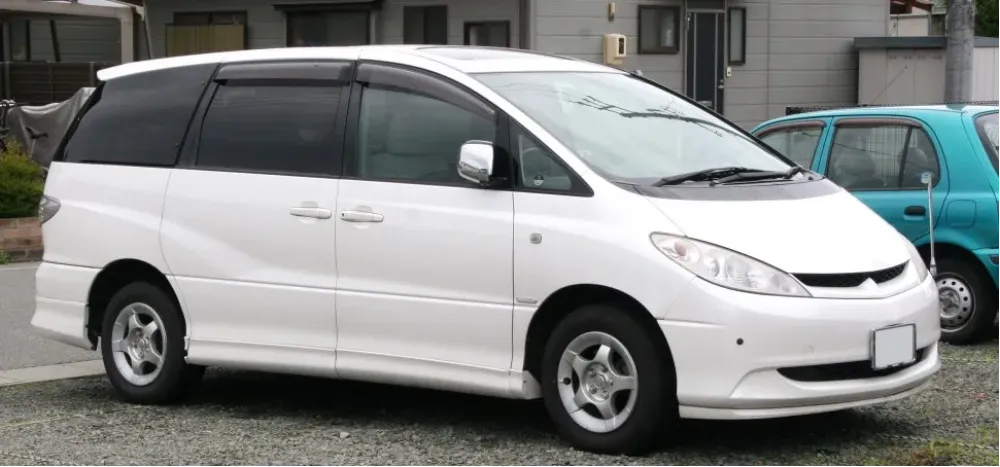
Click on image to view the full photo gallery
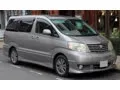
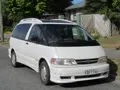
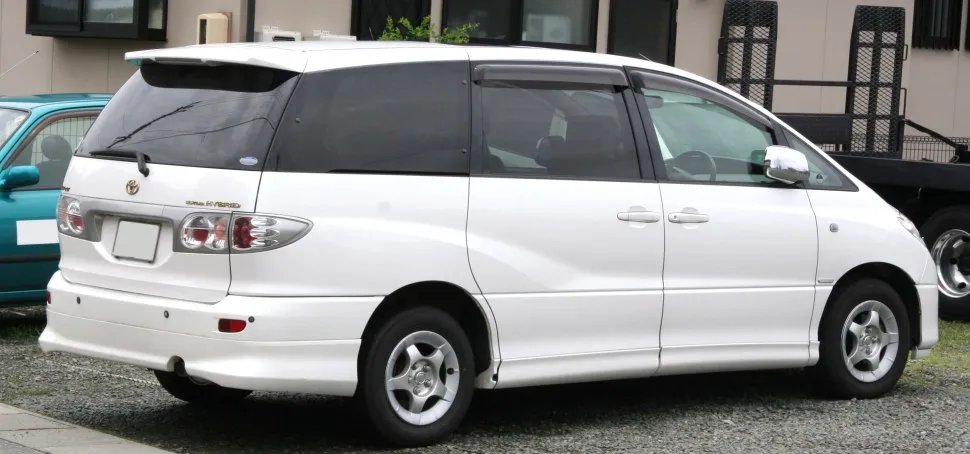
Toyota Estima II 3.0 i 24V (220 Hp)
Overall Rating
Toyota Estima:
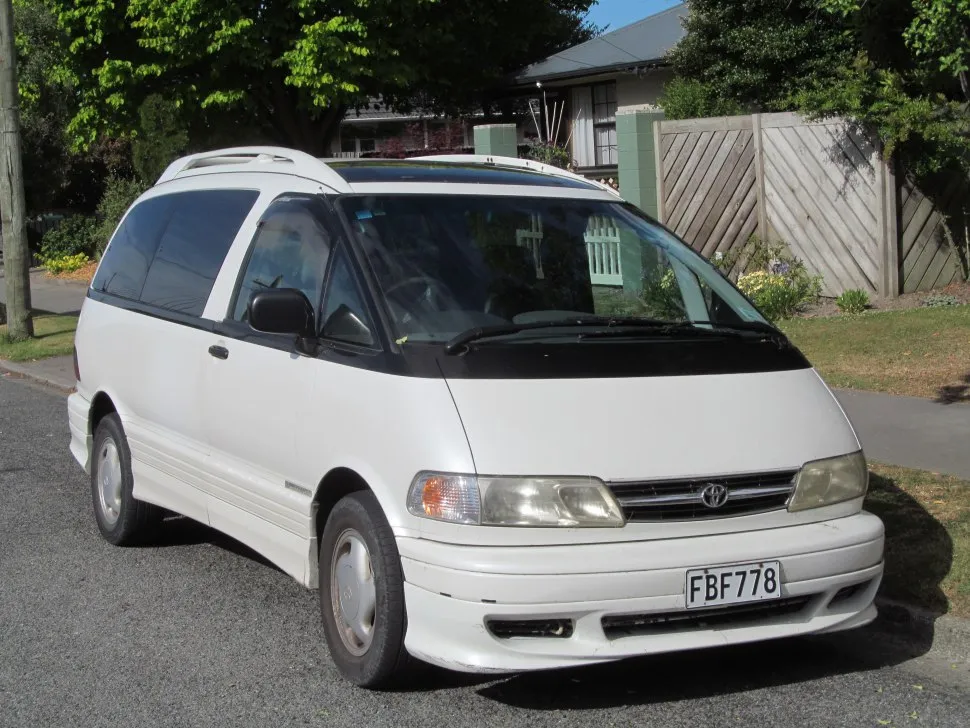
The Toyota Previa, also known as the Toyota Estima in Japan, and Toyota Tarago in Australia, is a minivan that was produced by Toyota from 1990 until October 2019 across three generations.
The name "Previa" is derived from the Spanish for "preview", as Toyota saw the first Previa as a vehicle that would preview technologies used in future minivans. The Previa was the second largest minivan in Toyota's lineup in Japan after the bigger and more luxurious Alphard/Vellfire....(Read more on Wikipedia)
II Overview:
Toyota Estima (II). With 294 Nm of torque, it offers ample pulling power. With a weight of 1730 kg, it falls in the mid‑range. Front‑wheel drive delivers efficiency and easy handling. A spacious vehicle designed to transport passengers comfortably, often with sliding doors. With seating for 8, it’s perfect for larger families.
The Toyota Estima II generation was not officially tested by Euro NCAP. While other regional tests might exist, a specific Euro NCAP rating is unavailable for this model.
3.0 i 24V (220 Hp) Verdict:

Performance Verdict
The 3.0L V6 engine provides robust performance, offering confident acceleration and effortless highway cruising. It's the most powerful option, making it ideal for heavier loads or spirited driving.
Fuel Economy
As expected for a 3.0L V6 in a minivan, this engine has the highest fuel consumption in the lineup. It's a trade-off for the increased power and smoothness.
Pros and Cons:
Pros:
- • Exceptional Toyota reliability and durability
- • Spacious and versatile interior with comfortable seating for up to 8
- • Smooth and comfortable ride quality, ideal for families
- • Available highly fuel-efficient hybrid powertrain option
- • Strong resale value due to brand reputation
Cons:
- • Base 2.4L engine can feel underpowered when fully loaded
- • V6 engine's fuel economy is less competitive
- • Exterior styling may be considered conservative or bland by some
- • Not officially tested by Euro NCAP for safety ratings
- • Some interior plastics might feel dated compared to newer rivals
Specifications:
Specifications are compared to those of the previous generation(I: 1990 - 1999).
| General: | |
|---|---|
| Brand: | Toyota |
| Model: | Estima |
| Generation: | II |
| Modification (Engine): | 3.0 i 24V (220 Hp) |
| Start of production: | 2000 |
| End of production: | 2005 |
| Powertrain Architecture: | Internal Combustion engine |
| Body type: | Minivan |
| Seats: | 8 |
| Doors: | 4 |
| Engine: | |
|---|---|
| Power: | 220 Hp @ 5800 rpm. Same horsepower |
| Power per litre: | 73.4 Hp/l [20mm more] |
| Torque: | 294 Nm @ 3800 rpm. |
| Engine Model/Code: | 1MZ-FE More details about the engine 1MZ-FE |
| Engine displacement: | 2997 |
| Number of cylinders: | 6 |
| Engine configuration: | Inline |
| Number of valves per cylinder: | 4 |
| Fuel injection system: | Multi-port manifold injection |
| Engine aspiration: | Naturally aspirated engine |
| Valvetrain: | DOHC |
| Engine oil capacity: | 4.7 l |
| Coolant: | 11 l |
| Engine layout: | Front, Longitudinal |
| Cylinder Bore: | 86 mm mm |
| Piston Stroke: | 86 mm mm |
| Compression ratio: | 10.5:1 |
| Performance: | |
|---|---|
| Fuel Type: | Petrol (Gasoline) |
| Weight-to-power ratio: | 7.9 kg/Hp, 127.2 Hp/tonne |
| Weight-to-torque ratio: | 5.9 kg/Nm, 169.9 Nm/tonne |
| Space: | |
|---|---|
| Kerb Weight: | 1730 |
| Fuel tank capacity: | 70 l |
| Size: | |
|---|---|
| Length: | 4770 mm mm [20mm more] |
| Width: | 1790 mm mm [10mm less] |
| Height: | 1785 mm mm [5mm more] |
| Wheelbase: | 2900 mm mm [40mm more] |
| Front track: | 1545 mm |
| Rear (Back) track: | 1530 mm |
| Powertrain: | |
|---|---|
| Drivetrain Architecture | The Internal combustion engine (ICE) drives the front wheels of the vehicle. |
| Drive wheel | Front wheel drive |
| Front brakes | Ventilated discs [Best for performance and cooling.] |
| Rear brakes | Disc |
| Tires size | 215 / 60 R16 |
| Wheel rims size | 6.5JJ x 15 |







If you could change one thing about the Toyota Estima, what would it be?