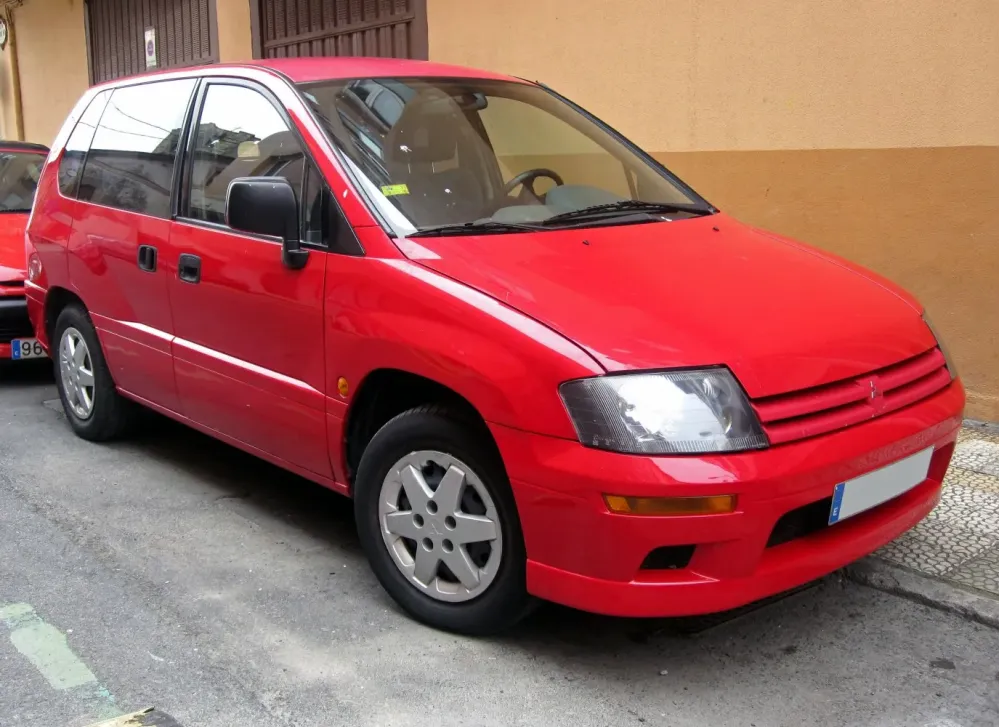
Click on image to view the full photo gallery
Mitsubishi Space Runner N50 2.4 GDI (150 Hp)
Overall Rating
Mitsubishi Space Runner:
The Mitsubishi RVR is a range of cars produced by Japanese manufacturer Mitsubishi Motors from 1991 to 2002 and then from 2010 to present. The first two generations were classified as compact multi-purpose vehicles , and the model introduced in 2010 is a subcompact crossover SUV.
The RVR was Mitsubishi's Recreational Vehicle debut during the Japanese economic boom. The cars were sold at the Mitsubishi Japan dealership chain called Car Plaza. RVR is an acronym for "Recreation Vehicle Runner". In addition, the original logo had a Cyrillic Я on the first letter, so that it reads ЯVR. It had a convenient size passenger cabin and spacious 4–5 person capacity with a youth-oriented approach, making it appealing to young people. Television commercials in Japan used Bugs Bunny and Daffy Duck as spokespeople. It was also developed and released during Japan's "bubble economy", and gained popularity due to the convenience of a passenger side sliding door....(Read more on Wikipedia)
N50 Overview:
Mitsubishi Space Runner (N50). With 225 Nm of torque, it offers ample pulling power. It has moderate fuel consumption (~11.9 l/100km). With a weight of 1400 kg, it falls in the mid‑range. Front‑wheel drive delivers efficiency and easy handling. Acceleration is relatively slow (0–100 km/h in 10.4 s). The top speed reaches 190 km/h. A spacious vehicle designed to transport passengers comfortably, often with sliding doors. Seating for 5 makes it ideal for daily use.
2.4 GDI (150 Hp) Verdict:

Performance Verdict
Provides a slight boost in power and torque over the 2.0L, resulting in marginally quicker acceleration (10.4s 0-100km/h). The GDI system aims for efficiency and responsiveness.
Fuel Economy
The GDI (Gasoline Direct Injection) technology was intended to improve fuel efficiency, though real-world benefits can vary. Early GDI systems sometimes had specific fuel quality requirements and potential for carbon buildup.
Pros and Cons:
Pros:
- • Spacious and versatile interior with flexible seating arrangements
- • Practical and family-friendly design with good cargo capacity
- • Generally reliable non-GDI engine options (2.0L)
- • Comfortable ride quality suitable for long trips
- • Good value on the used market
Cons:
- • Dated exterior styling compared to later rivals
- • Early GDI engine (2.4L) can be prone to carbon buildup issues
- • Average fuel economy for its class, especially the 2.0L urban cycle
- • Limited advanced safety features by modern standards
- • Performance is adequate but not engaging
Specifications:
Specifications are compared to those of the previous generation(N1_W,N2_W: 1997 - 1999).
| General: | |
|---|---|
| Brand: | Mitsubishi |
| Model: | Space Runner |
| Generation: | N50 |
| Modification (Engine): | 2.4 GDI (150 Hp) |
| Start of production: | 1999 |
| End of production: | 2002 |
| Powertrain Architecture: | Internal Combustion engine |
| Body type: | Minivan |
| Seats: | 5 |
| Doors: | 4 |
| Engine: | |
|---|---|
| Power: | 150 Hp @ 5500 rpm. |
| Power per litre: | 63.8 Hp/l |
| Torque: | 225 Nm @ 3500 rpm. |
| Engine displacement: | 2351 |
| Number of cylinders: | 4 |
| Engine configuration: | Inline |
| Number of valves per cylinder: | 4 |
| Fuel injection system: | Direct injection |
| Engine aspiration: | Naturally aspirated engine |
| Valvetrain: | OHC |
| Engine layout: | Front, Transverse |
| Cylinder Bore: | 86.5 mm mm |
| Piston Stroke: | 100 mm mm |
| Compression ratio: | 11.5:1 |
| Performance: | |
|---|---|
| Fuel Type: | Petrol (Gasoline) |
| Fuel consumption (economy) - urban: | 11.9 l/100 km |
| Fuel consumption (economy) - extra urban: | 7.3 l/100 km |
| Acceleration 0 - 100 km/h: | 10.4 sec |
| Acceleration 0 - 62 mph: | 10.4 sec |
| Maximum speed: | 190 km/h |
| Weight-to-power ratio: | 9.3 kg/Hp, 107.1 Hp/tonne |
| Weight-to-torque ratio: | 6.2 kg/Nm, 160.7 Nm/tonne |
| Acceleration 0 - 60 mph: | 9.9 sec |
| Space: | |
|---|---|
| Kerb Weight: | 1400 |
| Max. weight: | 1920 |
| Max load: | 520 |
| Trunk (boot) space - maximum: | 1800 l |
| Trunk (boot) space - minimum: | 430 l |
| Fuel tank capacity: | 63 l |
| Size: | |
|---|---|
| Length: | 4290 mm mm [20mm more] |
| Width: | 1695 mm mm [Same width.] |
| Height: | 1650 mm mm [15mm less] |
| Wheelbase: | 2550 mm mm [30mm more] |
| Front track: | 1460 mm |
| Rear (Back) track: | 1460 mm |
| Powertrain: | |
|---|---|
| Drivetrain Architecture | The Internal combustion engine (ICE) drives the front wheels of the vehicle. |
| Drive wheel | Front wheel drive |
| Number of gears | 5 |
| Transmission type | Manual |
| Front brakes | Ventilated discs [Best for performance and cooling.] |
| Rear brakes | Disc |
| Assisting systems | ABS (Anti-lock braking system) |
| Steering type | Steering rack and pinion |
| Power steering | Hydraulic Steering |
| Tires size | 205/65 R15 |
| Front suspension | Wishbone |
| Rear suspension | Coil spring |





Was the Mitsubishi Space Runner what you expected? Let us know!