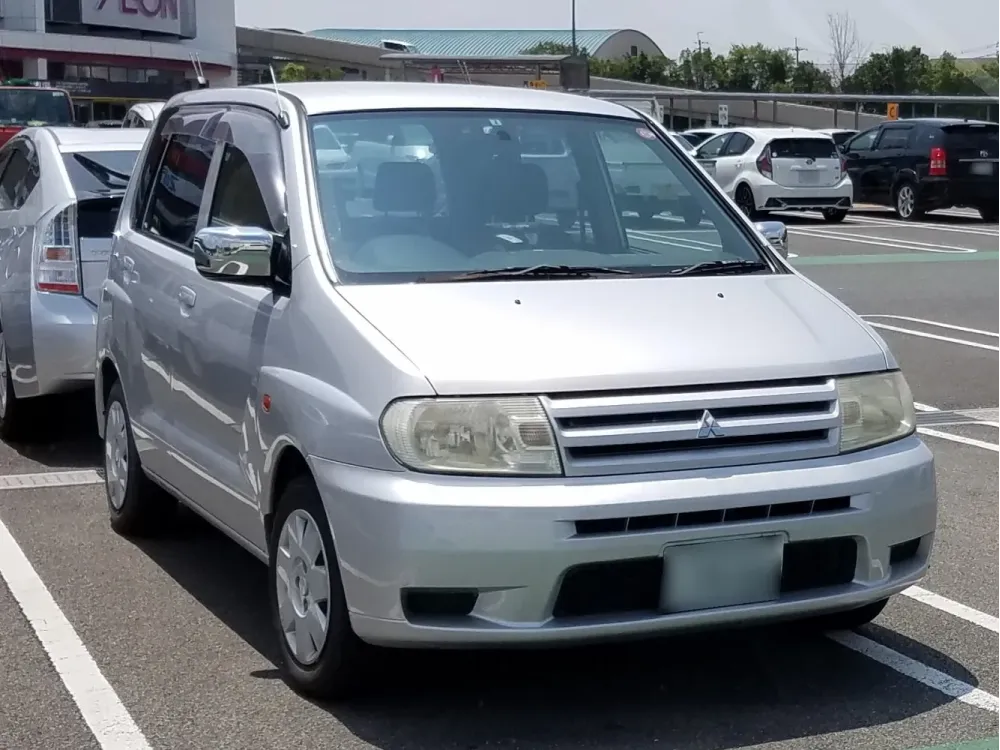
Click on image to view the full photo gallery
Mitsubishi Dingo CJ 1.3 i 16V (80 Hp)
Overall Rating
Mitsubishi Dingo:
The Mitsubishi Mirage Dingo is a mini MPV built by Mitsubishi Motors from 1998 to 2003, using a shortened version of the Mirage platform.
The "Dingo" name is derived from Bingo and its connotations of good fortune, but with the B replaced by D to represent Mitsubishi's Diamond logo. The "Dingo" name also sourced from a wild dog native to Australia, dingo. In Japan, it was sold at a specific retail chain called Car Plaza. The Dingo's exterior and interior is highly similar to the Mitsubishi Dion, which is another MPV sold in Japan....(Read more on Wikipedia)
CJ Overview:
Mitsubishi Dingo (CJ). With 118 Nm of torque, it offers ample pulling power. Weighing only 1140 kg, it’s quite light. Front‑wheel drive delivers efficiency and easy handling. A compact car with a rear door that swings upward to provide access to the cargo area. Seating for 5 makes it ideal for daily use.
The Mitsubishi Dingo CJ was not officially tested by Euro NCAP. As a compact car from its era, safety features might be basic compared to modern standards, focusing on fundamental passive safety.
1.3 i 16V (80 Hp) Verdict:

Performance Verdict
Offers adequate performance for city driving and light highway use, but can feel strained under full load or at higher speeds.
Fuel Economy
Good fuel economy for its class, making it an economical choice for daily commutes.
Pros and Cons:
Pros:
- • Compact and easy to maneuver in urban environments.
- • Practical and versatile interior for its size.
- • Generally reliable Mitsubishi engineering.
- • Optional 4WD for enhanced traction.
- • Good fuel economy for daily commuting (1.3L).
Cons:
- • Modest performance, especially with the 1.3L engine.
- • Dated interior design and materials by modern standards.
- • Limited availability of parts outside Japan.
- • Lack of advanced safety features.
- • GDI engine might require specific maintenance.
Specifications:
| General: | |
|---|---|
| Brand: | Mitsubishi |
| Model: | Dingo |
| Generation: | CJ |
| Modification (Engine): | 1.3 i 16V (80 Hp) |
| Start of production: | 1999 |
| End of production: | 2002 |
| Powertrain Architecture: | Internal Combustion engine |
| Body type: | Hatchback |
| Seats: | 5 |
| Doors: | 5 |
| Engine: | |
|---|---|
| Power: | 80 Hp @ 5000 rpm. |
| Power per litre: | 61.6 Hp/l |
| Torque: | 118 Nm @ 3000 rpm. |
| Engine displacement: | 1298 |
| Number of cylinders: | 4 |
| Engine configuration: | Inline |
| Number of valves per cylinder: | 4 |
| Fuel injection system: | Multi-port manifold injection |
| Engine aspiration: | Naturally aspirated engine |
| Valvetrain: | OHC |
| Engine layout: | Front, Transverse |
| Performance: | |
|---|---|
| Fuel Type: | Petrol (Gasoline) |
| Weight-to-power ratio: | 14.3 kg/Hp, 70.2 Hp/tonne |
| Weight-to-torque ratio: | 9.7 kg/Nm, 103.5 Nm/tonne |
| Space: | |
|---|---|
| Kerb Weight: | 1140 |
| Max. weight: | 1415 |
| Max load: | 275 |
| Fuel tank capacity: | 50 l |
| Size: | |
|---|---|
| Length: | 3905 mm mm |
| Width: | 1695 mm mm |
| Height: | 1635 mm mm |
| Wheelbase: | 2440 mm mm |
| Front track: | 1470 mm |
| Rear (Back) track: | 1470 mm |
| Minimum turning circle (turning diameter): | 9.4 m |
| Powertrain: | |
|---|---|
| Drivetrain Architecture | The Internal combustion engine (ICE) drives the front wheels of the vehicle. |
| Drive wheel | Front wheel drive |
| Number of gears | 4 |
| Transmission type | Automatic |
| Front brakes | Disc |
| Rear brakes | Drum |
| Steering type | Steering rack and pinion |
| Power steering | Hydraulic Steering |
| Tires size | 175/70 R14 |
| Front suspension | Coil spring |
| Rear suspension | Coil spring |




Fuel, speed, and comfort: How does the Mitsubishi Dingo rank in your book?