
Click on image to view the full photo gallery
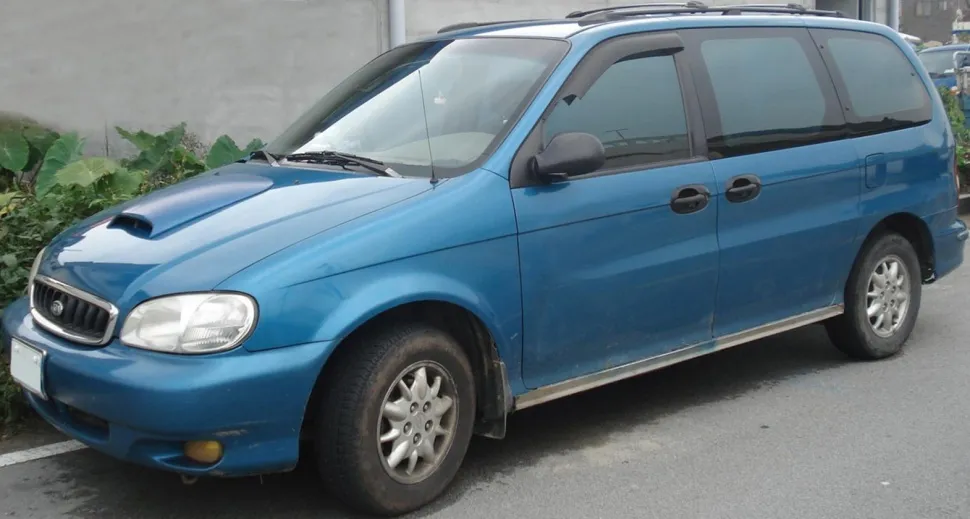
Kia Carnival I (UP/GQ, facelift 2001) 2.9 CRDI (144 Hp) Automatic
Overall Rating
Kia Carnival:
The Kia Carnival is a minivan manufactured by the Korean automaker Kia since 1998. It is marketed globally under various nameplates, prominently as the Kia Sedona.
The first-generation Carnival was introduced in January 1998, and was marketed in a single, short wheelbase version. Second-generation models were marketed in short and long wheelbase variants. A rebadged variant of the second generation was offered in North America as the Hyundai Entourage. Beginning in 2010, the second-generation model received updated equipment, including Kia's corporate Tiger Nose grille, as introduced by its then new design chief, Peter Schreyer. Kia introduced its third-generation minivan in 2014, solely in a long wheelbase format. The fourth generation was introduced in 2020, when Kia also began using the Carnival nameplate worldwide....(Read more on Wikipedia)
I (UP/GQ, facelift 2001) Overview:
Kia Carnival (I (UP/GQ, facelift 2001)). With 310 Nm of torque, it offers ample pulling power. At around 2088 kg, it’s on the heavier side. Front‑wheel drive delivers efficiency and easy handling. A spacious vehicle designed to transport passengers comfortably, often with sliding doors. With seating for 7, it’s perfect for larger families.
2.9 CRDI (144 Hp) Automatic Verdict:

Performance Verdict
Combines the improved CRDI power with the convenience of an automatic, offering a relaxed and capable driving experience.
Fuel Economy
Good fuel economy (8.8 l/100 km) for an automatic diesel minivan, making it a practical choice for families.
Pros and Cons:
Pros:
- • Spacious and versatile interior for families
- • Good value for money compared to European rivals
- • Practicality with 7 seats and ample cargo space
- • Improved CRDI diesel engine offers decent economy and power
Cons:
- • Dated safety rating (2-star Euro NCAP)
- • High fuel consumption for petrol V6 engines
- • Older TD diesel can be unrefined and noisy
- • Handling is not dynamic, typical for a large minivan
Specifications:
Specifications are compared to those of the previous generation(I (UP/GQ, facelift 2001): 2001 - 2005).
| General: | |
|---|---|
| Brand: | Kia |
| Model: | Carnival |
| Generation: | I (UP/GQ, facelift 2001) |
| Modification (Engine): | 2.9 CRDI (144 Hp) Automatic |
| Start of production: | 2002 |
| End of production: | 2006 |
| Powertrain Architecture: | Internal Combustion engine |
| Body type: | Minivan |
| Seats: | 7 |
| Doors: | 5 |
| Engine: | |
|---|---|
| Power: | 144 Hp @ 3800 rpm. |
| Power per litre: | 49.6 Hp/l |
| Torque: | 310 Nm @ 2000 rpm. |
| Engine Model/Code: | J3 [Same engine] More details about the engine J3 |
| Engine displacement: | 2903 |
| Number of cylinders: | 4 |
| Engine configuration: | Inline |
| Number of valves per cylinder: | 4 |
| Fuel injection system: | Diesel Commonrail |
| Engine aspiration: | Turbocharger, Intercooler |
| Valvetrain: | DOHC |
| Engine oil capacity: | 6.2 l |
| Coolant: | 9.4 l |
| Engine layout: | Front, Transverse |
| Cylinder Bore: | 97.1 mm |
| Piston Stroke: | 98 mm |
| Compression ratio: | 19.3:1 |
| Performance: | |
|---|---|
| Fuel Type: | Diesel |
| Fuel consumption (economy) - urban: | 16.4 l/100 km |
| Fuel consumption (economy) - extra urban: | 7.1 l/100 km |
| Fuel consumption (economy) - combined: | 8.8 l/100 km |
| Weight-to-power ratio: | 14.5 kg/Hp, 69 Hp/tonne |
| Weight-to-torque ratio: | 6.7 kg/Nm, 148.5 Nm/tonne |
| Space: | |
|---|---|
| Kerb Weight: | 2088 |
| Max. weight: | 2675 |
| Max load: | 587 |
| Fuel tank capacity: | 75 l |
| Size: | |
|---|---|
| Length: | 4925 mm [Same length.] |
| Width: | 1900 mm [Same width.] |
| Height: | 1730 mm [Same height.] |
| Wheelbase: | 2905 mm [Same wheelbase.] |
| Front track: | 1625 mm |
| Rear (Back) track: | 1600 mm |
| Ride height (ground clearance): | 170 mm |
| Minimum turning circle (turning diameter): | 13 m [above average] |
| Powertrain: | |
|---|---|
| Drivetrain Architecture | The Internal combustion engine (ICE) drives the front wheels of the vehicle. |
| Drive wheel | Front wheel drive |
| Number of gears | 4 |
| Transmission type | Automatic |
| Front brakes | Ventilated discs [Best for performance and cooling.] |
| Rear brakes | Drum [bad for performance and cooling.] |
| Assisting systems | ABS (Anti-lock braking system) |
| Steering type | Steering rack and pinion |
| Power steering | Hydraulic Steering |
| Tires size | 215/65 R15 |
| Wheel rims size | 15 |
| Front suspension | Wishbone |
| Rear suspension | Coil spring |




Help others decide – share your experience!